The Jakarta MRT, which opened in 2019, is the single best way for a tourist to move through this city — and once you have ridden it a couple of times, everything else about getting around starts to feel manageable. The 16-kilometer north-south line links Lebak Bulus, deep in South Jakarta, to Bundaran HI in the center in about 30 minutes, sliding under or over the surface traffic that would make the same trip an hour-plus by car. Of its 13 stations, only six really matter to a visitor; the rest serve residents and office commuters. This Jakarta MRT guide sticks to the stations and routes you will actually use, with current 2026 fares, every payment option, a first-time-rider walkthrough, and the honest status of Phase 2 — the part most guides get wrong.
The MRT is one piece of a wider system, and it works best in combination with the others. It is the express spine; the TransJakarta busway fills in the east-west gaps, the KRL commuter line reaches the satellite towns, and on the days you would rather not deal with any of it, the choice usually comes down to Grab or Gojek. If you want the bird’s-eye view of how all of these fit together, start with our pillar guide to getting around Jakarta.
Jakarta MRT at a Glance (2026)
| Item | Details |
|---|---|
| Line length | 16 km, 13 stations |
| Terminals | Lebak Bulus Grab (south) ↔ Bundaran HI (north) |
| Operating hours | 5:00 AM – 12:00 AM daily |
| Frequency | 5 min peak / 10 min off-peak |
| Fare range | IDR 3,000–14,000 (distance-based) |
| Payment | JakLingko, e-Money, Flazz, Brizzi, TapCash, single trip ticket |
| Average travel time | 30 min end-to-end |
| Phase 2 (Bundaran HI → Kota) | Under construction; partial opening expected 2027 |
The 6 MRT Stations Tourists Actually Use

Plenty of guides march you through commuter stops like Cipete Raya, Haji Nawi, and Fatmawati. Skip that. For a visitor, six stations carry almost all the value — here they are, north to south, with what each one actually puts you next to.
1. Bundaran HI (North Terminus) — Central Jakarta

The northern terminus and the most useful single station on the line. It surfaces right under the Selamat Datang Welcome Monument at the Bundaran HI roundabout, and an underground walkway feeds you straight into Plaza Indonesia and Grand Indonesia, plus Hotel Indonesia Kempinski, Mandarin Oriental Jakarta, and Pullman Jakarta Indonesia. On foot you are ten minutes from the Sabang street-food strip and a short stroll from the roundabout’s famous fountain photo. If you are staying central and shopping-minded, this is your home station — both of the city’s flagship malls sit right here, and our roundup of the best malls in Jakarta leans heavily on this corner.
2. Dukuh Atas BNI — KRL Interchange
The most important transfer point in the whole city. From here the MRT connects to the KRL Commuter Line (for Bogor, Tangerang, and Cikarang day trips), to BNI City Station for the Airport Railink to Soekarno-Hatta, to Sudirman KRL station, and to TransJakarta Corridor 1. If your day involves a train out to Bogor or a run to the airport, you will pass through here — our KRL guide and airport transfer guide pick up exactly where this interchange leaves off.
3. Setiabudi Astra — Sudirman Office District
Serves the Setiabudi business cluster and the JS Luwansa Hotel, with walkways toward the Sudirman office towers. Not a must for sightseeing, but genuinely handy if your hotel sits in this stretch.
4. Bendungan Hilir — Sudirman Mid-Point
The middle of Sudirman. It connects to Capital Place (home of Four Seasons Jakarta) and is a five-minute Grab from Pacific Place. Worth knowing if you are headed to either.
5. Istora Mandiri — GBK Stadium
Direct access to the Gelora Bung Karno (GBK) sports complex — the main stadium, the jogging tracks, the public sports facilities, and the Hutan Kota by Plataran urban forest. This is the station for a Persija match, a stadium concert, or a morning lap of the 279-hectare green space, and it is a useful one to bookmark if you are tracking the city’s events and festivals.
6. Senayan — Premium Shopping District

The gateway to Plaza Senayan, Senayan City, and the best shopping cluster in the south. Within walking distance you have the 25hours Hotel The Oddbird at ASHTA District 8, Fairmont Jakarta, and a deep bench of restaurants, including the flagship Sate Khas Senayan. For a trip built around shopping and good dinners, this is the South Jakarta station to anchor to.
Other Stations (Less Essential for Tourists)
- ASEAN — serves residential South Jakarta
- Blok M BCA — serves Blok M nightlife and the Blok M food court (occasional tourist value)
- Haji Nawi, Cipete Raya, Fatmawati, Lebak Bulus Grab — primarily residential commuter stations
Payment Options

Six payment methods work at the gates:
- JakLingko card — Indonesia’s integrated transit card, with an IDR 10,000 fare cap across all transit modes within three hours. Sold at Indomaret, Alfamart, and station vending machines. Card cost: IDR 50,000 (IDR 15,000 balance plus IDR 35,000 card).
- e-Money (Mandiri) — the most widely accepted alternative; top up at any Indomaret. Easiest for tourists.
- Flazz (BCA) — the second-most-common bank card.
- Brizzi (BRI) — works on the MRT and most other transit.
- TapCash (BNI) — same story as Brizzi.
- Single Trip Ticket (STT) — buy it at a station vending machine; valid for one ride only; a deposit applies.
For most foreign visitors the path of least resistance is Mandiri e-Money — grab one at any Indomaret for IDR 30,000 (the card) plus whatever top-up you want. It works on the MRT, TransJakarta, KRL, JakLingko Mikrotrans minibuses, and even toll roads. If you would rather optimize for the fare cap, our JakLingko card guide lays the two side by side so you can pick the right one for how you plan to travel.
Fare Table (2026)
| Trip | Stations | Fare |
|---|---|---|
| 1–2 stations | e.g., Bundaran HI → Dukuh Atas | IDR 3,000–4,000 |
| 3–4 stations | e.g., Bundaran HI → Bendungan Hilir | IDR 5,000–7,000 |
| 5–7 stations | e.g., Bundaran HI → Senayan | IDR 8,000–10,000 |
| 8+ stations | e.g., Bundaran HI → Lebak Bulus | IDR 11,000–14,000 |
Children under 90 cm ride free. Seniors (60+) and persons with disabilities ride at a 50% discount with ID verification. Even at the top of the range, IDR 14,000 is under a dollar — for context on how that stacks up against rides and taxis, our breakdown of Jakarta transportation costs puts the whole menu of fares in one place.
First-Time Rider Walkthrough

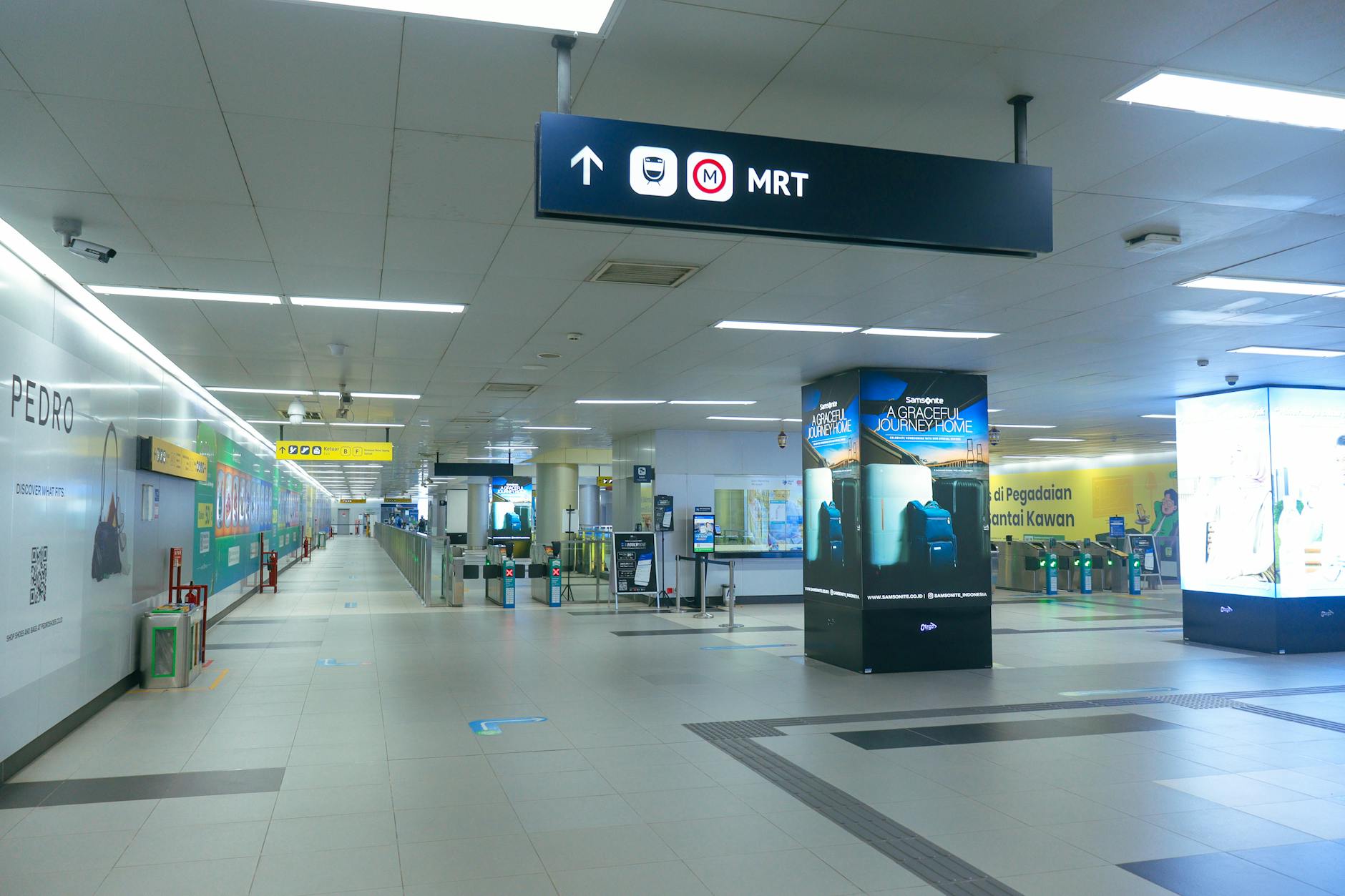
- Enter the station — most are underground (Bundaran HI, Dukuh Atas, Setiabudi, Bendungan Hilir); the southern stations are elevated.
- Find the ticket area — look for the “Tiket” signs; the STT vending machines take cash or card.
- Tap your card or STT at the entry gate; the gate opens.
- Follow signs to the right platform — north for the Bundaran HI direction, south for Lebak Bulus.
- Stand behind the yellow line on the platform.
- Board the train — they come every 5 minutes at peak, 10 off-peak.
- Get off at your station.
- Tap out at the exit gate; the fare is deducted by distance and the gate opens.
MRT vs. Other Transit Options

| Mode | Best For | Cost | Speed vs MRT |
|---|---|---|---|
| MRT | North-south corridor, rush hour | IDR 3k–14k | Baseline |
| TransJakarta bus | East-west, places MRT doesn’t reach | IDR 3,500 flat | Slower than MRT |
| KRL Commuter | Bogor, Tangerang day trips | IDR 5,000+ | Slower per km |
| Grab/Gojek car | Door-to-door, late night | IDR 25k–80k typ | Often slower in traffic |
| Gojek/Grab motorbike | Short trips, beat traffic | IDR 10k–25k typ | Often faster |
When the MRT Beats a Grab
On a weekday, the MRT wins outright between 7:00 and 10:00 in the morning and 4:00 to 8:00 in the evening. During those windows the surface traffic on Sudirman-Thamrin crawls at 5–10 km/h while the train runs at full speed underneath it. A Bundaran HI to Senayan hop is eight minutes on the MRT versus 30 to 60 by Grab in the thick of rush hour — the kind of gap that decides whether you make a dinner reservation.
Grab or Gojek wins when: you are loaded with bags, you are heading somewhere off the corridor (Kemang, Kota Tua, Glodok, Ancol), it is the small hours after the trains stop, or there are three-plus of you splitting one car. The full comparison, including which app tends to be cheaper, is in our Grab vs Gojek guide. And for the times a private car genuinely makes sense, our take on renting a car in Jakarta covers the with-driver option most visitors actually want.
Phase 2 (Bundaran HI → Kota) — Current Status
A lot of competitor guides will tell you the MRT runs to Kota Tua. It does not. Phase 2A (Bundaran HI → Thamrin → Monas → Harmoni → Sawah Besar → Mangga Besar → Glodok → Kota) is under construction as of 2026, roughly 60% complete, with the first segment targeted to open in 2027 and the run to Kota Tua not expected until the end of the decade. Until then, getting from Bundaran HI up to the Old Town means switching to Grab, TransJakarta Corridor 1, or the KRL to Jakarta Kota.
First-Timer Mistakes to Avoid
A few traps catch newcomers more than anything else. Don’t expect to tap a foreign credit card at the gate — you need a local e-money or JakLingko card, so buy one at the first Indomaret you see. Don’t plan a Kota Tua trip that ends at an MRT station; the line stops at Bundaran HI for now. Don’t eat or drink past the gates — it is enforced, and a sip of water is enough to draw a polite telling-off. Don’t ride end-to-end at 8 a.m. with luggage if you can help it, because the trains fill up; mid-morning is far more pleasant. And do tap out — the fare is calculated on exit, so forgetting to tap your card at the destination gate will cost you.
MRT Etiquette
- Let passengers exit first before boarding.
- Stand right, walk left on escalators.
- No food or drink inside the paid area (from the gates onward).
- Give up priority seats for elderly, pregnant, and disabled passengers (they are clearly marked).
- Phone calls are fine at a conversational volume.
- No smoking anywhere in stations or trains — fines apply.
- Photography is allowed for personal use; go easy on the flash on platforms.
Useful MRT Apps
- MRT-J — the official Jakarta MRT app, with live train tracking, station info, and ticket purchase.
- JakLingko — the integrated transit app, showing MRT plus TransJakarta plus KRL routes together.
- Google Maps — reliable MRT routing for tourists, with station names in English.
- Moovit — an international transit app with solid Jakarta MRT coverage.
Frequently Asked Questions About the Jakarta MRT Guide
Does the Jakarta MRT go to Kota Tua?
Not yet. Phase 2A construction toward Kota Tua is underway, with a partial opening expected in 2027. For now the northern terminus is Bundaran HI; from there, take Grab, TransJakarta Corridor 1, or the KRL to Jakarta Kota to reach the Old Town.
How much does the Jakarta MRT cost?
Fares are distance-based, from IDR 3,000 minimum (1–2 stations) to IDR 14,000 maximum end-to-end. Children under 90 cm ride free.
Can I use a credit card on the Jakarta MRT?
Foreign credit cards cannot be tapped at the gates. You need a JakLingko card, Mandiri e-Money, Flazz, Brizzi, TapCash, or a single trip ticket. Buy any of these at an Indomaret or a station vending machine, where foreign cards do work at the point of sale.
Does the MRT go to Soekarno-Hatta Airport?
No — the MRT does not reach the airport. For the airport, take the Soekarno-Hatta Airport Railink train from BNI City Station, transferring at Dukuh Atas MRT. Our airport transfer guide walks through the timing.
Is the Jakarta MRT safe?
Yes — it is very safe and clean, with security at every station, CCTV throughout, and clear emergency procedures. Solo female travelers consistently report no issues.
What hours does the Jakarta MRT operate?
Trains run 5:00 AM to 12:00 AM daily, with the same hours at weekends. The last southbound train from Bundaran HI leaves at 11:55 PM.
The MRT is the fastest, cleanest way for a visitor to cover Jakarta’s central spine, and it gets even better once you pair it with the rest of the network. From here it is worth reading up on the TransJakarta busway for the places the train does not reach, learning how to dodge the worst of the gridlock in our guide to avoiding Jakarta traffic, and lining up what to actually do once you arrive with our pick of the best attractions in Jakarta and the wider sweep of things to do in Jakarta.
External Resources for the Jakarta MRT
For official details, the official Jakarta MRT website publishes current schedules, fare changes, and Phase 2 construction updates. Metro Line Hub Jakarta aggregates traveler reviews and station information.