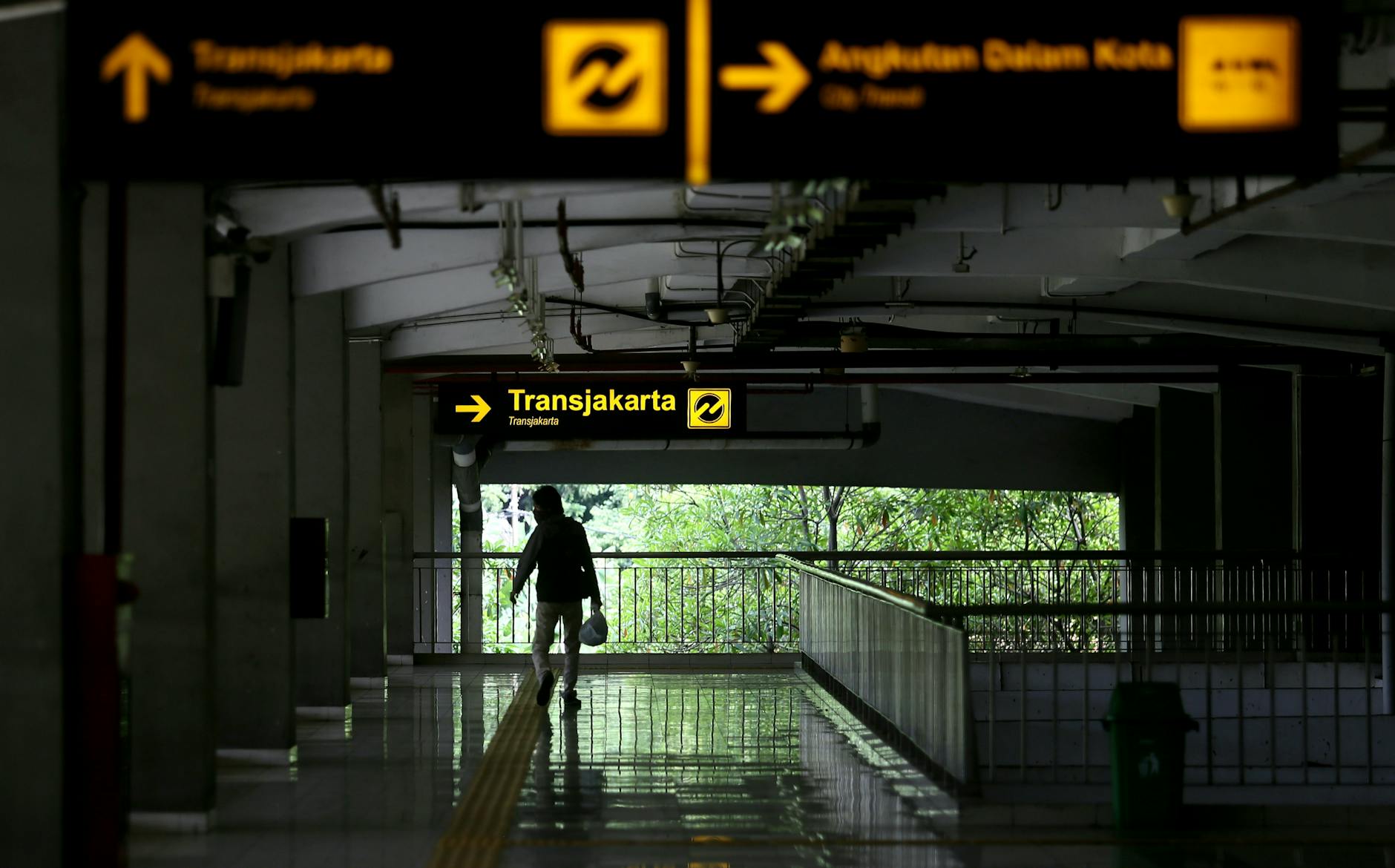
TransJakarta runs a bus rapid transit (BRT) network more than 250 km long, much of it on dedicated bus lanes laced across the city, and a regular ride costs IDR 3,500. For a visitor, this is the cheapest way to reach the places the MRT does not, including Kota Tua, Glodok, and Monas. The trouble is that most TransJakarta write-ups bury you under corridor numbers and a system map that looks like spilled spaghetti. This TransJakarta bus guide keeps it simple: the handful of corridors you actually need, the free Bus Wisata sightseeing routes almost everyone overlooks, the Corridor 1 run that strings Monas, Glodok, and Kota Tua together on one line at IDR 3,500 a ride, and the bit of halte etiquette that stops you boarding the wrong bus.
The busway shines brightest as part of a combination. It reaches the corners the Jakarta MRT cannot, but for a fast north-south hop in rush hour the train still wins, and the same e-money card you tap here also runs the KRL commuter line out to the suburbs. To see how all of it slots together, our pillar on getting around Jakarta is the place to start.
TransJakarta at a Glance (2026)
| Item | Details |
|---|---|
| Total network | 250+ km BRT network, much of it on dedicated lanes |
| Corridors | 14 main BRT corridors, plus cross-corridor, non-BRT, Royaltrans, Transjabodetabek and Mikrotrans routes |
| Operating hours | Round the clock on the 14 main BRT corridors (AMARI overnight service 22:00–05:00); other routes keep their own schedules |
| 24-hour service | AMARI overnight service on all 14 main corridors |
| Flat fare | IDR 3,500 (most BRT trips) |
| Premium AC Royaltrans | Set by route; check the fare for your route on transjakarta.co.id |
| Free Bus Wisata | IDR 0 — check current routes and days |
| Payment | JakLingko, e-Money, Flazz, Brizzi, TapCash |
The Corridors Tourists Actually Use

Corridor 1: Blok M ↔ Kota — The Tourist Spine
The single most useful TransJakarta corridor for tourists. Runs north-south through the heart of Jakarta along Jalan Thamrin and Jalan Gajah Mada. Connects Blok M nightlife in South Jakarta → Bundaran HI → Monas → Sawah Besar → Glodok → Kota Tua. Total trip: 45 minutes, IDR 3,500 flat.
Essential Corridor 1 halte (stops) for tourists:
- Blok M — South Jakarta nightlife terminal
- Bundaran HI — Connect to MRT, Plaza Indonesia, Grand Indonesia
- Monas — National Monument and Merdeka Square; change here (halte Monumen Nasional) for Corridors 2 and 3
- Sawah Besar — Pasar Baru shopping street
- Glodok — Chinatown food and temples
- Kota — Kota Tua Old Town and Jakarta Kota train station
Corridor 1 is also the simplest way to string Monas, Glodok, and Kota Tua into one day: all three sit on the same line, so you just ride north and get off where you want to explore, paying IDR 3,500 each time you tap in.
Corridor 2: Pulo Gadung ↔ Monumen Nasional — North Connection
Runs from Pulo Gadung in the east to Monumen Nasional, where it meets Corridor 1 (which itself runs Blok M to Kota). Less essential for typical tourist itineraries.
Corridor 9: Pluit ↔ Pinang Ranti — East-West Crosstown
One of the east-west BRT corridors, alongside Corridors 2 and 4. Useful for traveling from Pluit and northern destinations to Halim Perdanakusuma Airport (for domestic flights), Cawang, and Taman Mini Indonesia Indah area.
Other Corridors (Less Essential for Tourists)
Corridors 3, 4, 5, 6, 7, 8, 10, 11, 12, 13 and 14 serve commuter routes that rarely match tourist itineraries. Use them only if a specific Halte is your destination.
Free Bus Wisata Sightseeing Routes

One of Jakarta’s best transit secrets: Bus Wisata are free open-top double-decker tourist buses operated by TransJakarta. They run select routes with no fare — just board and ride, after checking TransJakarta’s latest announcements for current routes and days. Most TransJakarta guides skip this entirely, but it’s a remarkable free sightseeing tool.
Bus Wisata Routes
- BW1 (Jakarta Heritage) — Monas → Kota Tua → Sunda Kelapa → Monas
- BW2 (Jakarta Modern) — Bundaran HI → Senayan → SCBD → Bundaran HI
- BW3 (Jakarta Night) — Evening Bundaran HI loop with illuminated landmarks
Boarding points are clearly marked at Halte Monas, Halte Bundaran HI, and Halte Kota with signage in English. Days and hours change, so check TransJakarta’s latest announcements before you plan around a ride.
Halte (Bus Stop) Architecture

TransJakarta uses dedicated elevated halte (bus stops) rather than open street curbs. To use a halte:
- Find the halte entrance — usually a covered pedestrian bridge over the bus lane
- Tap your card at the gate to enter the platform
- Wait inside the enclosed platform — air-conditioned at major halte, fan-cooled at smaller ones
- Watch the digital signs for incoming bus route numbers
- Board the bus through the platform doors that align with bus doors
- Exit at your destination halte — tap your card at the exit gate, and ask the staff how a change of corridor is charged
Royaltrans — Premium AC Buses
Royaltrans is a separate premium service with routes of its own, such as Cibubur–Blok M, Cibubur–Balai Kota and Terminal BSD–Fatmawati. Premium AC, plush seats, more space per passenger. Fare: set by route, so look up yours before you ride. Suitable for travelers prioritizing comfort over price.
Mikrotrans — Feeder Routes
Mikrotrans are smaller minibuses that feed into the main BRT network. They operate on residential streets without dedicated bus lanes, using surface roads. Connect rural Jakarta to BRT halte. Less useful for tourists; only relevant if your specific destination is on a Mikrotrans route. Rides are free with a card tap, whether or not you have come off the BRT; Mikrotrans sits outside the three-hour integrated fare.
TransJakarta Fares
| Service | Fare | Notes |
|---|---|---|
| Standard BRT (all corridors) | IDR 3,500 | Regular fare, 07:01–04:59; an early-morning economy fare applies 05:00–07:00 |
| Mikrotrans (feeder) | IDR 0 | Free with a card tap; outside the 3-hour integrated fare |
| Royaltrans AC | Varies | Set by route |
| Bus Wisata | IDR 0 | Free; check current routes and days |
| AMARI overnight | IDR 3,500 | All 14 main corridors, 22:00–05:00 |
First-Time Rider Walkthrough
Walking onto a Jakarta bus halte for the first time can be intimidating. Here’s the simplified version:
- Buy a Mandiri e-Money card at Indomaret or another listed seller, stock permitting (IDR 30,000 for the card, which carries no balance, + a top-up of your choice such as IDR 20,000 = IDR 50,000 total)
- Find a halte — they’re elevated structures over bus-only lanes
- Tap your card at the entrance gate; gate opens; you’re now in the paid area
- Look at the digital signage showing incoming buses; find Corridor 1 (or your needed route)
- Wait at the marked door area aligned to your bus’s door
- Board the bus when it arrives; find a seat or hold the handrail
- Watch for your destination halte; the bus has digital signage announcing each stop
- Exit through the bus doors at your destination halte
- Tap your card at the halte exit gate to leave the paid area
The Corridor 1 Sightseeing Route

Start at Halte Bundaran HI and ride Corridor 1 north: Halte Monas first, then Halte Glodok and Halte Kota, getting off wherever you want to explore. Before you leave a halte to sightsee, ask the staff how your card will be charged when you tap in again.
Sample itinerary: Bundaran HI 9:00 AM → Monas (visit 90 min) → re-board → Sawah Besar (Pasar Baru shopping 45 min) → re-board → Glodok (Chinatown food 90 min) → re-board → Kota (Kota Tua 2 hours) → tap out at Halte Kota. Transit cost: IDR 3,500 a ride.
TJ Apps and Tools
- Tije — Official TransJakarta app with live bus tracking, route planner, halte locator
- JakLingko — Integrated transit app showing TransJakarta + MRT + KRL routes
- Google Maps — Reliable for tourist route planning; shows TJ routes
- Moovit — International app with TransJakarta integration
TransJakarta vs. MRT — When to Use Each
Use TransJakarta when:
- Visiting Kota Tua, Glodok, or Monas (MRT doesn’t reach these)
- Traveling east-west (Corridor 9 crosses the city; Corridors 2 and 4 link the east with the centre)
- Budget-focused (TransJakarta is cheaper than MRT for most trips)
- Carrying small luggage
Use MRT when:
- Traveling north-south during rush hour (MRT is dramatically faster)
- Going to Senayan, GBK Stadium, Plaza Senayan, Pacific Place
- You prefer underground/elevated comfort over surface buses
- Quick airport access via Dukuh Atas → BNI City airport train
See our Jakarta MRT guide for full comparison.
Halte to Attraction Walking Distances
| Halte | Attraction |
|---|---|
| Monas | National Monument |
| Monas | National Museum |
| Bundaran HI | Plaza Indonesia / Grand Indonesia |
| Sawah Besar | Pasar Baru |
| Glodok | Petak Sembilan / Chinatown |
| Kota | Kota Tua Fatahillah Square |
| Senayan (TJ + MRT) | Plaza Senayan / Senayan City |
| Pinang Ranti | Taman Mini Indonesia Indah (a Grab ride from the halte) |
First-Timer Mistakes on the TransJakarta Bus Guide Routes
A handful of slip-ups trip people up more than the rest. Don’t go looking for a curbside bus stop — TransJakarta loads from raised, enclosed halte reached by a footbridge, and walking the street below will only get you lost. Don’t tap out when you only mean to change corridors before asking the halte staff how a transfer is charged. Don’t board the first bus that pulls in without checking the digital sign — several routes share a platform, and the wrong one will carry you off in the wrong direction. Don’t expect cash to work; it is card-only, so sort an e-money card before you reach the gate. And on a crowded bus, keep your bag in front of you — not a TransJakarta-specific risk, just sensible big-city habit.
TransJakarta Etiquette
- Stand right, walk left on escalators
- Let passengers exit first before boarding
- Priority seats for elderly, pregnant, disabled (clearly marked)
- Women-only area in front of bus (designated by pink decals)
- No food/drink inside the bus or paid platform area
- No phone calls at high volume; texting fine
- Keep your card ready for fast exit at destination halte
Safety on TransJakarta
TransJakarta is very safe for tourists including solo female travelers. Halte are well-lit, security personnel present at major stops, and CCTV throughout. Standard urban precautions apply: keep bags secure on crowded buses, don’t display valuables, use the women-only area if uncomfortable in mixed seating.
Frequently Asked Questions About TransJakarta Bus Guide
How much does TransJakarta cost?
IDR 3,500 for a regular ride on the standard BRT corridors (unchanged for over a decade), with an early-morning economy fare from 05:00 to 07:00. Royaltrans premium AC fares vary by route. Bus Wisata sightseeing buses are free.
What’s the best TransJakarta route for tourists?
Corridor 1 (Blok M ↔ Kota) is the tourist spine — connecting Blok M, Bundaran HI, Monas, Glodok, and Kota Tua in one north-south line, at the regular IDR 3,500 fare.
Are TransJakarta buses safe for tourists?
Yes — very safe with security at every halte, CCTV throughout, and dedicated women-only seating areas. Solo female travelers report no issues.
Can I pay TransJakarta with cash?
No — TransJakarta requires a transit card (JakLingko, e-Money, Flazz, Brizzi, or TapCash). A regular Mandiri e-Money card costs IDR 30,000, without balance, at Indomaret and other listed sellers; special-design and co-branded cards are priced separately.
What’s the difference between TransJakarta and Mikrotrans?
TransJakarta runs in dedicated bus lanes on main roads. Mikrotrans are smaller feeder minibuses using residential streets. Mikrotrans rides are free with a card tap, transfer or not; JakLingko’s site sets out the rules of its three-hour integrated fare.
Does TransJakarta go to the airport?
No — TransJakarta doesn’t reach Soekarno-Hatta Airport. For airport access, use the airport train, Damri bus, or Grab/taxi. See our airport transfer guide.
TransJakarta is one of the most underrated transit systems anywhere — and a genuine bargain for tourists once the corridor logic clicks. Spend one afternoon riding Corridor 1 and you will wonder why anyone sits in traffic. From here, it pays to pair what you have learned with the rest of the network: the Grab vs Gojek comparison for the door-to-door days, the JakLingko card guide for squeezing the fare cap, and our notes on avoiding Jakarta traffic for the timing that makes any of it work. The Corridor 1 sites themselves are the heart of the city’s history, so it is worth lining them up against our guide to Jakarta’s landmarks, the wider list of best attractions in Jakarta, and the weekend-friendly roster of free things to do in Jakarta that the Bus Wisata pairs so neatly with. Track the budget across all of it with our breakdown of Jakarta transportation costs.

External Resources for TransJakarta
For official route updates, the official TransJakarta website publishes current schedules, fare changes, and new corridor announcements. The Wikipedia TransJakarta corridors page covers all 14 main BRT corridors and the other TransJakarta routes, with a system map.