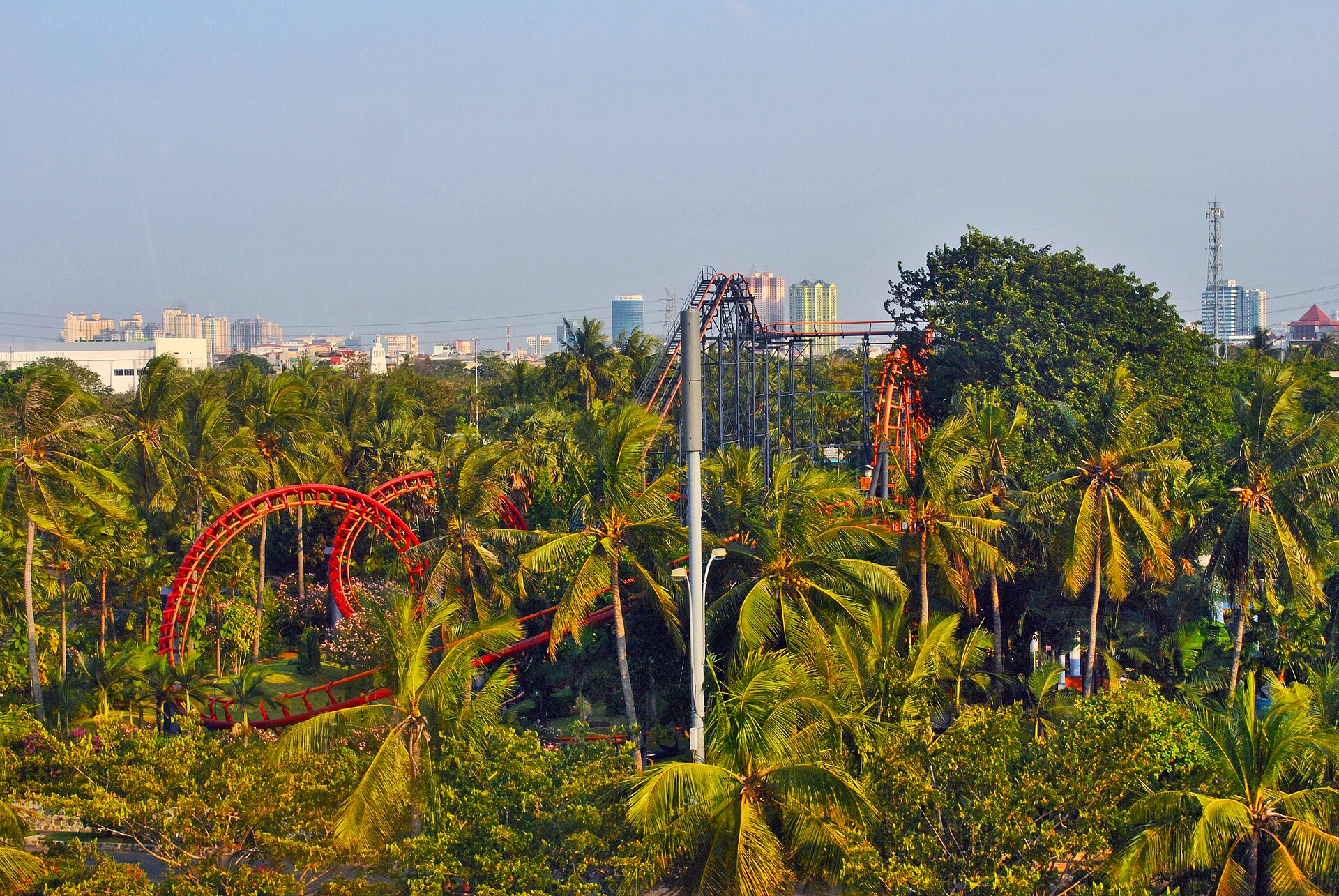
From the top of the Bianglala you can see the container cranes at Tanjung Priok, the Java Sea, and the red steel loop of Halilintar rising out of a stand of coconut palms. That combination — a proper looping roller coaster planted in tropical vegetation on a reclaimed north-coast waterfront — is the thing that makes Dunia Fantasi Jakarta feel like nowhere else. It is not the slickest theme park in Southeast Asia. It is, without much argument, the most Indonesian one.
This guide covers the 2026 ticket prices and why nobody should pay the weekend rate, the opening hours, the separate Ancol gate fee, which rides are worth queueing for, whether Fast Track earns its money, and how to structure a day so the heat does not defeat you by two o’clock. Prices and hours were checked in September 2026; Ancol changes both and runs promotions constantly, so confirm on ancol.com before you buy.
The essentials
| Detail | |
|---|---|
| Where | Inside Taman Impian Jaya Ancol, North Jakarta |
| Hours | Mon–Fri 10:00–18:00; Sat–Sun 10:00–20:00 |
| Ticket, Mon–Thu | 275,000 |
| Ticket, Friday | 300,000 |
| Ticket, Sat/Sun/public holidays | 400,000 |
| Fast Track | From 375,000 — skips the queue on 14 rides |
| Ancol gate fee | 35,000 per person, on top, plus a vehicle ticket |
| Ancol area hours | 06:00–23:00 |
| Time needed | A full day |
| Best for | Ages 7+, and really 10+ |
The ticket maths, and why nobody should pay 400,000
Dufan’s pricing is unusually aggressive about weekends. A Monday-to-Thursday ticket is 275,000. Friday is 300,000. Saturday, Sunday and public holidays are 400,000 — a 45 per cent premium for the privilege of queueing longer for every ride. Add the Ancol gate fee of 35,000 a head and a family of four is looking at 1,740,000 at the weekend against 1,240,000 midweek, before parking, food or anything else.
That gap is the single most consequential decision of your Dufan visit, and it is worth rearranging a trip around. But it is not the whole picture, because Ancol runs promotions more or less permanently and the promotional price is frequently far below the gate price. Promotions seen through 2026 have included:
- Tickets from 170,000 per person on a minimum purchase of three, well under the weekday gate rate.
- A buy-three-get-two deal for groups of five.
- A flat 150,000 tiket terusan giving access to every Ancol recreation unit in one day — Dufan, Sea World, Atlantis and the rest.
- Bundles including meal vouchers.
None of these is a permanent offer, and the terms change. But the pattern is consistent enough that walking up to the gate and paying list price on a Saturday is, in almost every case, an unnecessary decision. Check ancol.com’s promo page and compare against Traveloka and tiket.com before you leave the hotel. Ten minutes will routinely save more than a hundred thousand rupiah a head.
The Ancol gate fee
Worth stating plainly because it catches almost every first-time visitor: your Dufan ticket does not include entry to Ancol. The complex charges 35,000 per person to come through the gate, and again for the car or motorbike that brought you. Ancol’s own pages say so; it is not hidden, but it is not in the headline price either.
Two consequences. First, budget for it — for a family of four that is 140,000 plus parking before you reach the Dufan turnstile. Second, since you have paid it anyway, and since the area itself is open from 06:00 to 23:00, there is no reason to leave the moment Dufan closes. The waterfront, the beaches and the seafood market are all inside the same perimeter. Our North Jakarta and Ancol guide covers what else is in there.
The rides worth queueing for
The thrill rides
- Halilintar — the park’s signature looping roller coaster, and the ride everyone photographs. It is not modern by international standards, and it is rougher than a contemporary coaster, but it delivers exactly what it promises and the setting among the palms is genuinely striking.
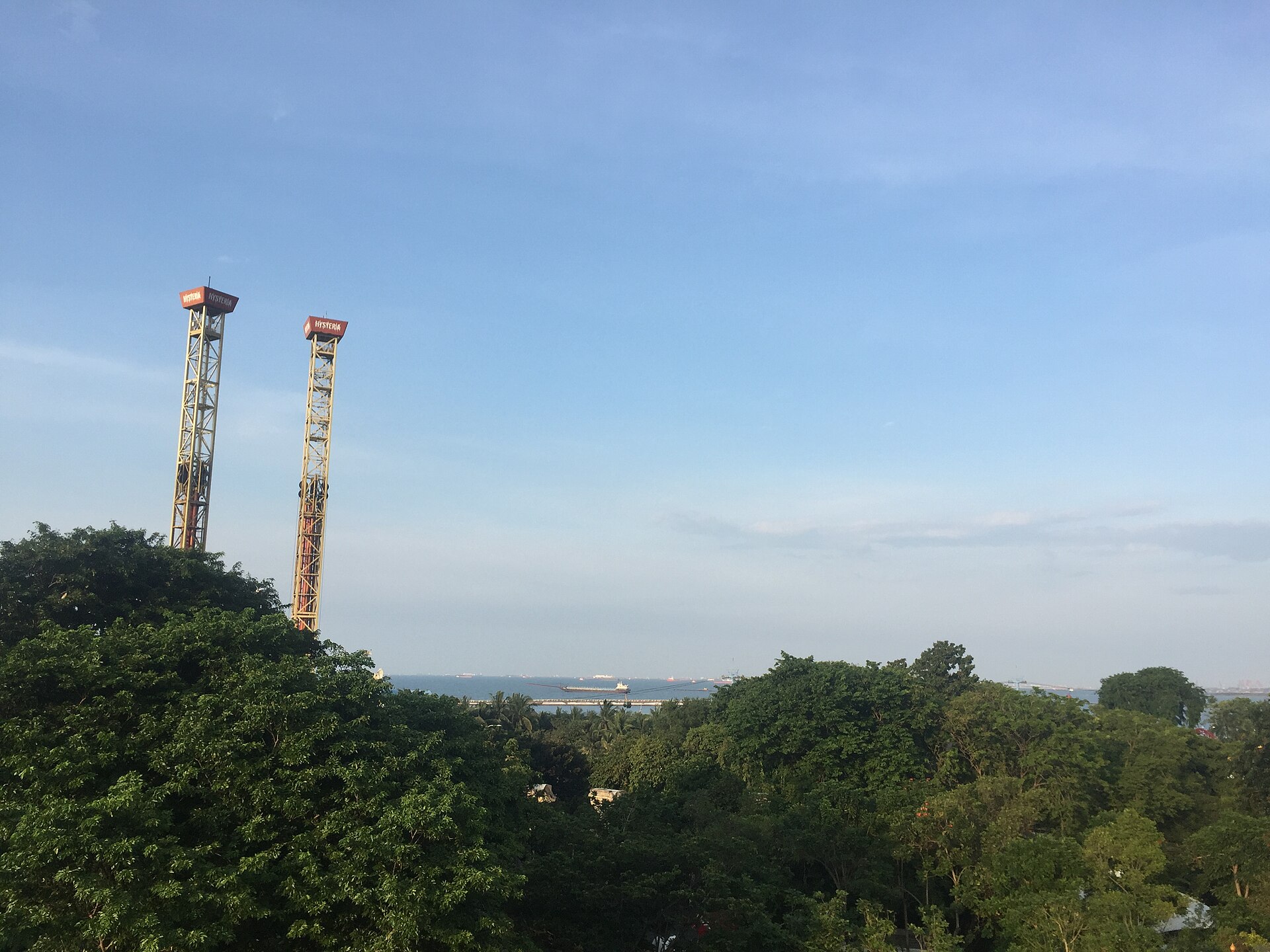
- Hysteria — twin drop towers. Straight up, a pause at the top with the Java Sea laid out in front of you, then straight down. Short, effective, and the one that produces the loudest noise in the park.
- Tornado — an inverting thrill ride that turns riders through a full rotation. The most intense thing at Dufan and not one for anyone with a delicate stomach.
- Kora-Kora — the swinging pirate ship, which sounds gentle and is not. A Dufan institution and the ride most Indonesian adults remember from childhood.
The wet rides, which you will want by noon
- Arung Jeram — the river rapids ride, in circular boats. You will get soaked. In Jakarta’s heat that is a benefit rather than a hazard, and this is the ride to save for the hottest part of the afternoon.
- Niagara-Gara — the log flume, with a proper drop at the end. Wetter than it looks from the queue.
Bring a dry bag or a plastic bag for phones and wallets, or use the lockers. Both rides will leave you genuinely wet rather than pleasantly damp, and in 90 per cent humidity you will not dry out quickly.
The indoor rides, which matter more here than you would expect
This is the part of Dufan that visitors from cooler countries underrate. Between about 11:00 and 15:00 the open sections of the park are punishing, and the air-conditioned indoor attractions become the structure around which a sensible day is built.
- Istana Boneka — an indoor boat ride through dioramas of Indonesian and world cultures, in the tradition of every such ride since 1964. Cool, dark, slow, unashamedly dated and quietly the most-loved thing in the park.
- Perang Bintang — an indoor dark ride, and a good place to be at one in the afternoon.
- Ice Age — a licensed indoor attraction, popular with younger children.
- Rumah Misteri — the haunted house, and better than most park versions.
The family and gentle rides
- Bianglala — the Ferris wheel, and the best view in North Jakarta. Ride it late, when the light goes.
- Alap-Alap — the junior coaster, and the right first coaster for a six-year-old.
- The carousel, teacups, bumper cars and swing rides are all present, all cheerful and all short-queue.
What to skip
Honestly: the arcade concessions, the paid photo booths, and any ride with a queue longer than forty minutes that is not on the list above. Dufan is a large park with a lot of filler, and the difference between a good day and an exhausting one is being willing to walk past things.
The themed zones
Dufan is laid out as a set of themed regions — Jakarta, Indonesia, Asia, Europe, America and Greece among them — each with its own architecture, planting and soundtrack. The theming is enthusiastic rather than immersive, and some zones have aged better than others, but it does give the park a coherent shape and makes it easy to navigate: you always know roughly where you are.
The Indonesian and Jakarta zones are the most interesting to a foreign visitor, because they are the only parts of any theme park anywhere built around Betawi and wider Indonesian design. If you are curious about that layer of the city, our Betawi cultural village guide is where to see it done properly.
Where Dufan came from
Dunia Fantasi opened in the mid-1980s, at a moment when Indonesia’s middle class was growing fast and a domestic theme park was both a commercial proposition and a piece of national statement-making. The name translates literally as “fantasy world”, and the abbreviation Dufan has been standard usage for so long that a great many Jakartans could not tell you what it stands for.
For anyone who grew up in Jakarta in the 1990s or 2000s, this park occupies roughly the position that a childhood seaside town occupies elsewhere: not objectively the best thing available, but freighted with a great deal of affection. Kora-Kora and Istana Boneka in particular are cultural reference points rather than merely rides, and you will notice Indonesian adults queueing for both without a child in sight.
That history explains the park’s slightly uneven texture. Rides have been added, replaced and refurbished across four decades, so a 1980s dark ride sits a few hundred metres from something installed last year. It also explains why the theming leans so heavily on regions of the world — in the mid-1980s, for most Indonesian visitors, a walk from “Europe” to “America” in an afternoon was itself the attraction.
Dufan today remains overwhelmingly a domestic park. Foreign visitors are a rounding error in its attendance, the signage and announcements are largely in Indonesian, and the food is Indonesian fast food rather than an international theme-park menu. That is a feature rather than a bug if you came to Jakarta to see Jakarta, and it does mean a little patience with language is useful — our etiquette guide has the phrases that help.
Is Fast Track worth it?
Fast Track starts at 375,000 and lets you skip the queue on fourteen named rides — the list includes Bianglala, Kora-Kora, Ice Age, Tornado, Perang Bintang, Halilintar, Arung Jeram, Niagara-Gara, Alap-Alap and Istana Boneka, which is essentially everything you actually came for.
| When | Verdict |
|---|---|
| Weekday, term time | No. Queues are short enough that you will not recoup it |
| Weekday, Indonesian school holidays | Marginal. Depends how early you arrive |
| Saturday or Sunday | Yes, if you can afford it. Queues run to an hour on the headline rides |
| Public holiday or the week after Idul Fitri | Yes, without hesitation |
The arithmetic that matters: on a busy Sunday you might manage eight rides in a day without Fast Track and eighteen with it. Whether that is worth an extra 375,000 depends on whether you are here once or every month. For a visitor with one Jakarta trip, on a weekend, with children who will remember this, it is defensible. Going on a Tuesday instead is cheaper and better.
A Dufan day, hour by hour
| Time | What you are doing |
|---|---|
| 09:30 | Through the Ancol gate. Park, or take the free internal shuttle to the Dufan entrance |
| 10:00 | Gates open. Straight to Halilintar, then Hysteria, then Tornado — the big three while the queues are empty |
| 11:15 | Kora-Kora and the surrounding zone while it is still bearable outside |
| 12:00 | Lunch, early, before the food outlets fill up |
| 13:00 | Indoor rides — Istana Boneka, Perang Bintang, Ice Age, Rumah Misteri. Air conditioning through the worst of the heat |
| 15:00 | Wet rides. Arung Jeram and Niagara-Gara, in that order |
| 16:00 | Dry off, ice cream, the gentle rides, whatever the children are still asking for |
| 17:15 | Bianglala as the light goes. Best view of the day |
| 18:00 | Weekdays: park closes. Weekends: two more hours, and the park is at its best after dark |
| Evening | Dinner at the Ancol waterfront — you have already paid the gate fee |
The principle underneath that schedule is simple and it applies to every outdoor attraction in this city: thrill rides early, indoors in the middle, water in the afternoon, views at dusk. Fight the heat and it wins.
What a Dufan day actually costs
Worth laying out, because the ticket is only part of it. For two adults and two children, arriving by car on a Tuesday and buying at gate price:
| Item | Cost |
|---|---|
| Dufan tickets, 275,000 × 4 | 1,100,000 |
| Ancol gate, 35,000 × 4 | 140,000 |
| Vehicle ticket and parking | Check current rates |
| Lunch inside the park, roughly | 300,000–500,000 |
| Water, snacks, lockers | 100,000 |
| Rough total, weekday, no promo | Around 1,700,000 |
| The same day on a Sunday at gate price | Around 2,200,000 |
| The same day on a 170,000 promotion | Around 1,180,000 |
The spread between the best and worst versions of the same day is close to a million rupiah, which is the whole argument for spending ten minutes on the promo page before you leave. Our Jakarta trip cost breakdown sets these figures against what the rest of a trip costs.
Crowds and the calendar
Dufan’s crowds are extremely predictable, and the difference between the best and worst days is enormous.
- Best: Tuesday to Thursday during Indonesian school term. Short queues, the low ticket price, and space to move.
- Fine: Friday, though the price rises and the afternoon fills up.
- Busy: Saturday and Sunday. Expect 30 to 60 minutes on the headline rides.
- Avoid: Indonesian school holidays, national public holidays, and above all the week after Idul Fitri, which is the single busiest period of the Indonesian leisure year. Our events and festivals calendar tracks the dates.
One more consideration: the wet season, roughly November to April, brings a heavy afternoon downpour most days. Outdoor rides close during lightning, and the park empties. That is either a disaster or an opportunity, depending on whether you have an umbrella and a willingness to wait it out in Istana Boneka — after a storm passes, queues are the shortest they will be all day.
Practicalities
What to bring
- A hat, sunscreen and more water than you think. Non-negotiable. There is shade, but not on the queue lines.
- A change of clothes, or at least a dry T-shirt. Two rides will soak you.
- A waterproof phone pouch. Cheap in any Indonesian convenience store and worth every rupiah.
- Cash and a card. Ancol is increasingly cashless but not entirely.
- A power bank. A full day of photographs and queue-checking will finish a phone.
Height restrictions
The thrill rides carry minimum height requirements, posted at each entrance. They are enforced, and there is no negotiating with the operator. If you have a child hovering around the threshold, measure them at home before you commit to a 275,000 ticket — a seven-year-old who cannot ride Halilintar, Hysteria or Tornado is left with a much shorter park.
Food
There are food outlets throughout, mostly Indonesian fast food and international chains, at theme-park prices. Some promotional tickets bundle meal vouchers, which are worth having. Outside food policies vary — check when you buy. The genuinely good eating at Ancol is at the waterfront afterwards, particularly Bandar Djakarta, where you choose seafood from tanks and pay by weight; our seafood guide has the detail.

Accessibility
The park is largely flat and paved, and pushchairs are manageable, though the queue lines are not always designed for them. Most thrill rides have restrictions for wheelchair users and for anyone with back, neck or heart conditions, and these are posted and enforced. Prayer rooms and toilets are distributed throughout.
Getting there
Ancol is in North Jakarta, roughly 25 km from most South Jakarta hotels and about 10 km from Monas, with no MRT station anywhere near it.
- Grab or Gojek is the simplest. Allow 40 minutes at 08:30 on a Sunday and well over 90 in the Friday evening peak. Cost the journey in minutes, not kilometres — see our traffic guide.
- KRL commuter line to Ancol station, then a short hop to the gate. Cheap and traffic-proof; see the KRL guide.
- TransJakarta serves the area — check the current corridor and stop, as routes change. Our TransJakarta guide explains the system.
- Driving costs the vehicle gate fee but lets you park close, which matters when you are carrying wet clothes and a tired child at seven in the evening.
Inside the complex, use the free internal shuttle. Ancol is 552 hectares and walking from the gate in the middle of the day is a mistake you make only once.
What age is Dufan for?
| Age | Verdict |
|---|---|
| Under 5 | Not worth it. Height restrictions rule out most rides. Atlantis or Sea World instead |
| 5–6 | Marginal. Alap-Alap, Istana Boneka and the gentle rides only. Check heights first |
| 7–9 | Works, with the caveat that some thrill rides may still be off-limits by height |
| 10–14 | The sweet spot. This is who Dufan is built for |
| Teenagers and adults | Good, particularly at a weekend evening. Not a world-class coaster park, but a genuinely enjoyable one |
For families with a wide age range, the honest answer is that Dufan splits the party. One adult takes the older children on the thrill rides while the other does Istana Boneka and the carousel with the small ones. Plan for that rather than hoping everyone will be happy on the same queue.
Dufan or somewhere else?
Set against the region’s other parks, Dufan is mid-table and knows it. It has neither the scale nor the capital investment of the Singapore or Japanese parks, and the ride technology is a generation or two behind. What it has is a strong setting, a genuinely Indonesian character, four decent thrill rides and a price that, on a weekday promotion, is a fraction of what an equivalent day costs almost anywhere else in Asia.
Within Jakarta, the comparison that actually matters is with the rest of Ancol. If your children are under seven, Sea World and Atlantis Water Adventure will give them a better day for less money and less walking. If they are ten and up, Dufan is the reason to come to Ancol at all. Everything is compared side by side in our guide to family-friendly attractions in Jakarta.
The honest verdict
Dufan is worth a day if you have children between about ten and fifteen, you go on a weekday, and you buy on a promotion. On those terms it is good value and a genuinely enjoyable park with a setting no other theme park can match.
It is not worth 400,000 a head plus a gate fee on a Sunday in the school holidays, when you will spend more time in queues than on rides and the heat will beat you by three o’clock. And it is not worth the journey at all for adults without children, or for families with under-sevens, both of whom have better options in Jakarta.
The park itself is showing its age in places, and visitors coming straight from a major international park will notice. But Halilintar breaking out of the palm canopy with the Java Sea behind it is a sight worth having, and the Bianglala at dusk over North Jakarta is one of the better views in this city. Go midweek, go early, and stay for the seafood.
Frequently asked questions
How much is a Dufan ticket in 2026?
Monday to Thursday 275,000, Friday 300,000, and Saturday, Sunday and public holidays 400,000. On top of that you pay the Ancol area gate fee of 35,000 per person plus a vehicle ticket. Promotional prices — sometimes as low as 170,000 per person on a minimum of three tickets — appear regularly on ancol.com and are usually much better value.
What time does Dufan open and close?
Monday to Friday 10:00 to 18:00, and Saturday and Sunday 10:00 to 20:00. The wider Ancol complex is open from 06:00 to 23:00, so you can arrive early and stay late even though the park itself has shorter hours.
Is the Ancol entrance included in the Dufan ticket?
No. This is the most common surprise. Ancol charges 35,000 per person to enter the complex, plus a vehicle fee, and this is separate from and additional to your Dufan ticket. For a family of four arriving by car, budget for that before you reach the turnstile.
Is Fast Track at Dufan worth it?
At weekends, on public holidays and during Indonesian school holidays, yes — it starts at 375,000 and covers fourteen rides including everything you came for, and it can double the number of rides you get through. On a term-time weekday it is money wasted, because the queues are short enough not to matter.
What are the best rides at Dufan?
Halilintar the looping coaster, Hysteria the twin drop towers, Tornado for the strongest stomachs, and Kora-Kora the swinging ship. Arung Jeram and Niagara-Gara are the wet rides and are best saved for the hot part of the afternoon. Istana Boneka, the indoor boat ride, is the sleeper favourite and the coolest place in the park at one o’clock.
How long do you need at Dufan?
A full day. The park opens at 10:00 and closes at 18:00 on weekdays or 20:00 at weekends, and that is roughly what it takes to do the headline rides without rushing. Anything less and you are paying a full-day price for a half-day visit.
Is Dufan suitable for small children?
Not really, under about seven. Height restrictions rule out most of the significant rides and are strictly enforced, which leaves a small child with the carousel, the teacups and Istana Boneka for the price of a full ticket. Atlantis Water Adventure or Sea World next door will make them far happier.
What should I wear to Dufan?
Light clothes, closed comfortable shoes and a hat, plus a change of top — two rides will soak you completely and the humidity means you will not dry out. Bring a waterproof pouch for your phone, or use the lockers.
Can you bring food into Dufan?
Policies on outside food vary and have changed over the years, so check at the gate or when you buy. There are food outlets throughout the park at theme-park prices, and some promotional tickets bundle meal vouchers, which are worth taking.
Is Dufan worth visiting?
On a weekday, on a promotional ticket, with children aged ten to fifteen — yes, comfortably. On a Sunday at full price, in a crowd, with under-sevens — no. Few attractions in Jakarta swing this hard on when you go and who you bring.
If your children are under about seven, the water park next door will give them a better day than the theme park for roughly a third of the price. Our guide to the best water parks in Jakarta compares Atlantis with everything else in the city, from Waterboom PIK down to a twenty-thousand-rupiah neighbourhood pool.
Related Jakarta Guides
- Best Family-Friendly Attractions in Jakarta
- Sea World Ancol: Aquarium Visit Guide
- North Jakarta & Ancol Area Guide
- Things to Do in Jakarta with Kids
- Fun Activities in Jakarta
- Best Seafood Restaurants in Jakarta
- The KRL Commuter Line
- Events & Festivals in Jakarta
- How to Avoid Jakarta Traffic
- Jakarta Trip Cost Breakdown
Photo Credits
Halilintar roller coaster at Ancol: Halilintar rollercoaster ride, Ancol, Jakarta – panoramio by musnahterinjak, CC BY-SA 3.0, via Wikimedia Commons.
The Hysteria drop towers at Dufan: Hysteria in Dufan by ErwinFCG, CC BY-SA 4.0, via Wikimedia Commons.