Every Jakarta resident eventually works out the same thing: the difference between a good weekend in the hills and a wretched one is not the hotel, the crater or the noodles. It is the Cipularang toll road on Sunday afternoon. A Bandung weekend getaway from Jakarta covers about 140 kilometres, and in free-flowing conditions the drive takes two and a half hours. On a Sunday between two and six, that same stretch regularly swallows four to six, most of it spent stationary near Purwakarta while everyone in the car stops speaking to each other. Plan around that one fact and Bandung is a pleasure. Ignore it and you arrive home at ten on Sunday night wondering why you bothered.
This guide treats Bandung as a two-night trip, Friday evening to Sunday early afternoon, structured hour by hour. It sits inside our wider guide to the best day trips from Jakarta, and pairs naturally with the shorter Bogor day trip from Jakarta if you only have one day. If the plan is to survive the city rather than leave it, our notes on avoiding Jakarta traffic and on renting a car in Jakarta cover the ground before the toll gate.
Why Friday Night Beats Saturday Dawn
The standard approach is to set an alarm for four on Saturday, get on the toll by five, and eat breakfast in Lembang by eight. It works, occasionally. It also means you arrive tired, burn the best two hours of Saturday on the road, and compete with every Jakarta family who had the same idea. Cipularang traffic builds from around six, and the queue at the Pasteur exit adds another forty minutes.
Leaving on Friday evening is better in almost every case. Traffic out of Jakarta is heavy until roughly eight but it moves, and the toll thins after nine. A seven or eight o’clock departure typically puts you in Bandung between ten and midnight. You lose a Friday night you were probably going to spend in a mall, and gain a complete Saturday that starts with breakfast rather than a dashboard.
The second reason is congestion inside Bandung itself. Jalan Setiabudi, the artery north to Lembang, starts clogging around nine on a Saturday and is properly jammed from ten, worst between the UPI campus and Terminal Ledeng where the Sersan Bajuri junction feeds in. Already in Bandung on Friday night, you can be on Setiabudi at half past six and clear it before the crowd wakes. The Friday departure is not about Friday. It is about buying a clear Saturday morning.
Getting There: The Short Version
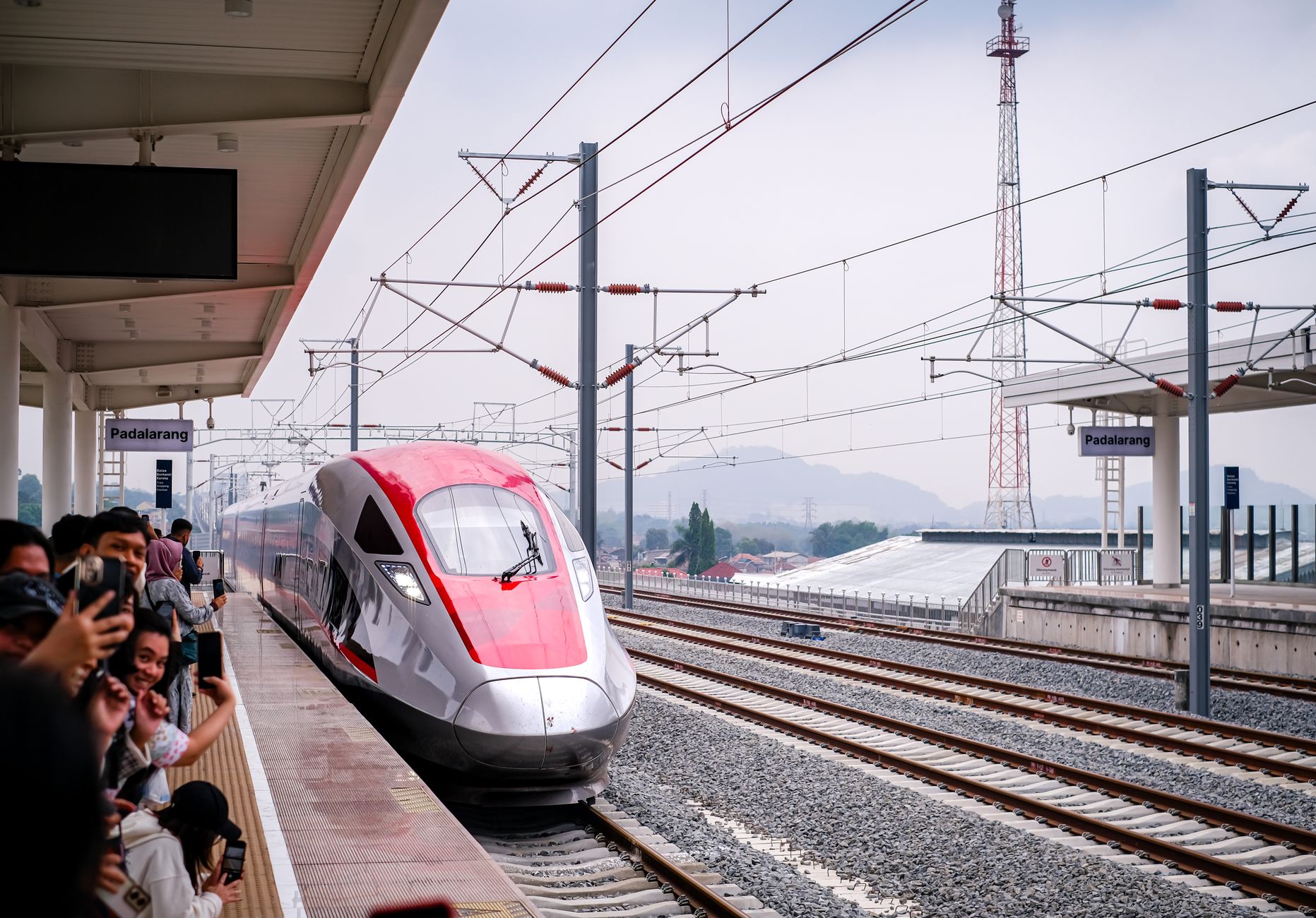
You have four realistic options, and a full transport comparison is covered separately on this site, so here is the compressed version. The Whoosh high-speed train runs Halim to Padalarang in about half an hour, with fares generally between IDR 200,000 and 250,000 for premium economy and up to around IDR 600,000 for first class. Padalarang is not Bandung — it is 20 kilometres northwest of the centre — but a feeder train to Bandung Station is bundled with the ticket and takes under twenty minutes.
Conventional rail from Gambir takes around three hours at IDR 100,000 to 200,000, though the operator has reshuffled this route since Whoosh opened and the Argo Parahyangan branding has been replaced, so check current schedules rather than older articles. Executive shuttles such as Cititrans and Daytrans run minibuses for roughly IDR 95,000 to 170,000 in three to five hours. Driving costs around IDR 70,000 to 100,000 in tolls each way plus fuel, and buys the freedom the mountain days reward.
The summary sentence: take Whoosh both ways and hire a car with driver locally for IDR 600,000 to 900,000 a day, unless you have small children or a mountain of luggage, in which case drive. For the equivalent inside the capital, see our breakdown of Jakarta transportation costs.
Where to Base Yourself: Dago, Braga or Lembang
This decision shapes the weekend, and most first-timers get it wrong by booking the prettiest photograph.
Dago, the long road climbing north from the centre, is the safe choice: cooler than the flats, the best cafés and restaurants, twenty minutes from Braga and forty to fifty from the Lembang turn-off on a good morning. Weekend rates run IDR 500,000 to 1,200,000. The catch is that upper Dago has its own weekend jam, because half of Bandung drives up for the view.
Riau and Braga put you in the middle of the city — Jalan Riau is the factory outlet strip, Braga is the art deco street. You can walk to breakfast and to the architecture, and reach Bandung Station in ten minutes. Expect IDR 400,000 for something plain up to IDR 1,500,000 for the better colonial-era properties. Bandung weekend rates commonly run 20 to 60 per cent above midweek, so book early.
Lembang and upper Setiabudi sell the fantasy — pine air, mist over the valley at six, nights around 15°C — at IDR 600,000 to 2,500,000. All of it is real, and so is the trade-off: every trip into Bandung proper is an hour or more each way at weekends, on a road with no alternative. If your weekend is Tangkuban Perahu, one attraction and a hot bath, stay up there and never come down. If you want Braga, the food and the outlets, do not. The mornings are not worth four hours of Setiabudi.
The reasoning is the same one we apply to choosing the right area to stay in Jakarta: pick for proximity to what you will actually do, not for the view from the lobby.
Planning a Bandung Weekend Getaway from Jakarta: The Two-Night Shape
Here is the itinerary that survives contact with reality, assuming a Friday evening departure and a Sunday lunchtime return.
Friday, 19:00–23:30
Leave by seven or eight; later Whoosh departures from Halim get you in around ten. Check in, then eat. Bandung’s late-night scene is thinner than Jakarta’s — much shuts by eleven — but Braga and the stalls around Alun-Alun run past midnight. A bowl of mie kocok is the correct first meal. Attempt nothing ambitious; you have just crossed a mountain range in a metal box.
Saturday, 05:45–07:30
This hour makes or breaks the weekend. Be in the car by a quarter to six. Setiabudi at six is quiet, Lembang at half past six is beautiful, and Tangkuban Perahu opens around seven. Take coffee to go rather than sitting through a hotel breakfast. Anyone still in bed at eight spends ninety minutes on a road that took you thirty-five.
Saturday, 07:30–15:00
Tangkuban Perahu, covered below; be walking back to the car park by half past ten, before the coach parties peak. Then down to Lembang for a late breakfast, followed by one attraction at most, or a long lunch and a nap. Do not stack Farmhouse, Floating Market, Dusun Bambu and a strawberry farm into one afternoon. You will spend it in car parks.
Saturday, 15:00–22:00
Descend before four; the Lembang-to-Bandung direction jams badly in late afternoon. Coffee on Dago, an early dinner of Sundanese lalapan, then Braga after dark when the art deco frontages are lit.
Sunday, 07:00–12:30
City morning: Braga on foot, Gedung Sate, Asia Afrika, and half an hour at an outlet if you must. Car-free hours operate on parts of Dago and Diponegoro on Sunday mornings. Buy oleh-oleh — Kartika Sari brownies, peuyeum, keripik — before eleven, eat early, and go. Our two-day Jakarta itinerary uses the same hour-by-hour structure for the capital.
Saturday Morning: North to Tangkuban Perahu
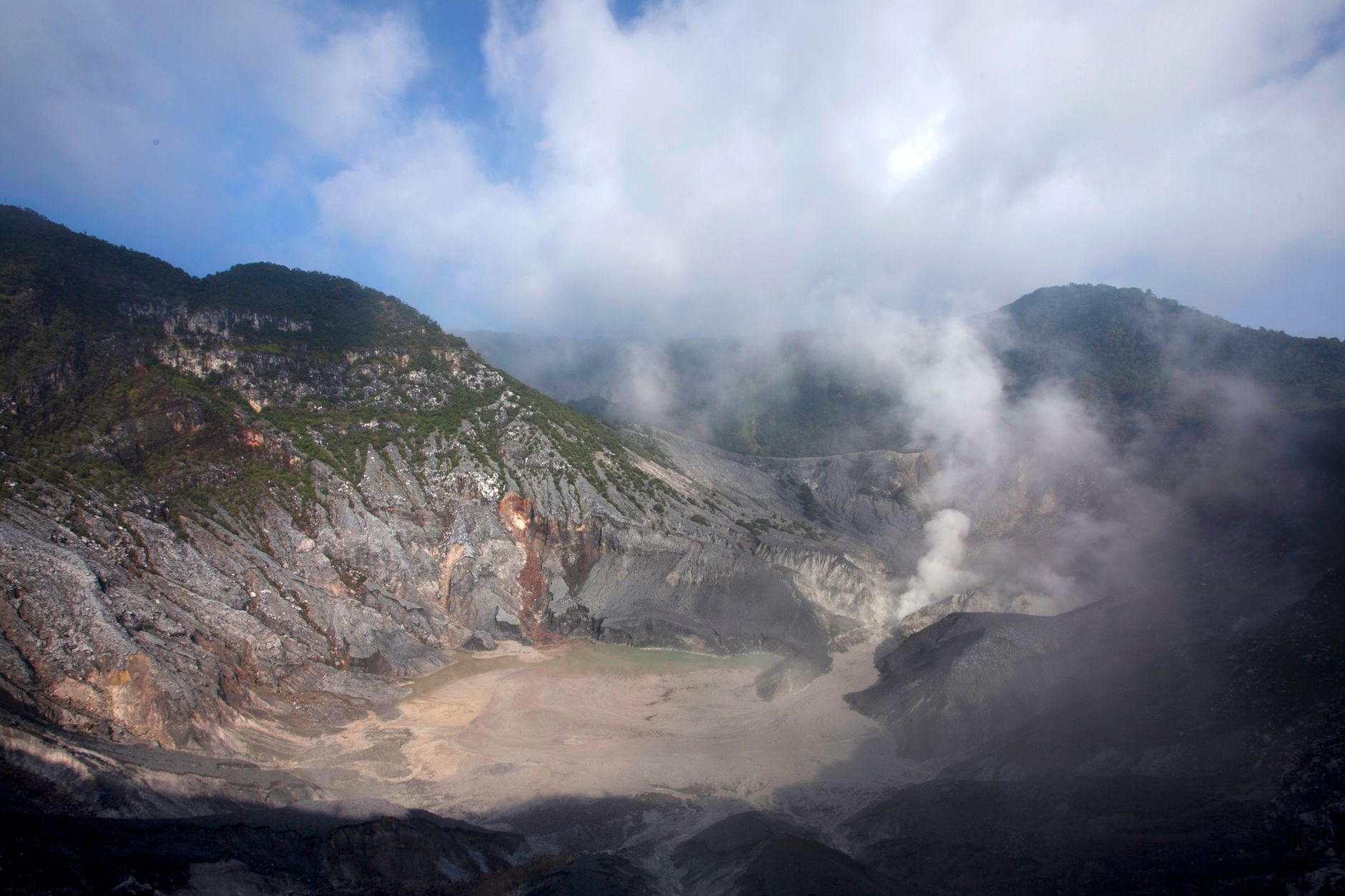
Tangkuban Perahu sits about 30 kilometres north of central Bandung, past Lembang, and it is the rare volcano you can drive to the rim of. That accessibility is both the appeal and the problem: by ten on a Saturday the rim is a shopping arcade with a crater behind it.
Gates open around seven and close around five. Foreign visitors have been charged in the region of IDR 200,000 on weekdays and IDR 300,000 at weekends, with Indonesian citizens paying a fraction of that — typically IDR 30,000 to 50,000 — plus a separate vehicle fee. Prices have moved more than once in recent years, and the weekday split is real: a Friday or Monday visit saves IDR 100,000 a head and about two thousand other people.
Kawah Ratu is the drive-up one
Kawah Ratu, the “Queen Crater”, is the main event: a vast pale bowl of sulphur-stained rock with steam venting from the floor, seen from a railed rim ninety seconds’ walk from the car. It is genuinely impressive at half past seven, when the light is low and the cloud has not come in. By eleven it is often flat white mist and you see nothing. That is a warning about weather, not crowds — cloud rolls up the mountain most days by late morning.
Kawah Domas is the walk-down one
Kawah Domas is smaller and more interesting: a 20 to 30 minute walk down from the rim into a field of bubbling mud pots and hot springs, where the traditional trick is boiling an egg in the ground. Coming back up is harder, and at 2,000 metres you notice it. A guide is required for the descent, quoted around IDR 300,000 for up to five people; agree the price, and whether it is per person or per group, before you set off.
My position: Kawah Domas is worth the money and Kawah Ratu is worth the photograph, so do both, in that order. Ratu first for the early light, then Domas while the mist closes in and there is nothing to see from the rim anyway.
The gas, and the fact that this is an active volcano
Tangkuban Perahu is monitored by PVMBG, Indonesia’s volcanology and geological hazard agency, and its alert level moves. It has sat at Level I (Normal) through 2026, but was raised to Level II (Waspada) after phreatic eruptions in 2019, closing the crater with a 1.5-kilometre exclusion zone. Access can be restricted at short notice, with no refund and no warning beyond a barrier across the road. Check the status before you drive up.
Even at Normal, the craters emit sulphur dioxide and hydrogen sulphide, and the official advice is not to descend into or linger in the crater basin. Take that seriously if you are pregnant, asthmatic or travelling with young children. The smell of rotten eggs is a cue to move upwind, not to take another photograph.
Kawah Putih: The Southern Alternative, and Why You Cannot Do Both
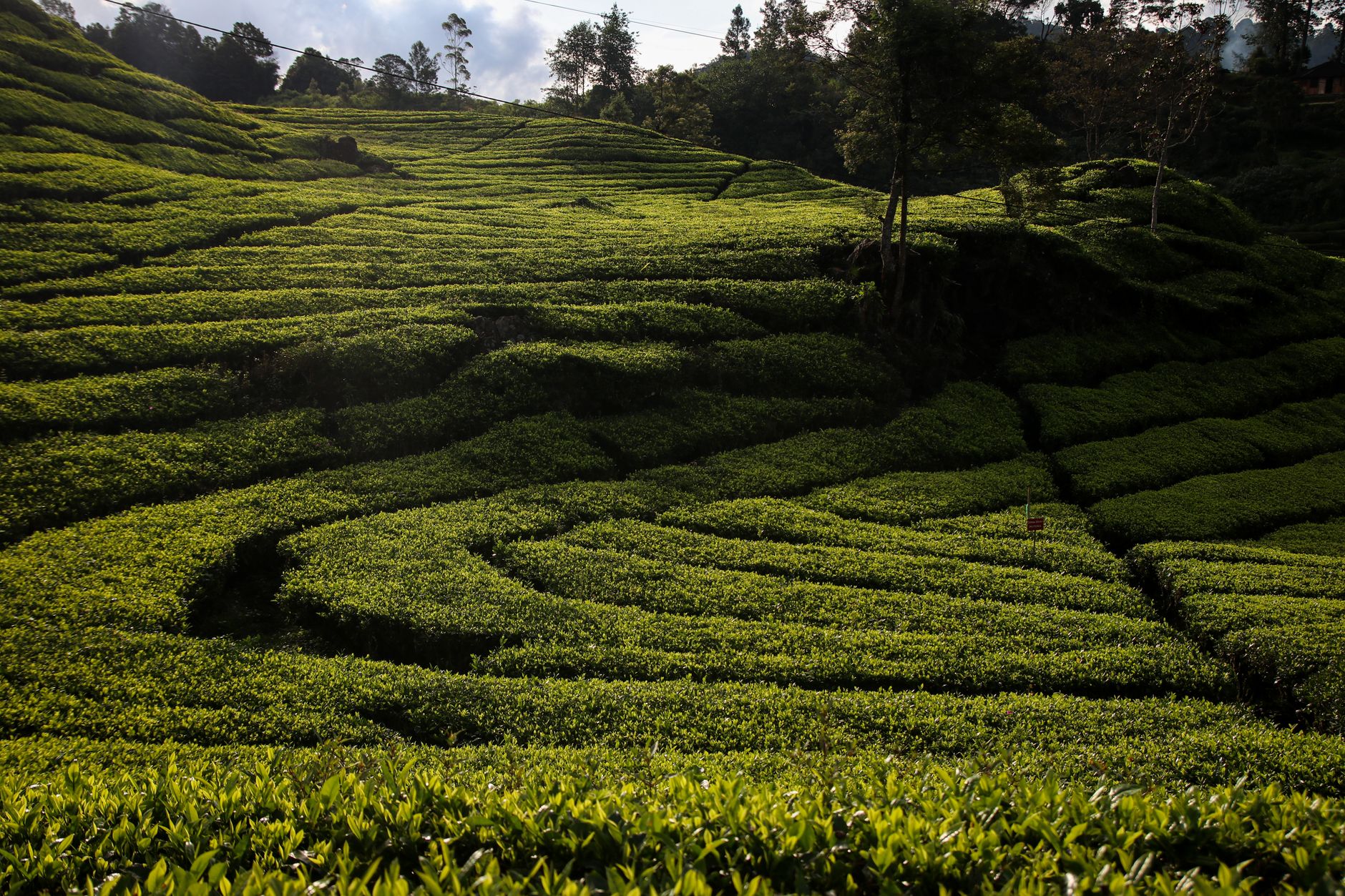
Kawah Putih, near Ciwidey, is the other crater: a milky turquoise-to-white lake in a bleached bowl of dead trees, about 50 kilometres south of the city at around 2,400 metres. It photographs better than Tangkuban Perahu and feels stranger — the colour shifts with sulphur content and light, and the place has a drained, eerie quality.
Entry has run around IDR 85,000 for foreign visitors and IDR 35,000 to 50,000 for Indonesians, open roughly seven to five. Lower parking is about IDR 11,000 and the Ontang Anting shuttle up to the crater around IDR 27,000 return; driving your own car all the way up is nearer IDR 150,000. The entry ticket is not the whole bill.
You cannot sensibly do both in one weekend, and the reason is geography rather than enthusiasm. Tangkuban Perahu is north, Kawah Putih is south, and the only road between them runs through Bandung. Add the two to three hours it takes to reach Ciwidey on a weekend morning and you have spent Saturday driving between two craters and seen neither properly.
Choose one. On a first weekend, or with anyone who dislikes long car journeys, take Tangkuban Perahu: closer, slots into the Lembang day, and nobody has to earn the view. If you have been before, or you want the more remarkable landscape and will give it the whole day, take Kawah Putih and write off Lembang entirely. Leave at five for that one, not six.
| Tangkuban Perahu | Kawah Putih | |
|---|---|---|
| Direction from Bandung | North, past Lembang (~30 km) | South, past Ciwidey (~50 km) |
| Weekend drive each way | 60–90 min from city centre | 2–3 hr from city centre |
| Foreign entry (indicative) | IDR 200,000 weekday / 300,000 weekend | ~IDR 85,000, plus shuttle and parking |
| Effort | Drive to the rim; optional 30-min descent to Kawah Domas | Shuttle up, then a short walk to the lake |
| Combines with | Lembang, Farmhouse, Floating Market, hot springs | Strawberry farms, Situ Patenggang, Rancabali tea |
| Best for | First-timers, families, half-day plans | Photographers, repeat visitors, full-day plans |
Lembang’s Built Attractions: An Honest Verdict
Lembang has spent fifteen years converting hillside into photo opportunities. Farmhouse Susu Lembang is the best known: a European-village pastiche with a hobbit house, alpine costumes for hire, and a ticket of roughly IDR 35,000 to 50,000 that you exchange for a bottle of milk or a sausage. Floating Market Lembang is a lakeside park with boats, a small train, food stalls paid for with a prepaid coin, and rides charged separately at IDR 25,000 to 50,000. It opens around nine on weekdays and eight at weekends, closing between six and seven.
The honest verdict: with children under about twelve, both are fine, and Floating Market is the better of the two — it scratches the same itch as the venues in our guide to things to do in Jakarta with kids. Two adults who came for mountain air and Sundanese food should skip both. Farmhouse is a queue for a photograph of a fake Alpine cottage, and “Floating Market” sets an expectation of Thailand that a landscaped pond with moored snack boats does not meet.
What Lembang does well is simpler: cool air, strawberries off the plant, grilled corn at a roadside warung, hot spring bathing at Sari Ater on the far side of the mountain, and the view over the basin at dusk. Pick one built attraction at most and give the rest of the afternoon to sitting outside without sweating, which is the actual reason Jakarta comes here.
Sunday Morning: Braga, Gedung Sate and the Art Deco
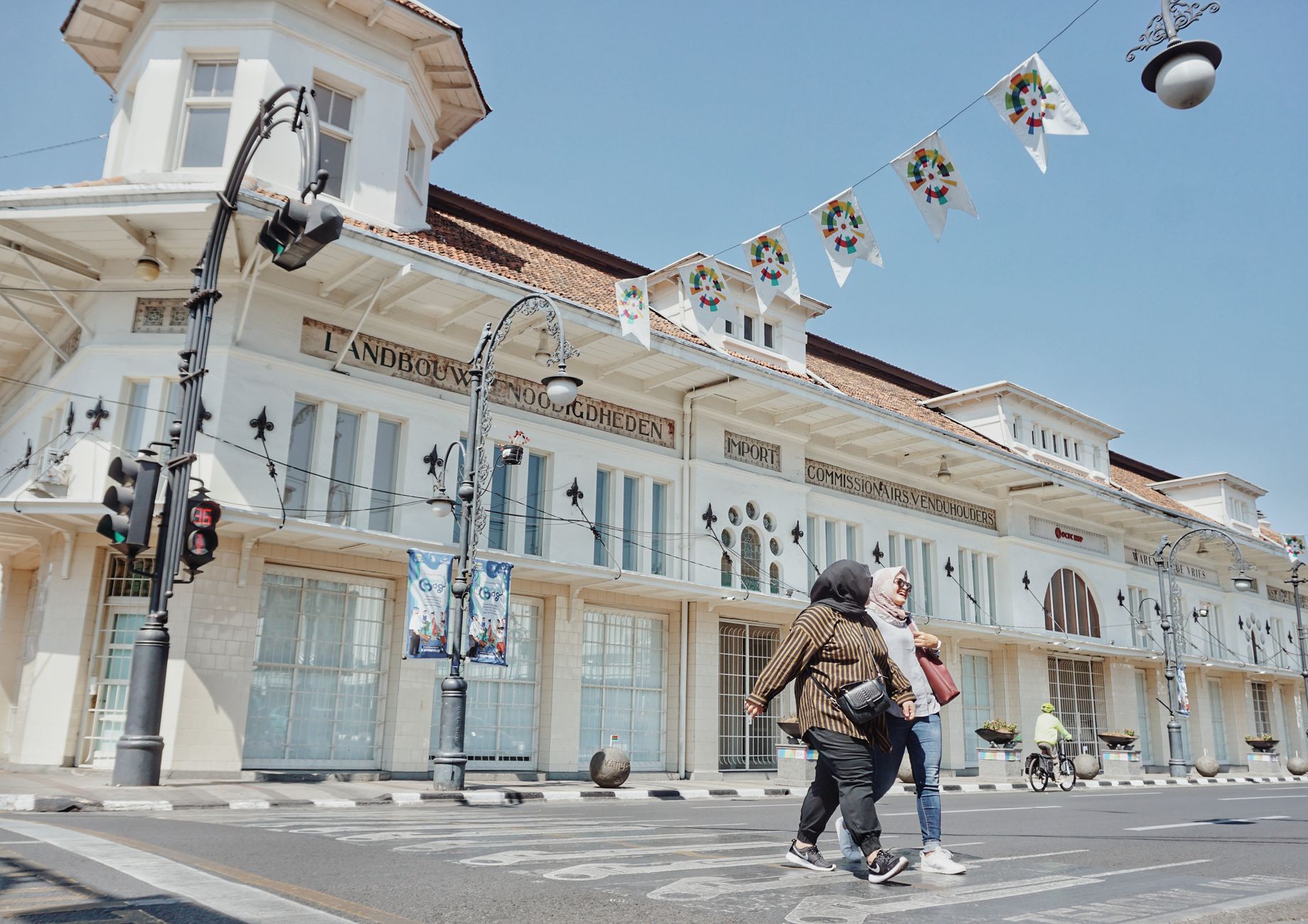
Bandung was the Dutch administration’s intended new capital, built out in the 1920s and 1930s, exactly when art deco peaked. The result is one of Asia’s largest concentrations of tropical art deco, and most visitors walk straight past it looking for a café.
Start on Jalan Braga. It is short — fifteen minutes end to end — and the ground floors have been colonised by bars and souvenir shops, but look up. The upper storeys are the original frontages: curved corners, horizontal banding, steel window frames. At the southern end, Jalan Asia Afrika holds Gedung Merdeka, venue of the 1955 Asian-African Conference, now a museum that is generally free or nearly so and closed on Mondays. The Savoy Homann and Grand Preanger are working hotels worth a look inside; nobody stops you walking through a lobby.
Gedung Sate, ten minutes north on Jalan Diponegoro, is the landmark: a 1920 government building whose central pinnacle of skewered ornaments earned it the nickname “satay building”. It is still the West Java governor’s office, so the interior is not generally open, but the Museum Gedung Sate at the same address runs roughly Tuesday to Sunday, 09:30 to 16:00, for about IDR 5,000, with reservation usually required. It is small and slightly gimmicky, and children enjoy it more than adults. The lawn in front, on a car-free Sunday morning, is where half of Bandung comes to walk.
The equivalent in the capital is covered in our guide to colonial Jakarta architecture and history, and the comparison is instructive: Jakarta’s colonial core is older and Dutch-mercantile, Bandung’s later and self-consciously modern.
Factory Outlets, Cihampelas and Whether the Bargains Are Real
Bandung’s shopping reputation rests on the factory outlets — shops selling supposed export surplus from West Java garment factories, concentrated on Jalan Riau, Jalan Dago and at Rumah Mode on Jalan Setiabudi. Jalan Cihampelas is the older, cheaper strip, now mostly denim and the elevated Teras Cihampelas walkway.
Here is the position, and it will not be popular: for a foreign visitor the outlets are not worth a morning. The genuine export-surplus era largely ended a decade ago. What hangs on the racks now is mostly ordinary local production at ordinary local prices, with a little real overrun stock that takes patience to find. Rumah Mode is the best of them, bigger and cheaper than the Riau and Dago shops, but that is a low bar and on a Saturday it is heaving.
Spend the time on food to take home and on craft instead. Bandung has good ceramics, rattan and wooden goods, and the textile shops around the centre carry West Javanese batik that differs from central Javanese work. For a serious purchase the capital has more depth: see where to buy batik in Jakarta and the broader picture in shopping in Jakarta.
What to Eat in Bandung
Sundanese food is the reason to come, and it is different enough from Javanese cooking that Jakarta regulars notice immediately: fresher, more raw vegetables, sharper sambal, less sweetness.
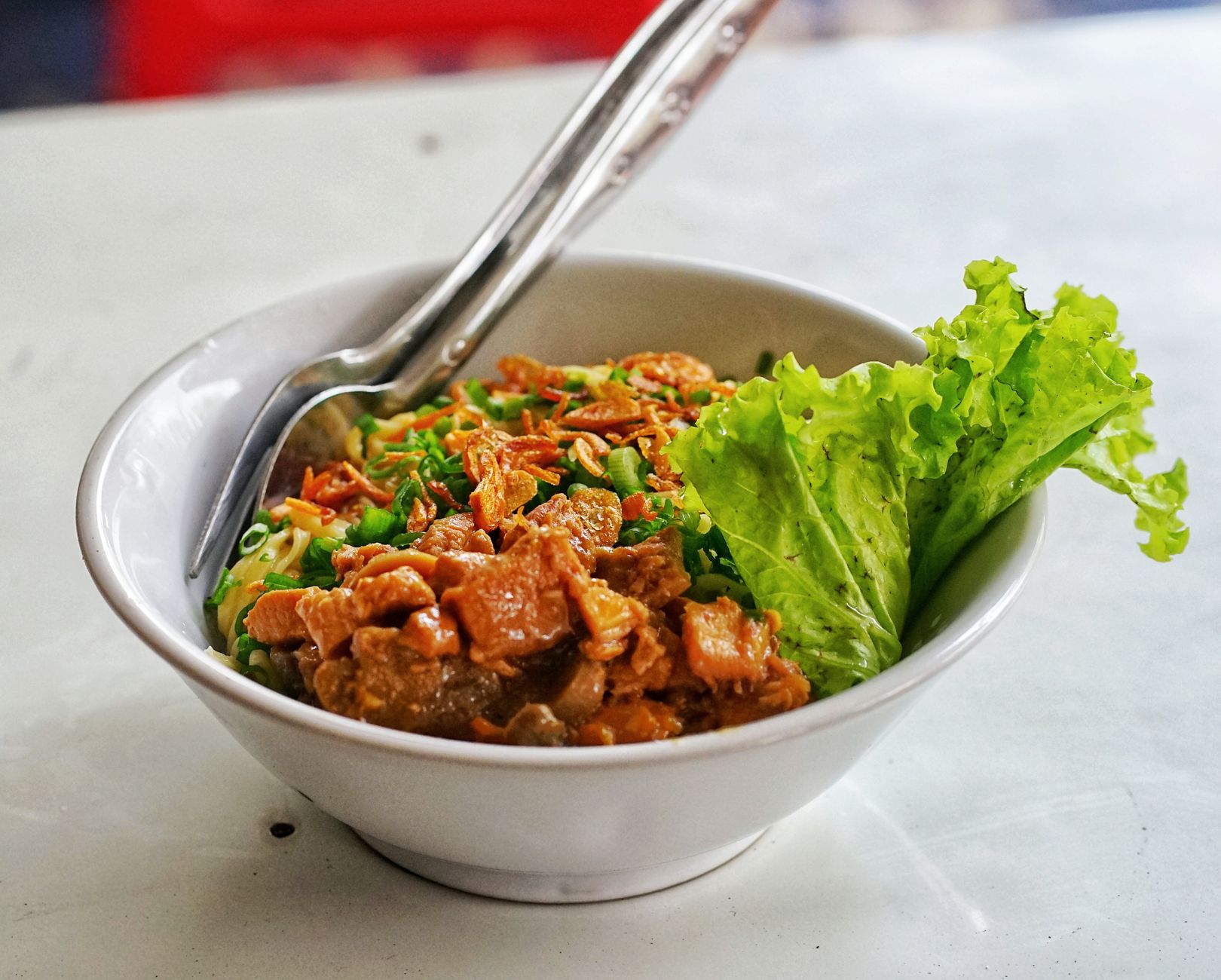
Mie kocok is the signature bowl — flat yellow noodles in rich beef bone broth with kikil (tendon), bean sprouts and lime. Mie Kocok Mang Dadeng has been going since the 1950s and charges around IDR 30,000 to 45,000. Eat it for breakfast, as locals do. Batagor, fried fish dumplings with peanut sauce, is a Bandung invention and siomay its steamed cousin; Batagor Riri on Jalan Burangrang is the reference version at IDR 20,000 to 35,000. Cart versions cost half that and are often just as good.
Nasi timbel is the full Sundanese set piece: rice steamed in banana leaf, fried chicken or grilled fish, tofu and tempeh, tumis kangkung, sayur asem, raw lalapan vegetables and a stone mortar of sambal you mix yourself. Warung Nasi Ibu Imas is the well-known name, with sets from IDR 25,000 to 60,000. Eat with your hands; the lalapan is not garnish. Surabi, a coconut-milk rice pancake cooked over charcoal in a clay pan, sweet with kinca palm sugar or savoury with oncom, is best from the Setiabudi stalls in the evening at IDR 10,000 to 25,000.
Coffee runs on two tracks. Warung Kopi Purnama on Jalan Alkateri has been pouring since the 1930s, serves kopi tubruk and srikaya on toast, and costs IDR 16,000 to 40,000. Then there is the third-wave scene on Dago and in the Riau backstreets, where West Javanese single-origin beans from Gunung Puntang and Malabar go for IDR 30,000 to 55,000. The old warung is the more interesting of the two.
Two practical notes. Sit-down restaurants and cafés typically add around 21 per cent service and tax, so the board price is not the bill; warungs and stalls do not. And alcohol is heavily taxed nationally while Bandung is more conservative about it — a beer that costs IDR 40,000 in a Kemang bar can be IDR 60,000 here, and many restaurants do not serve it. Our Jakarta food guide and the list of Jakarta dishes you must try make a useful comparison.
The Sunday Departure Problem
This is the section that justifies the article. The Cipularang is the only fast road between the two cities, it carries the entire weekend exodus in a compressed window, and it has an earned reputation for slow-moving queues around Purwakarta and Sukatani. Jasa Marga and the traffic police manage it with contraflow and, on long weekends, one-way schemes; these help but do not solve it.
The rule is simple. Be through the Pasteur toll gate and onto the Padaleunyi by noon. Not leaving the hotel at noon — through the gate. That means a final meal at half past ten and checking out at eleven. Do it and you are home by half past two with the weekend intact.
| Time you enter the toll at Pasteur | Typical Bandung–Jakarta drive | Verdict |
|---|---|---|
| Before 09:00 | 2.5–3 hr | Clear, but wastes half your Sunday |
| 09:00–12:00 | 2.5–3.5 hr | The sweet spot — aim here |
| 12:00–14:00 | 3–4 hr | Tolerable; expect one bad stretch |
| 14:00–18:00 | 4–6 hr | The trap. Avoid entirely |
| 18:00–20:00 | 3.5–5 hr | Still heavy, and now in the dark |
| After 20:00 | 2.5–3.5 hr | Fine if you can face a late arrival |
If noon is impossible, the correct move is not to leave at three. It is to stay: a long lunch, a café, a third coffee, and the road after eight. You get home around eleven, but you drive three hours instead of five and a half, and the extra time is spent in Bandung rather than in a stationary car.
The other correct move is to sidestep the road entirely, because Whoosh does not care about the Cipularang. Sunday evening departures do sell out, so book the return before you leave Jakarta and treat the ticket as fixed. This is the strongest argument for taking the train and hiring a car with driver in Bandung: you buy immunity from the worst part of the weekend. The same calculus applies at home, as our notes on getting around Jakarta and the KRL Commuter Line explain.
What a Bandung Weekend Actually Costs
A Bandung weekend getaway from Jakarta for two people, two nights, in Indonesian rupiah. The ranges reflect the gap between careful and comfortable.
| Item | Budget pair | Mid-range pair | Comfortable pair |
|---|---|---|---|
| Return transport, two people | 200,000 (shuttle) | 800,000–1,000,000 (Whoosh premium economy) | 1,800,000–2,400,000 (Whoosh business/first) |
| Two nights’ accommodation | 600,000–900,000 | 1,400,000–2,400,000 | 3,000,000–6,000,000 |
| Local transport (Grab / car with driver) | 250,000 | 700,000–900,000 | 1,400,000–1,800,000 |
| Attraction entry (crater, guide, one extra) | 150,000 (locals’ rate) | 700,000–850,000 (foreigner weekend rate) | 900,000–1,100,000 |
| Food and coffee, two nights | 400,000 | 900,000–1,300,000 | 2,000,000+ |
| Weekend total | ~1,600,000 | ~4,500,000–6,400,000 | ~9,000,000–12,000,000 |
The largest variable for foreign visitors is the Tangkuban Perahu ticket, which at weekend rates can cost a couple more than their hotel room — a reason to consider Friday or Monday, not a reason to skip it. Broader money thinking sits in our guides to budget travel in Jakarta and luxury travel in Jakarta. Getting around Bandung is cheap: Grab and Gojek both operate well, with short car trips at IDR 20,000 to 50,000 and motorbike rides at a third of that — the same comparison we make in Grab versus Gojek in Jakarta.
Weather, Altitude and the Wet Season
Bandung sits at about 768 metres in a bowl ringed by volcanoes, and it is markedly cooler than Jakarta: typically 18 to 20°C at night against Jakarta’s 25 to 27. Lembang drops to around 15°C after dark, and the Tangkuban Perahu rim at roughly 2,000 metres feels colder still in wind and cloud. Bring a layer. A light fleece is enough, and it is the item most often forgotten by visitors who have spent a week sweating in the capital.
The wet season runs roughly November to March, with annual rainfall well over three metres and November and March among the wettest months. The pattern is usually clear mornings and heavy afternoon downpours — another argument for the pre-dawn start. Mountain roads get slick, minor landslips are not unusual on the Ciwidey and Subang sides, and crater views are frequently white by ten. Ramadan matters too: many warungs curtain their windows during daylight and open in force at sunset, and Lembang traffic on the weekend after Idul Fitri is the worst of the year. Our general Jakarta travel tips cover the seasonal calendar.
FAQ: Bandung Weekend Getaway from Jakarta
Is two nights in Bandung enough? Two nights is the right length. One is not — you spend it travelling and get a single compromised day. Three is more than the city needs unless you are adding the southern craters or the Rancabali tea estates. Friday evening to Sunday lunchtime gives one full mountain day and one city morning.
What time should I leave Bandung on Sunday to avoid traffic? Be through the Pasteur toll gate before noon. Between two and six the Cipularang routinely takes four to six hours instead of two and a half, with the worst queues around Purwakarta. If you cannot make noon, do not leave at three — stay, eat properly, and drive after eight.
Tangkuban Perahu or Kawah Putih? Tangkuban Perahu for a first weekend: closer, fits into a Lembang day, and you can drive to the crater rim. Kawah Putih is the more striking landscape but sits 50 kilometres south on roads that crawl at weekends, so it needs a day of its own. They are on opposite sides of the city and cannot sensibly be combined.
Should I stay in Lembang or in Bandung city? Bandung city, unless the whole plan is mountains. Lembang mornings are lovely, but you pay with an hour or more each way on Jalan Setiabudi, jammed from about nine on a Saturday. Dago is the best compromise: cooler than the flats, good food, twenty-five minutes from Braga off-peak.
Are Bandung’s factory outlets worth visiting? Not really, for a foreign visitor. The genuine export-surplus era ended years ago and most of what hangs on the racks is ordinary local production at ordinary local prices. Rumah Mode is the best organised and cheaper than the Riau and Dago shops, but give it forty-five minutes at most.
Is Tangkuban Perahu safe to visit? Generally yes, but it is an active volcano monitored by PVMBG and access can close at short notice — it was shut with a 1.5-kilometre exclusion zone after phreatic eruptions in 2019. Check the alert level before driving up. Even at Normal status the craters emit sulphurous gases, and the advice is not to linger in the basin.
Do I need a car in Bandung? Not necessarily. Grab and Gojek work well in the city and short journeys run IDR 20,000 to 50,000. For the mountain day you want a vehicle all day rather than app rides. A car with driver costs around IDR 600,000 to 900,000 for ten to twelve hours, which beats hunting for a ride down from the crater.
When is the worst time to plan this trip? Long weekends and the week after Idul Fitri, when Lembang and the Cipularang both seize up. After that, the peak of the wet season in January and February, when crater views are often obscured by ten in the morning and mountain roads are slippery. Aim for the drier middle of the year.
Where to Go Next
If Bandung has convinced you that West Java deserves more time, work through the best attractions in Jakarta for the weekends you stay put, then plan the longer version with our three-day Jakarta itinerary or the fuller one-week Jakarta itinerary. Both leave room for a second overnight escape.
Eaters should compare what they found in Bandung with the best street food in Jakarta; the Sundanese and Betawi traditions diverge more than a two-hour distance suggests. For quieter corners of the capital, see our guide to Jakarta’s overlooked corners and the Jakarta neighbourhoods guide. And when you get home and need a bed, where to stay in Jakarta covers the areas worth the money.