Jakarta is a city that punishes walkers almost everywhere except one strip, and that strip runs from Bundaran HI down to Bundaran Senayan. Any honest SCBD Sudirman guide Jakarta visitors can actually use has to start with that fact, because it explains everything else: why the international hotels cluster here, why the MRT was built under this road first, why Sunday mornings turn into the biggest free public event in Indonesia, and why so many travellers end up spending three days in Jakarta without ever leaving a two-kilometre corridor. The sidewalks here are eight to nine metres wide. Elsewhere in the city they are a metre of broken concrete over an open drain.
This guide covers the daytime version of the district. If you want clubs, cocktail bars and the Senopati crawl, that lives in our SCBD nightlife guide and this article will not repeat it. For the wider picture of how Jakarta’s districts fit together, start with the Jakarta neighbourhoods guide, then read across to the South Jakarta guide and the Central Jakarta guide, because the Sudirman corridor is the seam where those two halves of the city meet. The Senayan area guide picks up at the southern end where the boulevard hits the stadium complex.
What SCBD Actually Is, and Why the Lot Numbers Confuse Everyone
SCBD stands for Sudirman Central Business District. It is not a general term for the office belt. It is a specific, privately masterplanned estate of roughly 45 hectares sitting on the western side of Jalan Jenderal Sudirman, developed by PT Danayasa Arthatama, part of the Artha Graha group, on a plan drawn up between 1987 and 1992. Before that it was low-rise kampung and warehousing. The first tower to open was the 30-storey Artha Graha Building in 1995, and the estate has been filling in ever since.
The confusing part is the addressing. SCBD is carved into around 25 numbered lots, and almost every building inside the estate is signposted by lot number rather than by street name. Pacific Century Place is Lot 10. The Energy tower is Lot 11A. Ask a Grab driver for “District 8” and you may get a blank look; say “SCBD Lot 28” and you will get a nod. The ceremonial address for much of the estate is still Jalan Jenderal Sudirman Kav 52-53, which is why five different destinations can share what looks like one address on a booking confirmation. When you order a car, put the lot number and the building name in the notes field, and pin the drop-off inside the estate rather than on Sudirman itself, because the boulevard has limited stopping and your driver will otherwise leave you a ten-minute walk from where you meant to be.
Locals also use “SCBD” loosely to mean the whole entertainment-and-office zone that spills east into Senopati, Gunawarman and Suryo. That is a South Jakarta neighbourhood conversation rather than a business district one, and it behaves completely differently after dark. Geographically, the estate sits in Kebayoran Baru, South Jakarta, even though the northern half of the corridor is administratively Central Jakarta.
The Sudirman-Thamrin Axis: Jakarta’s Only Real Walking Street
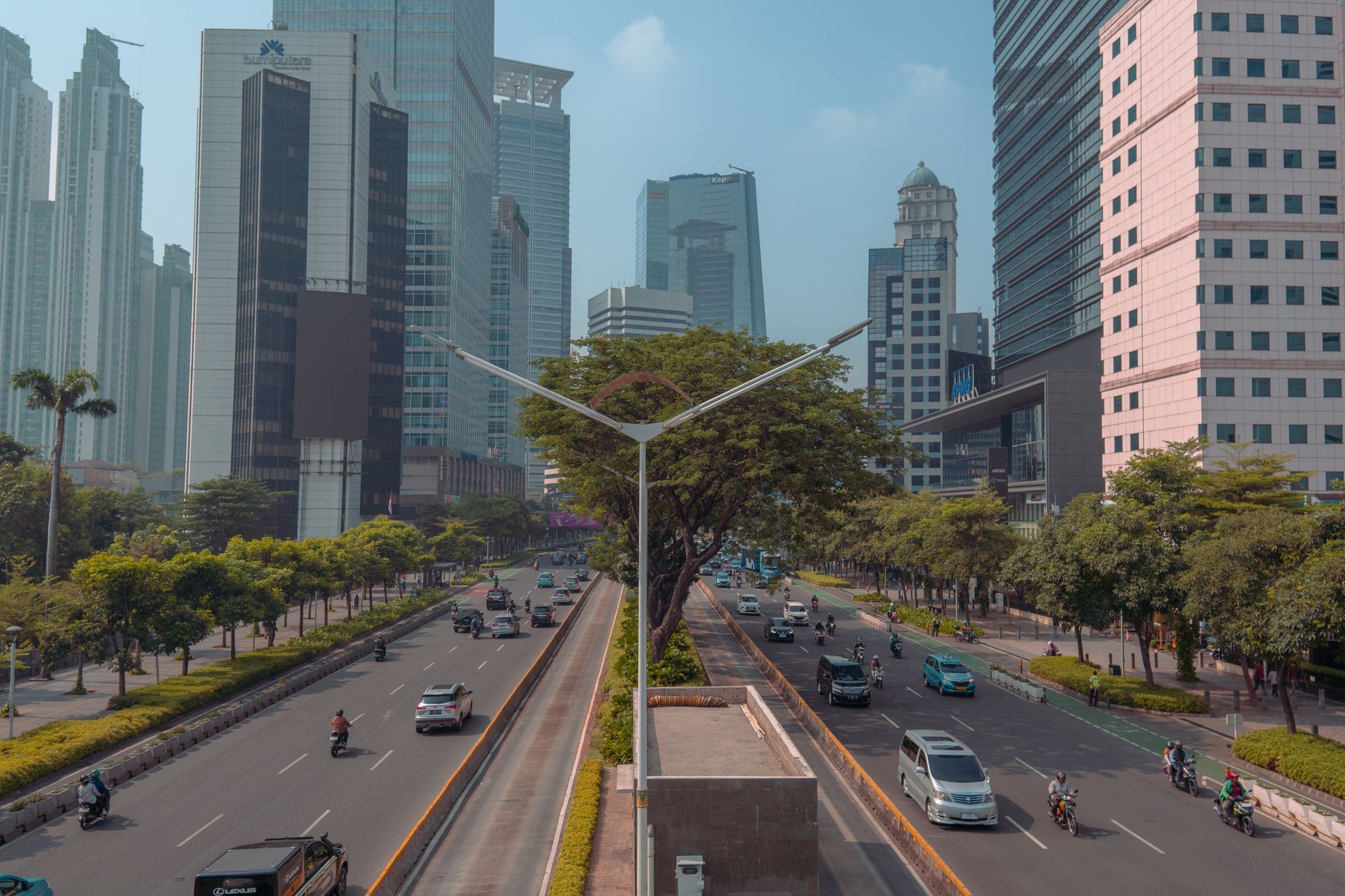
Jalan MH Thamrin runs north from the Hotel Indonesia roundabout towards Monas; Jalan Jenderal Sudirman runs south from the same roundabout to Bundaran Senayan. Together they form a straight ceremonial spine about six kilometres long, and between roughly 2018 and 2021 the city rebuilt the whole thing. Sidewalks were widened to 12 to 15 metres of total right of way, with eight to nine metres of that given over to pedestrians and a two-metre painted bike lane running alongside. There is real street furniture: benches, planters, kiosks, public toilets, and a run of paving inlays commemorating Indonesian athletes, a leftover flourish from the 2018 Asian Games.
It works. You can walk from Bundaran HI to Bendungan Hilir in about twenty-five minutes without once being forced into traffic, which is genuinely rare in this city. The bike lane is used, mostly by commuters and food-delivery riders, and it was made permanent with kerbs and planters rather than left as paint.
Now the caveat, and it is a big one. The boulevard is almost entirely unshaded. The young trees planted during the rebuild have not filled out, the paving is pale and reflective, and between 11:00 and 15:00 the walk becomes genuinely unpleasant, in the 33 to 35 degree range with high humidity. Sensible people do the outdoor part before 09:00 or after 17:00 and use the malls, the underground MRT concourses and the office-tower lobbies as air-conditioned stepping stones in between. In the November to March wet season, add a mid-afternoon downpour to the calculation; the drainage on Sudirman is far better than most of Jakarta, but you will still want an umbrella. Our broader Jakarta travel tips cover the heat and rain strategy in more detail.
Car Free Day: The Single Best Free Thing to Do in Jakarta
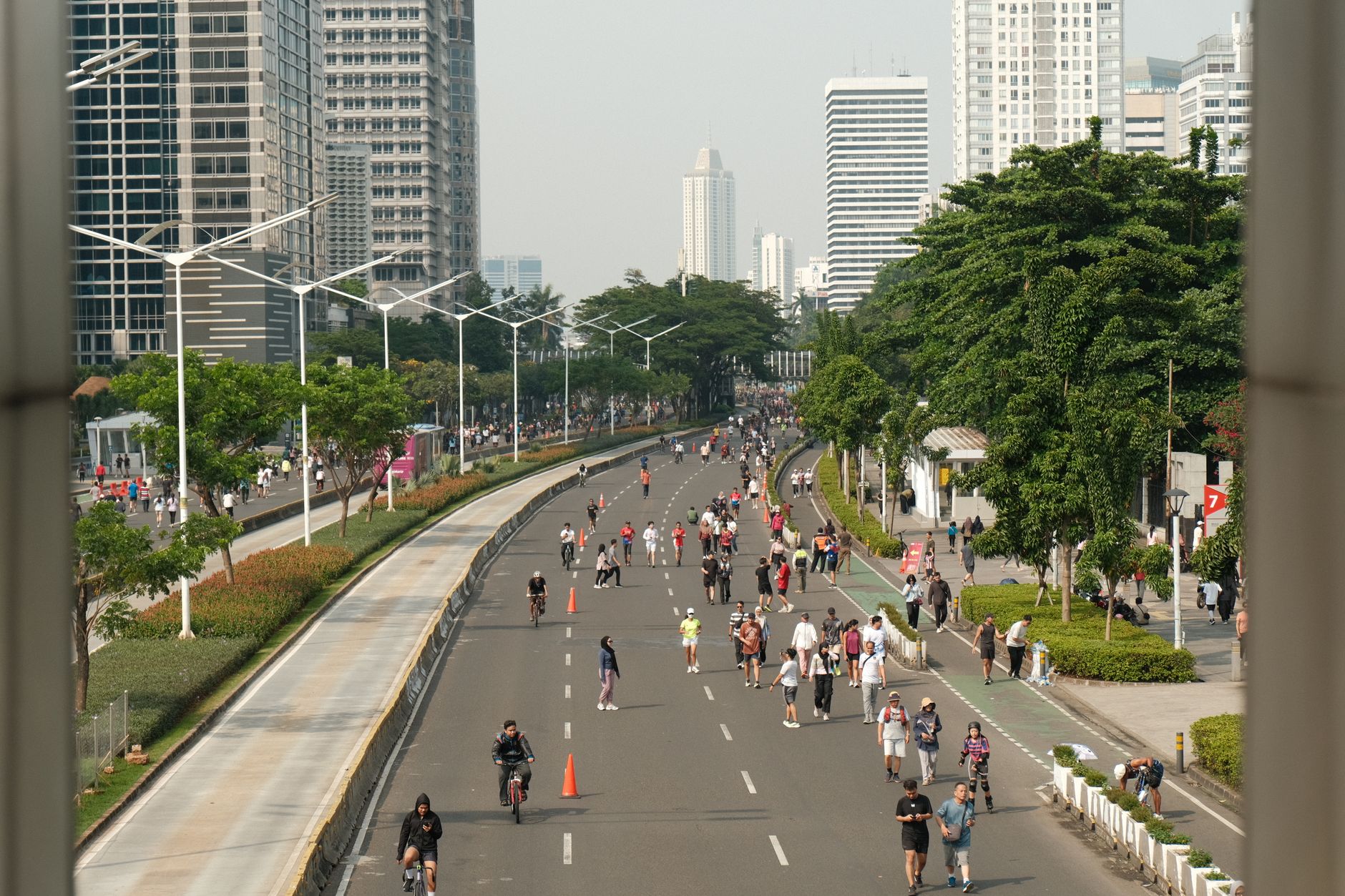
Every Sunday morning the city closes both directions of Thamrin and Sudirman, from Bundaran HI all the way south to Bundaran Senayan, and hands the road to people. Hari Bebas Kendaraan Bermotor, universally shortened to CFD, runs from 05:30 to 10:00. The start time was pulled forward from 06:00 in June 2026, which most visitors’ guides have not caught up with. Barriers go up before dawn and come down promptly; by 10:15 the traffic is back.
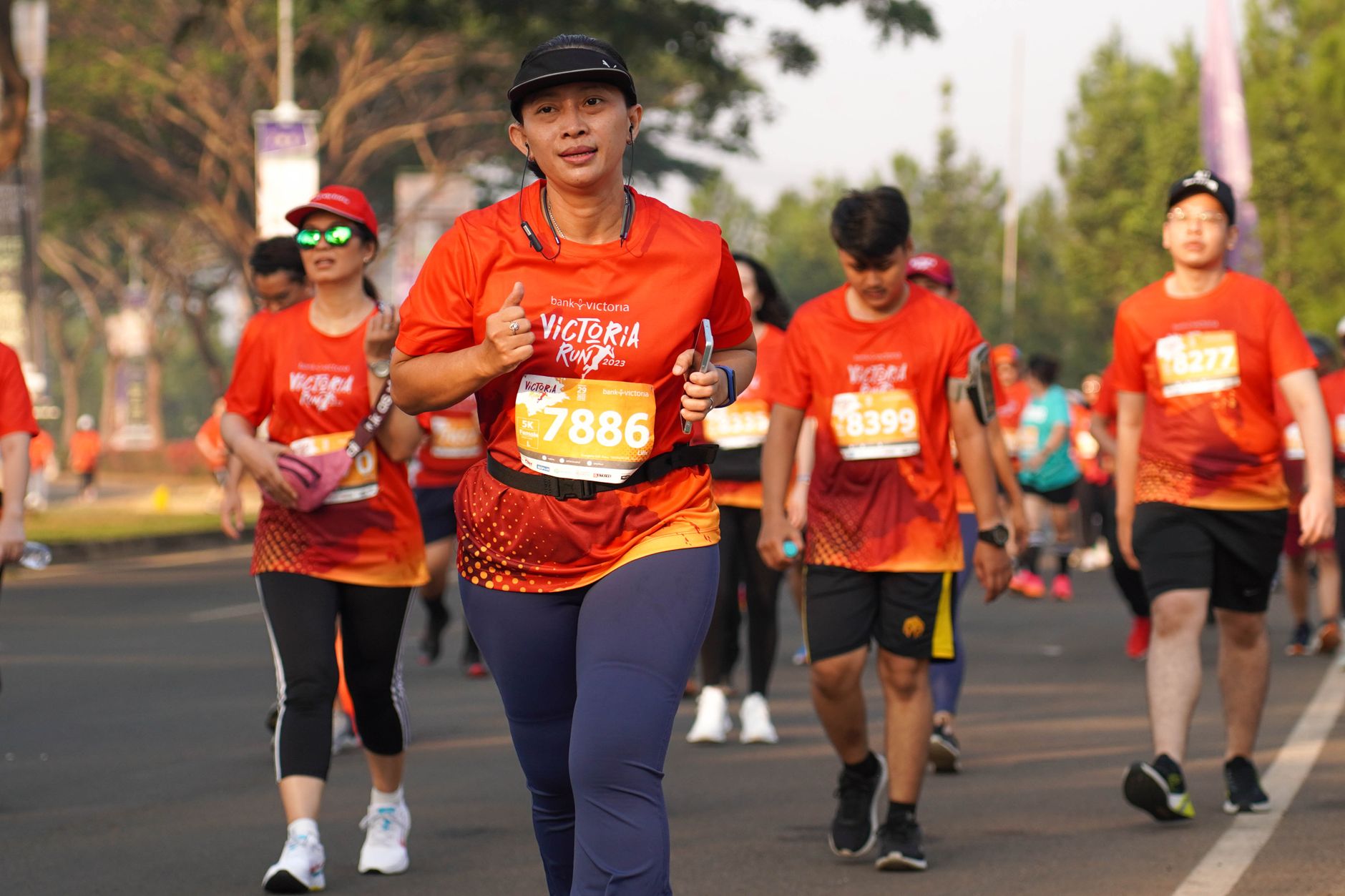
What happens in between is the most likeable thing Jakarta does. Tens of thousands of people take over eight lanes of asphalt. Running clubs do intervals up the centre line. Aerobics and zumba sessions blast competing sound systems from the intersections. There are badminton games, skateboarders, roller skaters, kids on scooters, a full-length street market of food carts and clothing stalls along the edges, free health checks from clinics and banks, brass bands, buskers, dance crews, and an unreasonable number of people photographing each other. It costs nothing. Nobody will hassle you. It is the one time of the week the city feels collectively good-humoured.
Timing it properly
Go early. This is not advice, it is the whole trick. Between 05:30 and 07:30 the road is busy but you can move, the light is beautiful, the air is briefly clean, and the food carts are setting up with everything fresh. From about 08:00 the crowd density roughly triples, the market stalls squeeze the walkable space to a slow shuffle, and by 09:00 the section between Bundaran HI and Dukuh Atas is close to gridlocked with pedestrians. If your only impression of CFD is 09:15 near the roundabout, you will wonder what people see in it.
Practical notes. The MRT opens around 05:00 and runs the length of the closure, so you can ride in, walk a couple of kilometres and ride back from a different station for well under Rp 15,000 all in. CFD is suspended on national holidays and long weekends, and it does not run during some large state events, so check the Dishub DKI Jakarta social feeds on Saturday night if the Sunday falls on a red date. Toilets are available in the MRT stations and the hotel lobbies along the route. Bring cash in small notes; many carts still prefer it, though QRIS payment is now near-universal. See our roundup of free things to do in Jakarta for what else costs nothing here.
What to eat on the road
The CFD food line-up is street food at street prices, which after a week of mall dining is a relief. Bubur ayam, ketoprak, kerak telor if you are lucky, siomay, es kelapa muda, fresh sugarcane juice, and a lot of coffee from cart baristas. Budget Rp 15,000 to Rp 35,000 per item. Standards vary; pick a cart with a queue of locals and a visible turnover of ingredients. If you want a proper survey of the genre, our Jakarta street food guide goes deeper than a Sunday morning allows.
The MRT Spine and the Dukuh Atas Interchange
The North-South MRT line was built directly under this corridor, which is the main reason the district is navigable without a car. Trains run roughly 05:00 to 24:00 at five to ten minute headways, fares run Rp 3,000 to Rp 14,000 by distance, and the stations are clean, air-conditioned and signed in English. Buy a Jak Lingko or bank e-money card rather than fighting the single-journey machines; our Jak Lingko card guide explains which card does what, and the Jakarta MRT guide covers the whole line.
| Station | Get off here for | Walking notes |
|---|---|---|
| Bundaran HI | Grand Indonesia, Plaza Indonesia, Hotel Indonesia roundabout, Sarinah, northern end of Car Free Day | Direct underground links into both malls; the busiest station on the line |
| Dukuh Atas BNI | KRL, LRT, airport train, TransJakarta, the canal-side plaza | The interchange. Allow 10-15 minutes between modes, some of it outdoors |
| Setiabudi Astra | Kuningan fringe, mid-corridor offices | Quietest of the six; useful if you are staying in Setiabudi |
| Bendungan Hilir | Pasar Benhil, the corridor’s best cheap eating | Five minutes west into a genuine neighbourhood of warungs |
| Istora Mandiri | SCBD proper, Pacific Place, ASHTA District 8, Istora Senayan arena | Closest station to the estate, still a 7-12 minute walk to most lots |
| Senayan | Bundaran Senayan, Senayan City, Plaza Senayan, GBK complex | Southern end of Car Free Day |
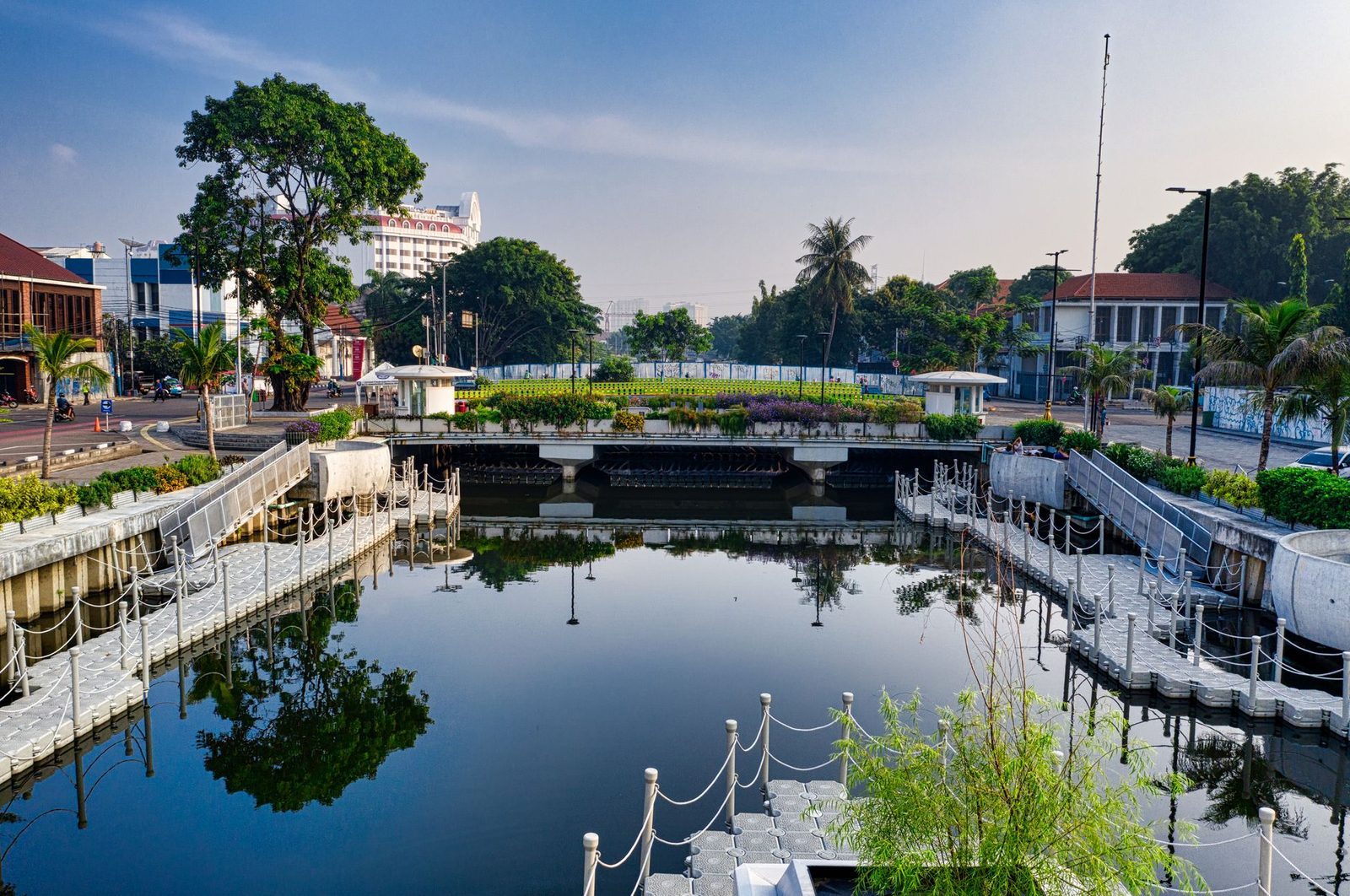
Dukuh Atas deserves its own paragraph because it is the most ambitious piece of urban transport engineering in the country. Within a few hundred metres you have Sudirman KRL commuter station, Dukuh Atas BNI on the MRT, Dukuh Atas on the Jabodebek LRT, BNI City station for the Soekarno-Hatta airport train, and multiple TransJakarta corridors, all being knitted together by a 17,000 square metre, twelve-storey transport hub with retail on the lower floors, offices in the middle and hotel space above. Full integration is targeted for 2027, and until then some connections still involve walking outside across a plaza and over the Banjir Kanal Barat on the circular “donut” pedestrian bridge. It is a good five to fifteen minutes between modes depending on which pair you are connecting, so do not plan a two-minute transfer with luggage. For the commuter-rail side of the equation see the KRL commuter line guide, and for the buses the TransJakarta guide. If you are heading for the airport train, the airport transfer guide compares it honestly against a car.
Citayam Fashion Week and What Became of It
In mid-2022 the plaza and zebra crossings around Dukuh Atas became the stage for one of the strangest and most revealing things to happen in Jakarta in years. Teenagers from Citayam, Bojonggede and Depok, satellite towns an hour out on the KRL, started riding in on cheap commuter tickets, dressing up in thrifted and self-styled outfits, and using the crossing as a catwalk. Someone called it Citayam Fashion Week and it exploded: content creators, television crews, then the mayor of Jakarta, then the EU ambassador walking the crossing in a suit.
What made it interesting was the class geography. These were kids from the periphery claiming the most expensive public space in Indonesia, using infrastructure their parents’ generation did not have. The nickname for the district was quietly rewritten as Sudirman, Citayam, Bojonggede, Depok. It also made a lot of people uncomfortable, and the backlash was instructive: complaints about litter and crowding, an attempt by companies to trademark the name in July 2022, and eventually the barriers and the tidying-up.
It faded within months. The crowds thinned through late 2022, and by 2024 most of the remaining scene had drifted to Kota Tua, itself a better stage in some ways. What survives at Dukuh Atas is a modest weekend hangout: teenagers photographing each other on the plaza steps in the late afternoon, occasional impromptu shows. If you turn up on a Tuesday lunchtime expecting a spectacle you will see office workers eating gado-gado. Go around 16:00 to 19:00 on a Saturday if you want the residual version, and read it as a story about who Jakarta’s public space is for rather than as an attraction.
Office-Worker Lunch Culture: Eating at Every Price Level
Between 12:00 and 13:30 the corridor performs a daily migration. Roughly a quarter of a million people leave towers within a few blocks of each other, and the entire food economy of the district is built around feeding them fast. This is the best time to eat here, because the lunch sets are cheaper than the same kitchen’s dinner menu and everything is at peak turnover.
At the bottom end, walk five minutes west of Bendungan Hilir MRT into Pasar Benhil and the lanes around it. This is where the office towers’ security guards, drivers and junior staff actually eat: nasi padang piled out of glass cases, soto, pecel lele, ayam bakar, all in the Rp 25,000 to Rp 45,000 range, cash or QRIS, no service charge. During Ramadan, Benhil becomes the most famous takjil market in Jakarta and the afternoon crowd is enormous. The equivalent in the SCBD estate itself is the cluster of warungs and food trucks that set up on the fringes of the lots at lunchtime; they migrate, so follow the queues.
The middle tier is mall food courts and casual chains. Pacific Place, ASHTA, Grand Indonesia and Plaza Indonesia all run food courts on their lower or upper levels where a decent plate runs Rp 50,000 to Rp 90,000. This is the reliable, air-conditioned, no-surprises option and there is no shame in it at midday. Above that sit the sit-down restaurants in the malls and around Senopati, where mains land between Rp 120,000 and Rp 250,000 and the printed price is not the price. Restaurants and bars in this district almost universally add around 21 per cent for service and government tax, so mentally add a fifth to every menu number. At the top, SCBD has a genuine fine-dining scene with tasting menus from Rp 800,000 upward per head before drinks, which our best restaurants in Jakarta roundup covers properly.
| Level | Where | Typical spend per person | Service charge |
|---|---|---|---|
| Warung and market | Pasar Benhil, lot-edge food carts, CFD stalls | Rp 25,000-45,000 | None |
| Mall food court | Pacific Place LG, Grand Indonesia, ASHTA | Rp 50,000-90,000 | Usually included in shelf price |
| Casual restaurant | Mall levels, Senopati fringe, hotel cafes | Rp 120,000-250,000 | ~21% added |
| Fine dining | SCBD lots, five-star hotel restaurants | Rp 500,000-1,500,000+ | ~21% added |
If your budget is the deciding factor rather than the convenience, our cheap eats in Jakarta guide will get you fed for a third of the mall price, and the Jakarta food guide explains what the dishes actually are.
ASHTA, Pacific Place, Plaza Indonesia and Grand Indonesia Compared
Four malls anchor the corridor and they are genuinely different animals, which is not something you can say about most Jakarta shopping centres.
Pacific Place opened in November 2007 at the northern edge of SCBD and remains the district’s establishment mall: six levels, around 250 stores, roughly 107,000 square metres of retail, anchored by Galeries Lafayette, Kem Chicks, CGV cinemas, Best Denki and KidZania. The tenant mix skews heavily to luxury fashion and it is attached to the Ritz-Carlton. It is calm, expensive and slightly austere. It is also the most useful mall in the district for a business traveller because of the tailoring, the bank branches and the sheer density of meeting-friendly cafes.
ASHTA District 8 opened in November 2020 inside the District 8 complex on Lot 28, and it is the opposite proposition: only about 15,000 square metres, but designed as an open, sunlit, plant-heavy space rather than a windowless box. Anchors are Flix Cinema, The Gourmet by Ranch Market and CS Fresh. It is where the SCBD office crowd goes to be seen at lunch and after work, and it photographs well, which is most of the point. Small enough to walk in twenty minutes.
Plaza Indonesia and Grand Indonesia face each other across the Bundaran HI roundabout at the northern end. Plaza Indonesia is the older, tighter, more serious luxury mall; Grand Indonesia is vast, split into East and West Malls joined by a skybridge, and stocked for the mass market as much as the luxury one. Grand Indonesia is where you go to get things done and where the choice of food is best; Plaza Indonesia is where you go to buy a handbag. Our Grand Indonesia mall guide maps the layout, the luxury shopping guide covers the top end, and the best malls in Jakarta ranks them against the rest of the city.
| Mall | Opened | Character | Nearest MRT | Best for |
|---|---|---|---|---|
| Pacific Place | 2007 | Quiet, luxury, corporate | Istora Mandiri | Meetings, tailoring, cinema, KidZania with kids |
| ASHTA District 8 | 2020 | Small, open-air feel, design-led | Istora Mandiri | Lunch, coffee, people-watching, photos |
| Plaza Indonesia | 1990 | Compact, old-money luxury | Bundaran HI | Serious brand shopping |
| Grand Indonesia | 2007 | Huge, mixed-market, two buildings | Bundaran HI | Everything else, especially eating |
One more worth walking to: Sarinah on Thamrin, Indonesia’s first department store, reopened in 2022 after a full renovation and now leaning hard into Indonesian craft, batik and design rather than imported brands. It is the only shop on the corridor where the merchandise is meaningfully local. Pair it with our guide to buying batik in Jakarta before you spend anything.
Working From the Corridor: Coworking, Meetings and Practicalities
If you are here for work rather than sightseeing, this corridor is the easiest part of Indonesia to be productive in. Fibre is fast, power is stable, and almost every tower lobby has a passable cafe.
Day passes at coworking spaces run roughly Rp 145,000 to Rp 250,000 including coffee and meeting-room credits, with GoWork inside Pacific Place the most convenient for the estate and several operators occupying floors in Equity Tower and the Kuningan towers a short ride east. One correction worth making: CoHive, which still appears on a lot of “best coworking in Jakarta” listicles with a Rp 75,000 day rate, collapsed into insolvency in 2023. Do not plan around it. Book directly with the operator the day before, because walk-in availability at the Sudirman locations is genuinely tight on weekday mornings.
For informal meetings, hotel lobby lounges are the local default and nobody will move you along if you buy a coffee. Expect Rp 60,000 to Rp 110,000 for a flat white in a five-star lobby, which is the rent you are paying for two hours of quiet and reliable wifi. Serviced meeting rooms can be booked by the hour in most of the coworking operators from around Rp 200,000.
Practicalities. Buy a local SIM at an official Telkomsel, XL or Indosat outlet in one of the malls rather than at the airport counter; the same package is typically 30 to 50 per cent cheaper and registration with your passport takes ten minutes. Most business hotels along the corridor have 24-hour gyms and will sell day passes to non-guests for around Rp 150,000 to Rp 400,000. ATMs are everywhere; use ones inside bank branches or mall interiors. Our Jakarta business travel guide goes into visas, meeting etiquette and expense norms, and the business hotels guide covers where to actually sleep.
On movement: within the corridor, walk or take the MRT. Beyond it, the calculus changes fast. A Grab car from SCBD to Kemang can take twelve minutes at 07:00 and fifty-five at 18:00 for the same eight kilometres. Motorbike taxis halve that and are the local answer; see Grab versus Gojek for the app comparison and how to avoid Jakarta traffic for the timing strategy. Costs are itemised in our Jakarta transport costs breakdown.
Rooftop Views by Day
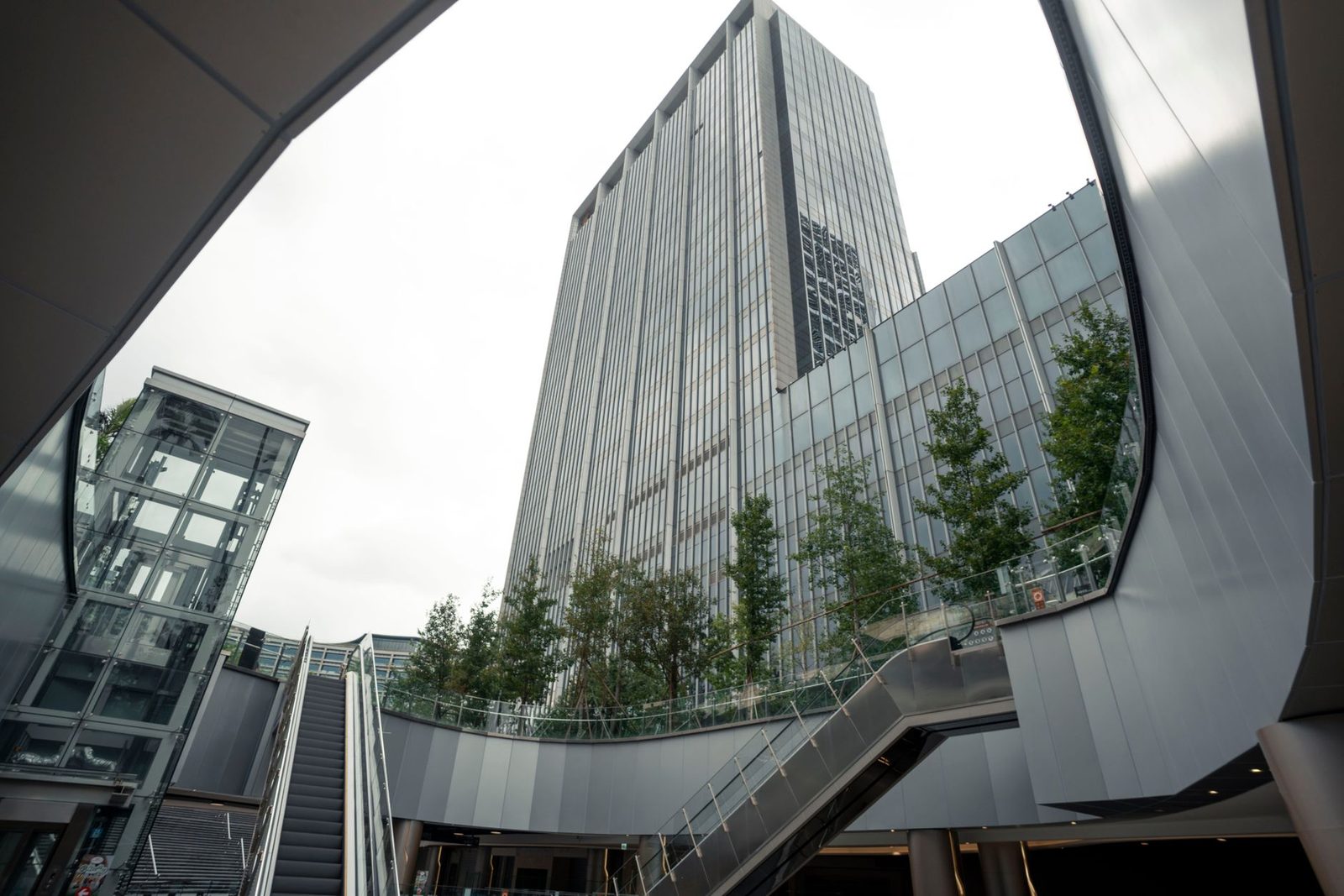
Jakarta has no public observation deck on this corridor, which is an odd gap for a skyline this dense. What it has instead is a stack of hotel and mall rooftops that were designed as bars, and the honest position is that most of them do not open until late afternoon. If you want height in daylight your options narrow to a handful of rooftop restaurants that serve lunch, generally from around 11:00 or noon, and to hotel executive lounges if your room rate includes one.
The daytime view is worth having at least once, and it is a different view from the evening one: you can actually read the city’s structure, see the Ciliwung and the Banjir Kanal Barat threading through, pick out Monas to the north and the Senayan green mass to the south, and understand how abruptly the towers stop and the low-rise kampung begins. On a clear morning after rain you will see the Bogor hills. On a typical hazy afternoon you will see about three kilometres. Confirm hours the same day, because rooftop venues here change opening times and operators frequently; our rooftop bars guide tracks which are currently trading. For a cheaper elevated view, the upper food-court levels of Grand Indonesia and the walkways of the District 8 complex give you something for the price of a coffee.
Green Space, and the Hutan Kota Question
The corridor is not green. The planted medians and young street trees are an improvement on what was there before, but there is no park on Sudirman itself. The two places that come closest sit at the southern end.
Hutan Kota by Plataran occupies about 3.2 hectares at Jalan Jenderal Sudirman Kav 54-55, on the edge of the Gelora Bung Karno complex. It is a commercial hospitality operation rather than a public park: a set of restaurants, pavilions and event lawns under mature trees, generally open from around 11:00 to 22:00 daily. There is no ticket to walk in, but the space is designed to sell you lunch, and lunch is not cheap. It is nevertheless the only place on this corridor where you can sit under a canopy of real trees and hear birds instead of engines, and for that reason it is worth an hour.
The larger and free option is the GBK complex itself, whose outer ring road and landscaped grounds are open to walkers and runners and get busy at dawn and dusk. That is properly covered in the Senayan chapter linked above, and it is where locals go when they want to move outdoors without paying for the privilege. North of the roundabout, Taman Menteng and the leafy colonial streets of Menteng are the nearest thing Central Jakarta has to a walkable park district; the Menteng guide makes the case for a morning there.
A Practical SCBD Sudirman Guide Jakarta Walking Route
If you only give the corridor one day, do it on a Sunday and structure it around the road closure.
Start at Bundaran HI at 06:00, on the MRT if you are staying south or on foot if you are at one of the Thamrin hotels. Walk south down the open road, stopping for bubur ayam and coffee from the carts, as far as Dukuh Atas, which takes twenty minutes at a browsing pace. Detour left onto the canal plaza to see the transport hub and the donut bridge. Continue south towards Bendungan Hilir, and if you are hungry again cut west into Pasar Benhil for a proper breakfast. By 09:00 the crowd will be thick; that is your cue to duck into the MRT at Bendungan Hilir and ride two stops to Istora Mandiri.
Spend the hot middle of the day indoors: ASHTA for coffee, Pacific Place for lunch and anything you need to buy, and if the heat has beaten you, a cinema. From about 16:00 the outside becomes tolerable again. Walk the estate properly, then finish either at Hutan Kota under the trees or, if you want the view, on a rooftop as the towers light up. That hand-off from day to night is where this guide ends and the Jakarta nightlife guide begins.
The Honest Downsides
Four things, stated plainly.
It is expensive. This is the most costly square kilometre in Indonesia and prices reflect the rents, not the country. A coffee that costs Rp 18,000 in Glodok costs Rp 75,000 here, and the 21 per cent added at the till catches people out. If your trip is on a budget, sleep somewhere else and visit; the budget travel guide and the where to stay guide both make that argument.
It is corporate, and that flattens the experience. The estate was masterplanned from scratch on cleared land, so there is no accumulated street life, no old shophouses, no shrines wedged between buildings, none of the layering that makes Kota Tua or the kampung lanes interesting. What you get is competent international urbanism that could be Singapore or Kuala Lumpur.
It empties at weekends outside CFD hours. Saturday afternoon on Sudirman is eerie: wide clean pavements, almost nobody on them, half the ground-floor cafes shut because their customers are office workers who are not there. The energy moves east to Senopati and south to Kemang and does not come back until Monday.
And the boulevard is brutal at midday. Eight metres of unshaded pale paving under an equatorial sun is a design failure however good the intentions were. Plan around it rather than testing it.
FAQ: SCBD Sudirman Guide Jakarta
Is SCBD worth visiting if I am not here for business? Yes, but for specific things rather than as a general sightseeing area. Come for Car Free Day on Sunday morning, for the malls if you want air conditioning and reliable food, and for the rooftop views. If you want history, temples or street life, spend your time in Kota Tua, Glodok or Menteng instead and treat Sudirman as the place you sleep and change trains.
What time does Car Free Day start and finish? Sundays from 05:30 to 10:00, along Jalan MH Thamrin and Jalan Jenderal Sudirman between Bundaran HI and Bundaran Senayan. The 05:30 start replaced the older 06:00 start in June 2026. It is cancelled on national holidays and occasionally for large state events, so check the Jakarta transport agency’s social media the night before if the date is a public holiday.
Can I walk from Bundaran HI to SCBD? You can, and the pavement is continuous and wide the whole way. It is roughly four kilometres to the Istora end, about fifty minutes at a steady pace. Do it early morning or evening. At midday take the MRT instead; it costs a few thousand rupiah and you will arrive dry.
Is Glodok MRT station open yet, so I can ride from SCBD to Chinatown? No. The North-South line currently terminates at Bundaran HI. Phase 2A is targeting the Harmoni section for 2027 and the Glodok and Kota stations by the end of 2029. Until then, take the KRL commuter line to Jakarta Kota, or a TransJakarta corridor bus.
How much should I budget per day around Sudirman? Eating from warungs and food courts and using the MRT, Rp 200,000 to Rp 300,000 covers a full day comfortably. Add mall restaurants and a rooftop drink or two and you are at Rp 700,000 to Rp 1,200,000. Fine dining and a five-star hotel take that well past Rp 3,000,000. The 21 per cent service and tax on restaurant bills is the line item people forget.
Where is the best place to stay on this corridor? Thamrin near Bundaran HI if you want walkable malls and direct MRT to both Kota-bound trains and the south; SCBD or Senayan if your meetings are in the estate; Setiabudi if you want lower rates within walking distance of the same MRT line. Compare in our where to stay in Jakarta guide.
Is the area safe to walk alone at night? Yes, by any reasonable standard. The corridor is well lit, heavily secured and busy with office and hotel staff until late. Ordinary urban caution applies: watch your phone near crowded crossings, use the app-based cars rather than unmetered street taxis, and be aware that pavements away from the main boulevard deteriorate quickly.
What happened to Citayam Fashion Week? It peaked in mid-2022 at Dukuh Atas, drew national attention, then faded within months under a mix of crowd management, commercial trademark attempts and simple novelty exhaustion. Much of the scene relocated to Kota Tua by 2024. A small weekend version still gathers on the Dukuh Atas plaza in the late afternoon.
Where to Go Next
The corridor is a spine, not a destination, and the interesting parts of Jakarta hang off it. Ride the MRT four stops south and you are in the shopping and eating country covered by our Blok M shopping guide; take the KRL north from Sudirman station and you are in the old city in twenty minutes. For the whole map, work back through the neighbourhoods pillar linked at the top of this page.
Specific onward reading: the North Jakarta and Ancol guide for the waterfront and the port, the getting around Jakarta guide for the full transport picture, Jakarta’s landmarks for the monuments you will pass on Thamrin, and the three-day Jakarta itinerary if you want the corridor slotted into a working plan rather than treated on its own.
Pacific Place, on the western edge of SCBD, houses the district’s one genuinely family-shaped attraction: KidZania, a child-scale city occupying the whole of level six. Our KidZania Jakarta guide explains how to get there from Istora Mandiri MRT, when to arrive, and how to build the rest of an SCBD day around it.
SCBD is also home to the city’s highest-ranked restaurant. August, in Sequis Tower, was No. 42 on Asia’s 50 Best Restaurants 2026, and its pastry chef was named Asia’s Best Pastry Chef. Our guide to the best fine dining restaurants in Jakarta has the details and the rest of the top tier.