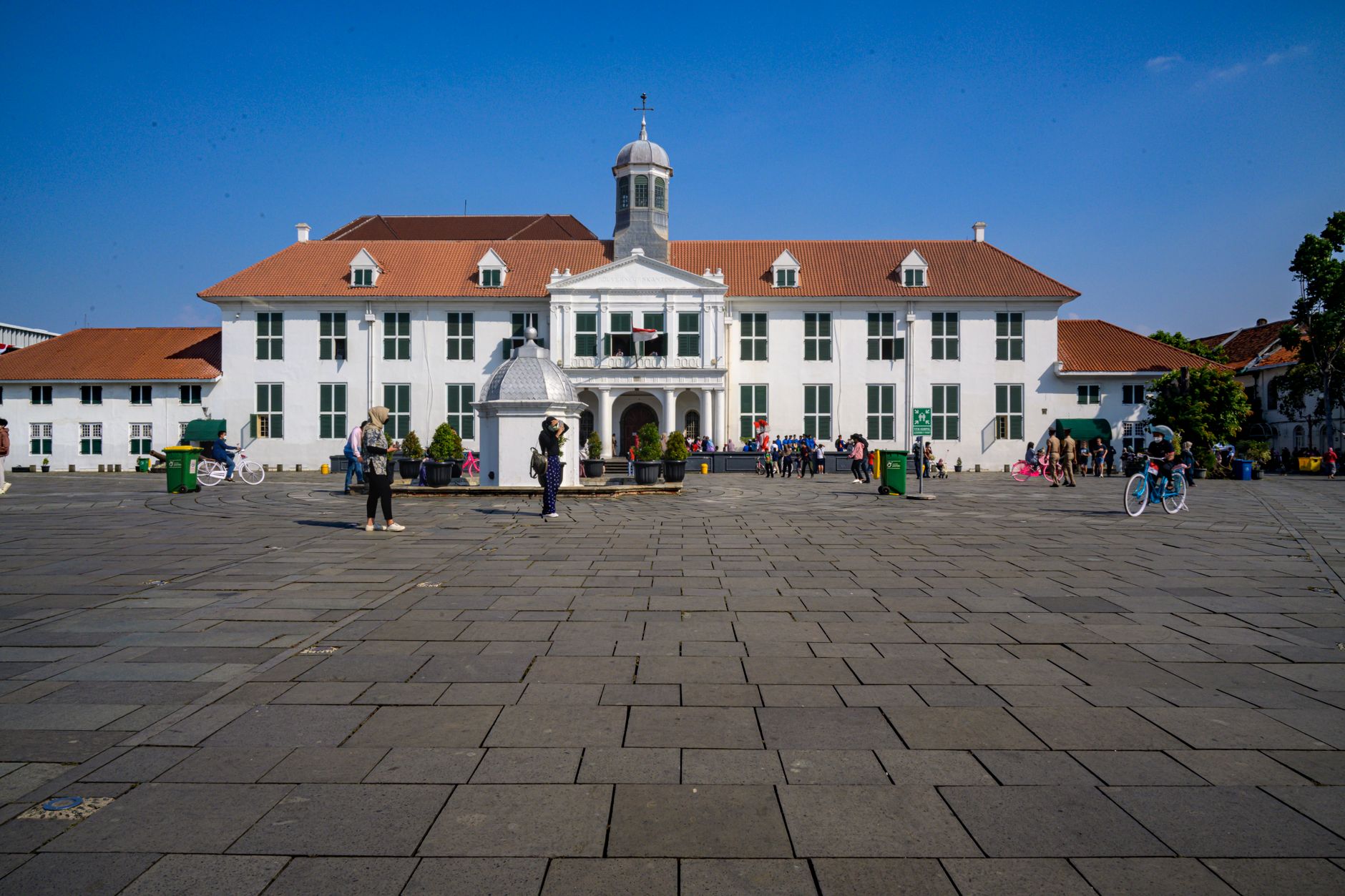
Almost everyone who visits Jakarta’s old town sees the same 200 metres of it. They come out of Jakarta Kota station, follow the crowd, arrive at Fatahillah Square, photograph the Dutch town hall, buy a coconut, and leave ninety minutes later with the impression that Kota Tua is a hot brick plaza full of people selling things. They are not wrong about the plaza. They have also missed roughly four fifths of the district. This Kota Tua neighborhood guide is about the other four fifths: where the boundaries actually are, what the 2022–23 revitalisation changed, which streets reward walking, and which parts you can skip without regret.
It sits within our Jakarta neighbourhoods guide, and it deliberately does not repeat two pieces you may also want: the step-by-step Kota Tua walking tour gives you a 2.5-hour route with twelve stops in order, and eating in Kota Tua handles the food. What follows is orientation and judgement — how the neighbourhood is put together, what changed recently, and how to spend your time in it. If you are heading further north afterwards, the North Jakarta and Ancol guide picks up at Sunda Kelapa.
Where Kota Tua Actually Begins and Ends
Kota Tua is not a square. It is a district of roughly 1.3 square kilometres, and depending on which official designation you use, the heritage zone stretches considerably further. The original walled Batavia of the seventeenth century covered both banks of the Ciliwung, from the harbour at Sunda Kelapa in the north down to what is now Glodok in the south, contained by canals and defensive works that have almost entirely gone.
For practical purposes, treat the neighbourhood as bounded by four things. To the north, Jalan Kakap and the approach to Sunda Kelapa harbour. To the east, the railway viaduct and Jakarta Kota station. To the south, Jalan Pancoran and the top of Glodok. To the west, Jalan Roa Malaka Selatan and the warehouse blocks behind Kali Besar. Everything inside that box is old town in some meaningful sense. Fatahillah Square, the bit everyone photographs, occupies less than two hectares of it and sits in the eastern third.
The consequence is that if you never leave the square you have not seen Kali Besar, the canal that was the commercial spine of Batavia. You have not seen Toko Merah. You have not walked Jalan Pintu Besar Utara past the bank museums. You have not crossed Jembatan Kota Intan, the oldest surviving bridge in the city. And you certainly have not been to Sunda Kelapa. All of those are within a twenty-minute walk of where you are standing.
| Sub-area | Walk from Fatahillah Square | What it is | Worth the detour? |
|---|---|---|---|
| Fatahillah Square | 0 min | The colonial plaza and its four museums | Yes, but budget 90 minutes, not a day |
| Jalan Pintu Besar Utara | 2 min south | Café Batavia, Bank Mandiri and Bank Indonesia museums | Yes, the best museums in the district are here |
| Kali Besar | 5 min west | Restored canal promenade, Toko Merah, warehouse facades | Yes, and it is the quietest part |
| Jembatan Kota Intan | 10 min northwest | 1628 Dutch drawbridge, restored 2021–22 | Ten minutes, no more, but photogenic |
| Glodok | 15 min south | Jakarta’s Chinatown, temples, medicine shops, markets | Yes, and arguably more interesting than the square |
| Sunda Kelapa | 25 min north or 8 min by Grab | Working schooner harbour, Museum Bahari | Yes, if you go before 11:00 |
What the Revitalisation Actually Changed
If you visited Kota Tua before 2022 and go back now, it is a different place, and the difference is mostly good. The Jakarta provincial government completed a major revitalisation programme, reopening the reordered core in August 2022 with further work running through 2023.
Vehicles are largely gone from the core
The headline change is the low emission zone. Roughly 0.14 square kilometres around Taman Fatahillah were pedestrianised, with five streets converted from motor traffic to paved pedestrian space and the square’s former ring road closed. The paving was redone in a style referencing the 1627 layout, street furniture and lighting were replaced, and cabling was buried. You can now walk from the square west toward Kali Besar without dodging cars, which was genuinely impossible before.
What this means for you: do not ask a Grab driver to drop you at Fatahillah Square. They cannot get there. Set your pin at Jakarta Kota station, at the Museum Bank Indonesia end of Jalan Pintu Besar Utara, or at one of the peripheral car parks, and walk the last 300 to 600 metres. Drivers who accept a pin inside the zone will either cancel or leave you somewhere confusing.
Parking moved out and became paid
Free on-street parking in the core has gone. Vehicles are directed to designated lots on the fringes, including areas near the station and along the southern approaches, at metered rates that are modest by central Jakarta standards but no longer nothing. Tour buses drop and go. This is the correct policy and it does mean the district works far better arriving by train than by car.
The vendors were relocated, not removed
The pre-2022 square was a dense scrum of informal traders. The revitalisation relocated most of them into designated zones at the edges of the pedestrian area, which cleaned up the sightlines considerably. It did not eliminate the trade, and enforcement has drifted since — on a busy Sunday you will still find drinks sellers, photo props, portrait artists and toy hawkers working the square itself. The difference is that they now have somewhere to be, and the square photographs cleanly on a weekday morning in a way it never used to.
The wider heritage-district plan continues, with buildings around the square and along Kali Besar being progressively restored and, in several cases, converted to commercial use. Some sit empty behind hoardings for years. Expect at least one scaffolded facade whenever you visit.
Jakarta Kota Station: The Front Door, and the Wrong Doors
Jakarta Kota is the terminus of several KRL Commuter Line services and the natural entrance to the neighbourhood. It is also, quietly, one of the finest buildings in the district: a 1929 Art Deco terminus by Frans Ghijsels, with a deep steel-trussed train shed and a symmetrical concourse that most passengers walk through without looking up. Do look up. It is a protected monument and it is free.
Fares from anywhere on the network are IDR 3,000 to 6,000, trains run roughly 04:00 to midnight, and from Central Jakarta you will usually change at Manggarai. The KRL Commuter Line guide explains the interchange, and a JakLingko card saves the queue at the ticket machine. From the station’s western exit, Fatahillah Square is a five-minute walk past Café Batavia.
TransJakarta also serves the area, with the Kota corridor terminus immediately outside and a flat IDR 3,500 fare, though corridors mostly stop around 22:00. See the TransJakarta guide for the routing. Coming by Grab or Gojek from Sudirman costs roughly IDR 45,000 to 80,000 and takes 30 to 60 minutes, and again, you will be dropped at the edge.
There is no MRT here yet. The North–South line still terminates at Bundaran HI and the extension toward Kota remains under construction, with completion repeatedly pushed back. Anyone telling you to take the MRT to Kota Tua is working from a plan, not a timetable.
Jalan Pintu Besar Utara and the Bank Museums
This short street running south from the square is the most underrated stretch in the neighbourhood. On its eastern side stands Café Batavia, occupying a building from the 1830s and trading as a restaurant since 1993 — colonial-revival interior, walls covered in framed portraits, upstairs windows looking straight onto the square, and prices that are high for Jakarta and reasonable for what the room is. It opens early and closes late, typically 08:00 to midnight. You are paying for the setting. Have a coffee upstairs and decide for yourself whether dinner is worth it.
Further south, two former bank headquarters now house the district’s best museums. Museum Bank Mandiri occupies the vast 1933 Nederlandsche Handel-Maatschappij building: three floors of period banking hall, original teller counters, safe deposit vaults, adding machines, stained glass and an atmosphere so intact it is regularly used as a film set. Entry is around IDR 5,000, opening roughly Tuesday to Sunday 09:00 to 15:00, closed Mondays. For the price of a bottle of water it is the single best value in Jakarta.
Directly opposite, Museum Bank Indonesia sits in a converted 1828 hospital that became the De Javasche Bank headquarters. It is the more polished of the two: air-conditioned, professionally curated, multilingual, with a strong section on the monetary history of the archipelago from spice-trade currencies through the hyperinflation of the 1960s to the 1998 crisis. Entry is nominal, often around IDR 5,000, and it opens Tuesday to Sunday from about 08:00 with last entry mid-afternoon. If you visit one museum in Kota Tua, and the weather is punishing, make it this one — it is the only building in the district with reliably cold air.
The wider architectural story of these buildings is covered in our piece on colonial Jakarta architecture, and both museums appear in our broader survey of Jakarta’s museums and cultural sites.
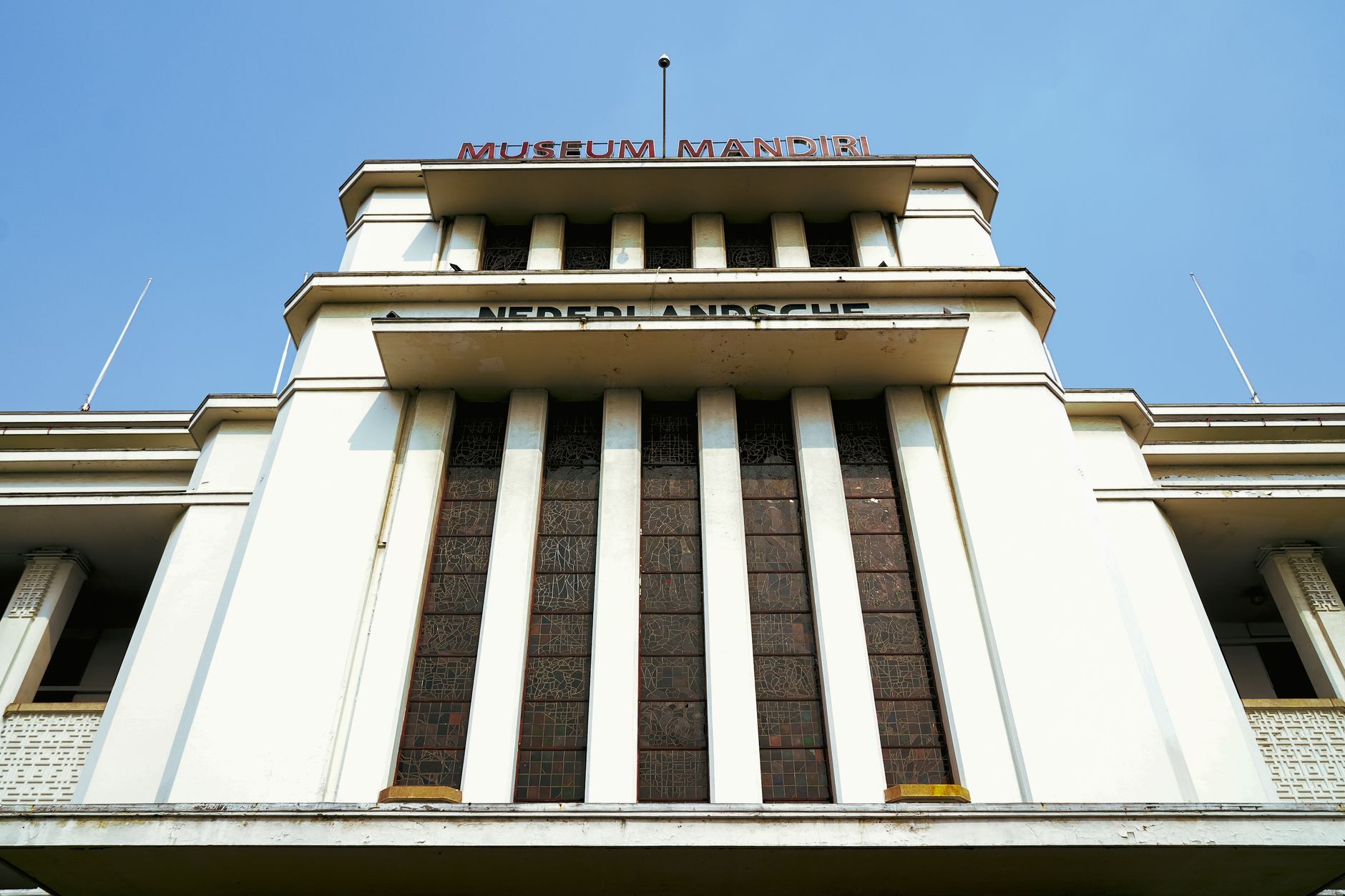
Kali Besar: The Canal, Toko Merah and Jembatan Kota Intan
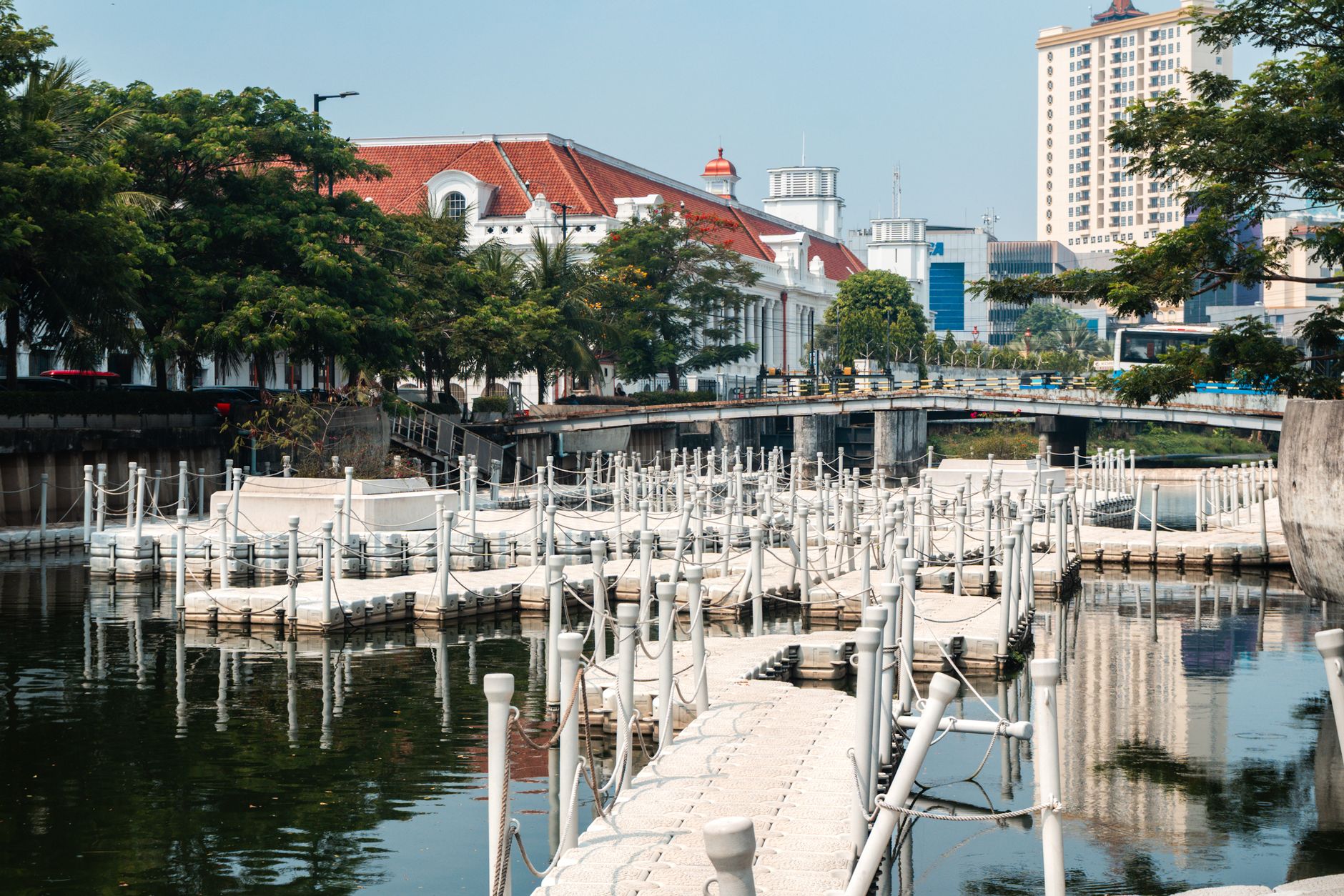
Walk five minutes west from the square and the crowd thins to almost nothing. Kali Besar, the Great Canal, is a straightened section of the Ciliwung that the Dutch dug as Batavia’s commercial artery, lined on both banks with merchant houses and warehouses. For decades it was a stinking drain with traffic on both sides. Since a restoration completed in the late 2010s it has a raised timber and concrete promenade, planting, seating, lighting and — crucially — a floating aeration and filtration system that has made the water tolerable rather than repellent.
Toko Merah
The standout building is Toko Merah, the Red Shop, on Jalan Kali Besar Barat. Built in 1730 as the residence of Governor-General Gustaaf Willem van Imhoff, it is deep red brick, two storeys, with teak interiors and an original staircase, and it has served in turn as a home, a naval academy, a hotel and a shop. It is one of the oldest intact buildings in Jakarta. It is normally closed to casual visitors and opens for exhibitions, private events and occasional heritage days, so check before making a special trip. Even from outside it is the best facade on the canal.
Jembatan Kota Intan
Ten minutes further northwest, Jembatan Kota Intan is a small wooden drawbridge painted bright red, originally built in 1628 and rebuilt several times since, most recently rehabilitated around 2021–22 with structural strengthening that preserved its form and a small garden added at the approach. It is the oldest surviving bridge in Jakarta. It takes about ninety seconds to appreciate and it is heavily photographed at golden hour. The surrounding streets are working commercial blocks — timber, hardware, small workshops — which is part of the appeal if you like cities that still do things.
The stretch of Kali Besar between Toko Merah and the bridge, walked at eight in the morning, is the loveliest part of Kota Tua and virtually nobody is there. That is my main practical recommendation in this entire guide. If you also want the district’s less obvious corners, our list of lesser-known corners of Jakarta covers a few more.
The Glodok Edge
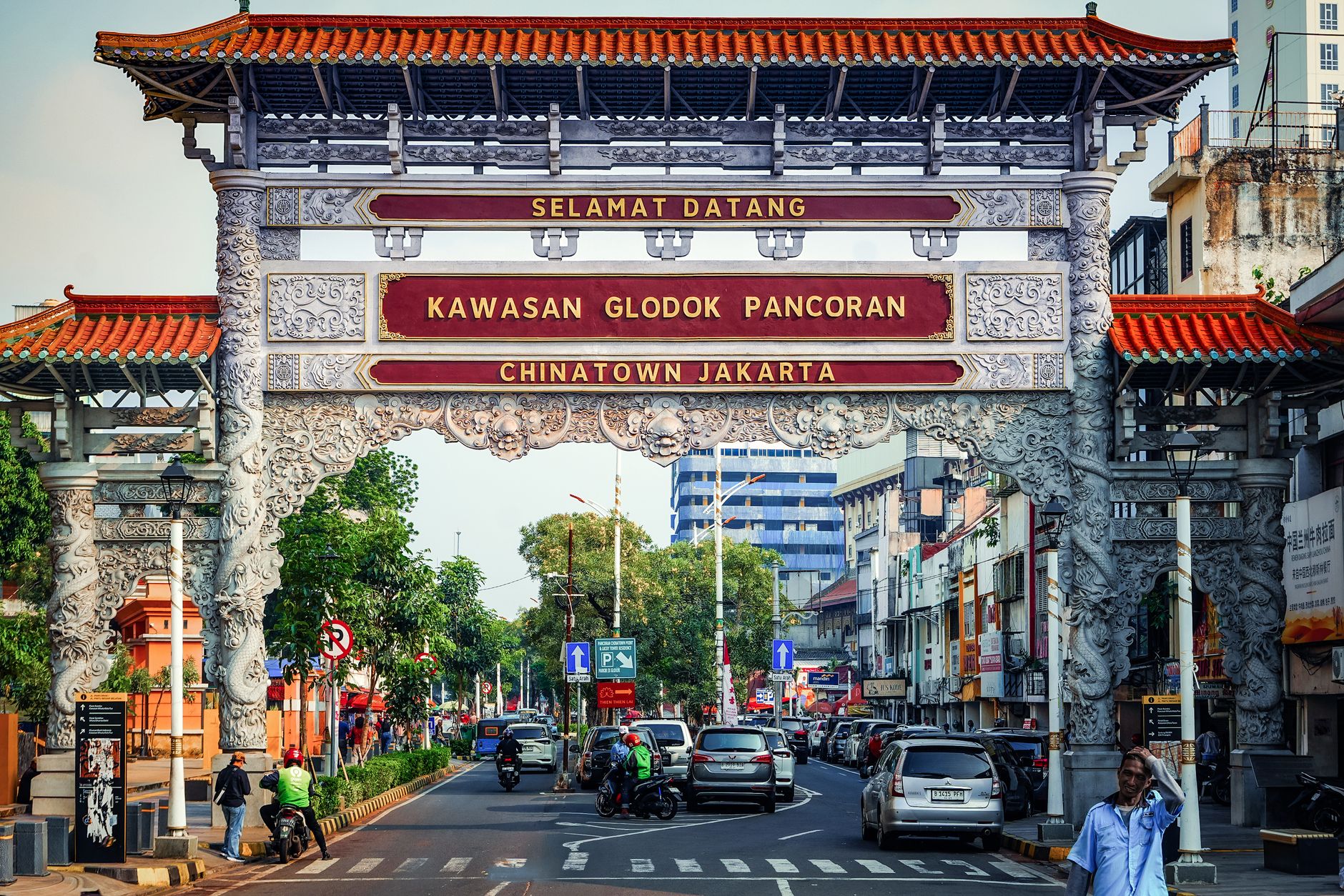
Fifteen minutes south of the square, across Jalan Pancoran, is Glodok — Jakarta’s Chinatown and, in historical terms, an inseparable part of old Batavia. The Dutch confined the Chinese population here after the 1740 massacre, and the area has been continuously Chinese-Indonesian ever since. It is denser, dirtier, older-feeling and considerably more alive than Fatahillah Square.
What is there: Jalan Pancoran and the Pancoran Chinatown Point complex, the covered market lanes of Petak Sembilan with their fish, fruit, sweets and shophouse frontages, herbal medicine shops that have not changed their fittings in fifty years, and several working temples. Vihara Dharma Bhakti, dating from 1650, is the oldest Chinese temple in Jakarta and survived a serious fire in 2015; it has been restored and remains in active use. Our guides to Tian Hou temple and Buddhist temples in Jakarta cover the etiquette for visiting.
Glodok is the answer to the common complaint that Kota Tua is a photo stop with nothing behind it. It has plenty behind it. Go on a weekday morning, dress modestly for the temples, and accept that the market lanes are wet, tight and not particularly interested in you, which is exactly why they are good.
North to Sunda Kelapa
The other direction most visitors ignore is straight north. Sunda Kelapa, the harbour that predates the Dutch and gave Jakarta its original reason to exist, is 1.5 to 2 km from Fatahillah Square. Wooden pinisi schooners still moor there and still load cargo by hand for the eastern islands. Entry is nominal, a few thousand rupiah, and the nearby Museum Bahari occupies genuine VOC warehouses from the 1650s onward, with the leaning Menara Syahbandar watchtower a hundred metres away and usually covered by the same ticket.
The walk north along Jalan Kakap is unshaded, narrow and shared with lorries, so most people take a Grab for IDR 15,000 to 25,000. Museum Bahari keeps early hours, roughly Tuesday to Sunday 09:00 to 15:00. Going at 07:30 and returning to Kota Tua for the museums at nine is the single most efficient version of a Kota Tua morning.
The Square by Hour: Weekday, Weekend, Evening
Kota Tua is three different places depending on when you stand in it, and getting this wrong is the most common reason people leave disappointed.
| When | What it is like | Best for | Watch out for |
|---|---|---|---|
| Weekday 07:00–09:30 | Near empty, cool, cleaners and commuters, clean sightlines | Photography, Kali Besar, unhurried walking | Museums are not open until 09:00 |
| Weekday 10:00–15:00 | Moderate crowds, school groups, full heat | Museums, Café Batavia, air conditioning | Temperatures of 32–34°C with high humidity |
| Saturday and Sunday, all day | Very busy, thousands of domestic visitors, performers, music | Atmosphere, people-watching, street food | Constant selling, crowded museums, slow going |
| Any evening 18:00–22:00 | Lit, cooler, buskers, couples, food carts, families | The nicest atmosphere of the week | Museums shut; keep valuables secure in the crowd |
My preference is a weekday split: arrive at 07:30, walk Kali Besar and the canal while it is quiet, do the bank museums from nine, eat, leave by two, and come back another evening if you want the buskers and the lights. Sunday afternoon in the square is a genuine local social occasion and worth experiencing once, but it is not when you will enjoy the architecture.
The Ondel-Ondel Economy and How Tipping Works
On any busy day the square fills with costumed characters, and it is worth understanding what you are looking at. The ondel-ondel are the tall Betawi effigy puppets, red-faced male and white-faced female, worn over a wicker frame by a performer inside. They are a genuine Betawi tradition with roots in village protective ritual, and they are also, in 2026, a livelihood. Beside them you will find people dressed as Dutch colonial soldiers, Indonesian independence fighters, Suzzanna-style horror characters, superheroes and, on Sundays, a fairly surreal assortment of cartoon mascots.
The system is straightforward and unspoken. If you photograph them, you pay. If you pose with them, you definitely pay. The going rate is IDR 5,000 to 20,000 per photo, more if there are several performers or if you have asked for a set-up shot. Nobody will name a price up front, which is what unsettles first-timers; they will simply hold out a tin or a hat afterwards, and a refusal is met with disappointment rather than confrontation. Carry a stack of IDR 5,000 and IDR 10,000 notes and the whole thing becomes frictionless.
What you should not do is photograph an ondel-ondel from twenty metres with a long lens and walk away feeling clever. The performers are working in a heavy costume in 33-degree heat for a few hundred thousand rupiah a day. It is one of the cheaper cultural transactions available to you. Our wider notes on Jakarta cultural experiences put the Betawi traditions in context.
Bicycles, Touts, Scams and the Heat
The bicycles are the other visual signature: sepeda ontel, restored Dutch-style roadsters in bright colours, rented with a matching wide-brimmed hat for photographs. The Paguyuban Onthel Kota Tua, the operators’ association, runs roughly 70 to 80 bikes from a handful of stands around the square, and rental is typically IDR 20,000 to 30,000 for 30 minutes. Since 2023 most operators accept QRIS payment via a card with a QR code, though cash is still easier. The bikes are for pottering and photos within the pedestrian zone, not for going anywhere.
The scams here are minor by regional standards, but they exist. The recurring ones: unsolicited “guides” who attach themselves and then charge, quoted photo prices that inflate after the shot, unmetered ojek and becak rides where the fare is decided at the destination, and shops near the square selling generic imported souvenirs as local craft at four times the Pasar Baru price. Nothing here is dangerous. It is all resolvable by agreeing prices in advance and saying no clearly. If you want to buy something genuine, our guides to the best Jakarta souvenirs and where to buy batik point at better places than the square.
Pickpocketing on very crowded Sundays and during holiday periods is the one real risk. Front pockets, bag zipped, phone away when you are in the thick of it.
The heat is the bigger enemy. Fatahillah Square is a large expanse of brick and stone with almost no shade, and surface temperatures at midday in the dry season are brutal. There are drinks vendors everywhere and a handful of shaded arcades under the museum colonnades, but you will feel it. Between roughly 11:00 and 15:00, plan to be inside something. During the November to March wet season the afternoon downpours are heavy, the square drains poorly in the corners, and the surrounding streets can flood briefly. Our general Jakarta travel tips cover hydration, timing and what to do when it rains.
Which Museums Earn Their Entry Fee
Kota Tua has more museums than any comparable area in Indonesia, and they are not of equal quality. Entry fees are trivial across the board — nothing here costs more than a coffee — so the real currency is your time and tolerance for heat.
| Museum | Entry (IDR, approx.) | Hours (approx.) | Verdict |
|---|---|---|---|
| Museum Bank Indonesia | 5,000 | Tue–Sun, from 08:00, last entry mid-afternoon | Best curated and the only cool building. Go here first. |
| Museum Bank Mandiri | 5,000 | Tue–Sun 09:00–15:00 | Extraordinary interior, minimal interpretation. Go for the building. |
| Jakarta History Museum (Fatahillah) | 5,000–25,000 | Tue–Sun 09:00–15:00 | The landmark. Collection is thin, the building and dungeons are not. |
| Wayang Museum | 10,000 weekday / 15,000 weekend | Tue–Sun 09:00–16:00 | Reworked in recent years and much improved. Worth an hour. |
| Museum Seni Rupa dan Keramik | 7,500 weekday / 11,250 weekend | Tue–Sun 09:00–15:00 | Pleasant, quiet, skippable unless you like ceramics. |
| Museum Bahari (Sunda Kelapa) | 5,000–50,000 depending on nationality | Tue–Sun 09:00–15:00 | Worth it for the VOC warehouses; collection reduced after the 2018 fire. |
My ranking, if you only have time for two: Museum Bank Indonesia and Museum Bank Mandiri. They are the ones with the strongest sense of what Batavia actually was, and they are almost always quieter than the square. The Jakarta History Museum is the famous one and you should look inside for the courtyard, the dungeons and the seventeenth-century furniture, but its permanent display has been criticised for years and the criticism is fair. The Wayang Museum has genuinely improved and is now the most engaging of the four square-side museums, particularly if you catch a puppet demonstration.
Note that all of them close on Mondays and public holidays, and most stop admitting visitors between 14:30 and 15:30. A Monday visit to Kota Tua means a square, some coffee and a walk, nothing more. If your museum appetite is larger, Jakarta’s culture and history museums covers the National Museum and the rest of the central cluster.
Where Kota Tua Is Genuinely Lovely, and Where It Isn’t
Time for the honest assessment, because the marketing on this district oversells one part badly.
Genuinely lovely: Kali Besar’s promenade before nine in the morning, when the water is still and the warehouse facades reflect. The interior of Museum Bank Mandiri, which is one of the most atmospheric rooms in Southeast Asia. Jakarta Kota station’s train shed. The Glodok market lanes on a weekday. Jembatan Kota Intan at golden hour. Sunda Kelapa’s quay at half past seven. The square itself on a weekday morning before the crowd builds, when you can actually see the buildings.
Not lovely: Fatahillah Square between eleven and three on a hot Sunday, which is a treeless brick oven containing several thousand people, at least a dozen of whom want to sell you something in the next four minutes. The stretch of shops immediately outside the pedestrian zone, which is generic and overpriced. The eastern approaches from the station on a wet afternoon. And the general condition of a good number of heritage buildings just outside the restored core, which are shuttered, decaying and waiting for money that has not arrived.
The gap between those two lists is the whole point of treating Kota Tua as a neighbourhood rather than a square. The square is the least interesting thing in it once you have taken your photograph.
Kota Tua Neighborhood Guide Verdict: How Long to Spend
Half a day is not enough and a full day is too much unless you are combining it with Glodok and Sunda Kelapa. The honest answer is five to six hours, split rather than continuous.
The version I would run: 07:30 at Sunda Kelapa, 09:00 at Museum Bahari, 10:00 back to Kota Tua for the bank museums, 12:00 lunch, 13:00 Kali Besar and Kota Intan, 14:30 Glodok, out by 16:30. That is a substantial day covering four distinct sub-districts, with all the outdoor walking done in the cooler hours and the museums used as heat shelter.
If you have less time, do the bank museums and Kali Besar and skip the square’s museums entirely. If you have more, add an evening return for the lights and the buskers. Kota Tua slots neatly into day one of our two-day Jakarta itinerary, and most of what makes the neighbourhood good costs nothing, which is why it features so heavily in our list of free things to do in Jakarta.
Kota Tua Neighborhood Guide: Frequently Asked Questions
How big is Kota Tua and how much can you walk? The heritage district covers roughly 1.3 square kilometres, and the useful core runs about 1.5 km north to south from Kali Besar down to Glodok. Everything except Sunda Kelapa is comfortably walkable in a morning. Fatahillah Square, which is what most people mean by Kota Tua, is under two hectares and represents a small fraction of the neighbourhood.
Can you drive into Kota Tua? Not into the core. Since the 2022 revitalisation a low emission zone covering around 0.14 square kilometres has closed five streets around Taman Fatahillah to motor traffic, and parking has moved to paid lots on the fringes. Set your Grab pin at Jakarta Kota station or the Museum Bank Indonesia end of Jalan Pintu Besar Utara and walk the last few hundred metres.
Do you have to tip the ondel-ondel and costumed performers? If you photograph or pose with them, yes. The unwritten rate is IDR 5,000 to 20,000 per photo, more for a group or a staged shot. No price is announced in advance; a tin or hat appears afterwards. Carry small notes. It is a livelihood rather than a scam, and refusing after taking the picture is genuinely rude.
What does this Kota Tua neighborhood guide recommend if you only have two hours? Arrive at Jakarta Kota station, look at the 1929 train shed, walk to Museum Bank Indonesia for the air conditioning and the currency history, cross to Museum Bank Mandiri for the banking hall, then walk five minutes west to Kali Besar and back through Fatahillah Square. That gives you the best of the district and skips the weakest museums.
Is Kota Tua safe? Yes, with normal urban care. Violent crime against visitors is rare. The genuine risk is pickpocketing in dense weekend and holiday crowds around the square. The lesser irritations are unsolicited guides, inflated photo fees and unmetered becak rides. Agree prices in advance, keep your phone away in crowds, and the district is straightforward day or evening.
Which day should you avoid? Monday, because every museum in the district and at Sunda Kelapa is closed, along with public holidays. Sundays and school holiday periods are fine for atmosphere but poor for photography and museum queues. The best window is Tuesday to Friday morning, arriving before nine.
How does Kota Tua connect to Glodok and Sunda Kelapa? Glodok is about 1 km south of Fatahillah Square, a 15 to 17 minute walk down through Jalan Pancoran, or a five-minute Grab. Sunda Kelapa is 1.5 to 2 km north, walkable in 25 minutes along an unshaded lorry route or IDR 15,000 to 25,000 by Grab. Both were part of the same seventeenth-century city and both are more rewarding than the square.
Is Kota Tua worth visiting at night? Yes, and it is under-rated. From about 18:00 the square cools, lighting comes on, buskers and food carts set up, and it becomes a pleasant local evening space rather than a heat trap. The museums are shut, so treat it as a separate visit rather than a continuation. Keep valuables secure in the busier crowds.
Where to Go Next
Once you have the neighbourhood in your head, plot the sub-districts against the rest of the city with our Jakarta attractions map, and follow the district’s food street by street in our Jakarta street food guide. For the wider colonial-era story across the city, see Indonesian heritage sites in Jakarta and our roundup of Jakarta’s landmarks.
Heading elsewhere in the city, the Central Jakarta guide covers Monas, the National Museum and Istiqlal, half an hour south by KRL, while the South Jakarta guide, the Menteng guide and the Kemang guide handle the modern city. If old markets are your thing, Jakarta’s flea and vintage markets continues the theme south of Glodok.
Kota Tua has also become the backpacker’s base of choice in Jakarta, with hostels in restored colonial buildings on the old town square and Glodok’s cheap food lanes a short walk south. Our guide to backpacking Jakarta sets it against Jalan Jaksa and Blok M, and explains how to cross the city from here for a few thousand rupiah.