The first thing that catches most visitors out in Jakarta is not a rule at all. It is the speed at which a stranger will ask where you are from, whether you are married, and how old you are — inside about ninety seconds, usually with a smile, usually while handing you change. Nobody is being nosy. That is simply how a conversation opens here, and if you answer it in the same spirit you have already cleared the highest hurdle in Jakarta etiquette customs. The rest is smaller than you think.
This guide covers what actually matters day to day in Jakarta: how people greet each other, what to do with your hands and feet, how religion shapes the timetable of an ordinary week, what to wear, how to eat, how to read an Indonesian “yes”, and the handful of legal and social lines it genuinely pays to know about. Prices quoted here were checked in September 2026; treat them as the right order of magnitude rather than gospel. Everything else is behaviour, and behaviour does not inflate.
The ten things that matter, at a glance
If you read nothing else, read this. Everything below is elaboration.
| Situation | What to do | Why it matters |
|---|---|---|
| Handing over money, food, a business card | Use your right hand, or both | The left hand is the bathroom hand. This one is not negotiable |
| Meeting someone | Light handshake, then touch your own chest | A firm Western grip reads as aggressive |
| Addressing anyone older or in a service role | Pak for men, Bu for women | Costs nothing, changes the whole exchange |
| Entering a home, a mosque, some shops | Look for shoes at the door and copy | Shoes carry the street inside |
| Pointing at something | Thumb, not index finger | An index finger at a person is rude everywhere in Indonesia |
| Visiting a mosque | Cover shoulders and knees; women cover hair | Loaner robes exist but yours will fit better |
| Friday around midday | Expect a city that slows down | Jumu’ah prayers empty offices from roughly 11:30 to 13:30 |
| Someone says “maybe” or “we’ll see” | Hear “no” | A flat refusal is considered unkind. Read the softening |
| Being offered food or drink at a house | Accept, even if you only touch it | Refusing outright reads as rejecting the host |
| Losing your temper in public | Don’t | Visible anger loses you the argument and the room |
Why Jakarta is not Bali, and why that changes everything
A large slice of the etiquette advice online about Indonesia was written about Bali, and Bali is a Hindu island with a tourism economy several decades old, where locals have long since made peace with sunburnt strangers in vests. Jakarta is a Muslim-majority capital of over ten million people where tourism is a rounding error next to government, banking and manufacturing. You are not a demographic here. You are an individual, usually a novelty, occasionally the first foreigner a particular satpam — security guard — has spoken to that week.
That has two consequences. The good one is that goodwill runs deep and mistakes are forgiven instantly; nobody has been worn down by decades of bad guests. The less comfortable one is that there is no tourist bubble to hide inside. Behaviour that Seminyak absorbs without blinking will get you stared at in Menteng. Dress and conduct that would be unremarkable in a beach town are read here the way they would be in any other working capital city.
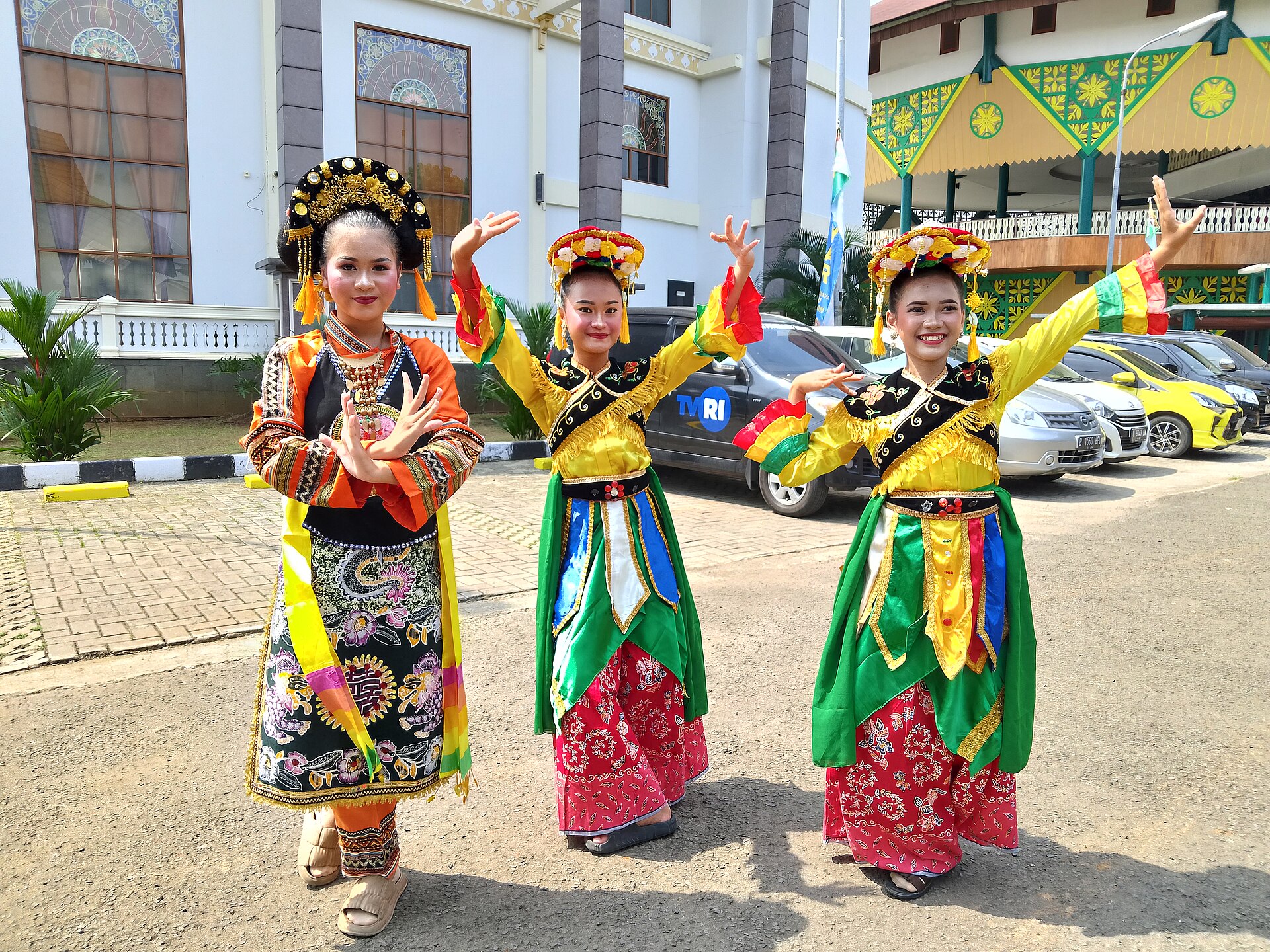
Jakarta is also, culturally, two things layered on top of each other. Underneath is Betawi culture — the creole people of old Batavia, a blend of Malay, Javanese, Sundanese, Chinese, Arab, Indian and Portuguese lines, with their own dialect, their own food and their own wedding rituals. On top of that sits the whole of Indonesia, because everyone comes to Jakarta for work: Javanese, Sundanese, Batak, Minangkabau, Bugis, Chinese-Indonesian, Papuan. The Javanese instinct for indirectness and hierarchy is the strongest single current in how people speak to each other, but a Batak colleague will be far blunter and nobody thinks that odd. Read the person, not the map. Our guide to the Betawi cultural village at Setu Babakan is the easiest place to see the local layer on its own terms.
Greetings, names and the first thirty seconds
The handshake that is not really a handshake
Indonesians shake hands, but not the way an American sales manager does. The grip is light — sometimes barely a grip at all, more a brief clasp — and it is released quickly. Immediately afterwards, most people touch their own right hand to their chest, over the heart. Do the same. It takes half a second and it signals that the greeting was sincere rather than transactional, and it is the single easiest thing you can copy on day one.
Between men and women, wait. Many Muslim women do not shake hands with men outside their family. The safe sequence is to offer a slight nod and a smile and let her extend a hand if she wants to; if she instead places her hand on her chest, mirror that. No offence has occurred in either direction. The same applies in reverse — a foreign woman meeting an observant Muslim man may find he does not offer a hand.
You will also see the salim: a younger person takes an older person’s right hand and brushes it against their own forehead or cheek. This is a family and community gesture of respect, most visible at Idul Fitri when children queue up to greet grandparents. You are not expected to perform it. You are expected to notice it happening and not walk through the middle of it.
Names, titles and what to call people
Get the honorifics right and you will be treated markedly better everywhere, from the immigration desk to the warung. They are simple:
- Pak (short for Bapak) — any adult man older than you, or in any position of authority or service. The driver, the security guard, the minister.
- Bu (short for Ibu) — the same for women.
- Mas — a younger man, roughly your own age or below. Javanese in origin but universal in Jakarta. This is what you call the waiter, the Gojek rider, the barista.
- Mbak — the female equivalent of Mas.
When in doubt, age up: calling a thirty-year-old Pak is a small flattery, calling a fifty-year-old Mas is a small insult. Use the title with the person’s first name, not their surname — Indonesians often have no surname at all, and where they do, the given name is still the one that gets used. Pak Joko, not Pak Widodo.
Many Indonesians have a single name, which routinely breaks Western booking forms. If a hotel or airline demands a surname from a local friend, the usual workaround is to repeat the name in both fields. It is a form-design problem, not a naming problem, and pointing it out as strange is a small unkindness.
The questions that are not actually nosy
Where are you from, are you married, do you have children, how old are you, what is your religion, how much do you earn. All of these are ordinary small talk in Indonesia and none of them is an intrusion. They are the way strangers locate each other socially — a way of working out which register of language and which honorific to use.
You do not have to answer honestly or in detail. “Belum” — “not yet” — is the culturally perfect reply to are-you-married and do-you-have-children, because it accepts the premise without committing to anything, and it will make people laugh. For religion, an answer is genuinely expected; Indonesia’s identity system recognises six official religions and “none” is a concept that lands oddly. Naming the tradition you were raised in, whatever your current practice, saves a long conversation.
Asking the same questions back is not just permitted, it is the polite move. Refusing to reciprocate makes you the strange one.
Hands, feet, heads and the space between people
Physical etiquette in Indonesia comes down to a handful of rules that are consistent across the archipelago and are worth internalising until they are automatic.
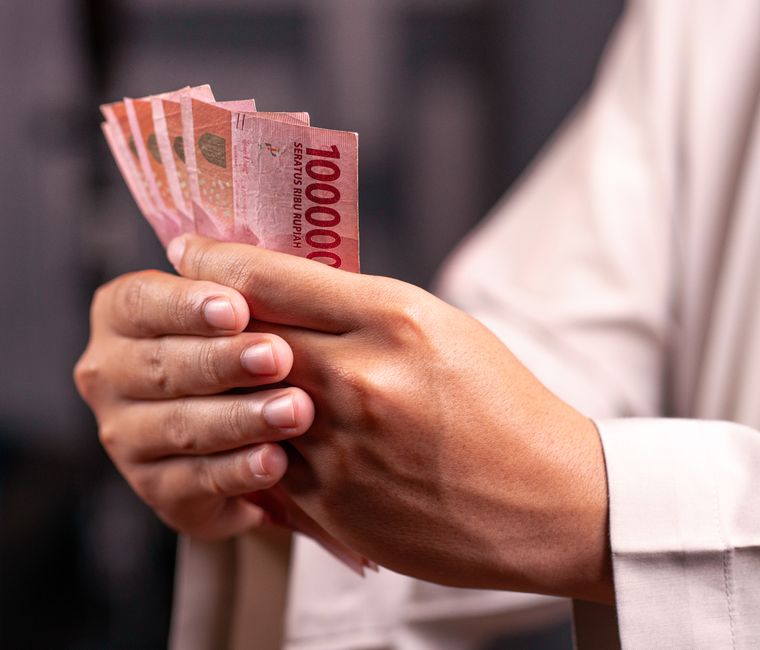
The right hand does everything social. Give and receive with the right hand, or with the right hand supported by the left touching your own forearm — the two-handed version reads as extra respect and is standard for business cards and gifts. Eat with the right hand if you are eating by hand. The left hand is reserved for bathroom hygiene, and handing someone food or money with it is roughly as welcome as sneezing into your palm and then offering a handshake. Left-handers get a pass on eating in practice, but not on giving.
Point with your thumb. An open right hand, or a thumb tucked over a closed fist, gesturing towards the thing. An extended index finger aimed at a person is aggressive. This matters more than you would expect when you are ordering food by pointing at a display case — use the thumb and you will notice the vendor relax.
Do not touch adult heads. The head is considered the most spiritually elevated part of the body. Ruffling a small child’s hair is usually fine and often affectionate, but never do it to a teenager or an adult, and never to anyone wearing a hijab or a peci.
Feet are the opposite. Do not point the soles of your feet at a person, an altar, a Qur’an or a photograph of someone. When you sit on the floor — at a mosque, at a traditional performance, in someone’s front room — tuck your feet behind you or sit cross-legged. Do not move objects with your foot, ever, including a dropped item on a shop floor.
Passing in front of someone. The Indonesian version is a small bow, right hand extended downward in front of you, and a murmured “permisi” — excuse me. It looks slightly theatrical the first time you do it and completely natural by the fourth. It is the single most useful physical habit to pick up, because Jakarta is crowded and you will be squeezing past people all day.
Public affection. Hand-holding is fine. Anything more than that — kissing, prolonged embraces — is not, including between married couples. This applies with more force outside the malls and nightlife districts of the south. Same-sex couples should be aware that visible affection attracts attention that is at best curious and occasionally hostile; more on that below.
Religion in ordinary daily life
Indonesia is not an Islamic state, but it is not a secular one either. The state ideology, Pancasila, opens with belief in one God, and religion is printed on the national identity card. Around 85 per cent of Indonesians are Muslim, and in Jakarta you will also meet Protestants, Catholics, Buddhists, Hindus and Confucians in significant numbers. This is a religiously observant city where interfaith coexistence is a matter of visible civic pride — the Istiqlal Mosque and the Catholic Cathedral face each other across a road in Central Jakarta and are now joined by an underground Tunnel of Friendship.
Prayer times and what they actually change
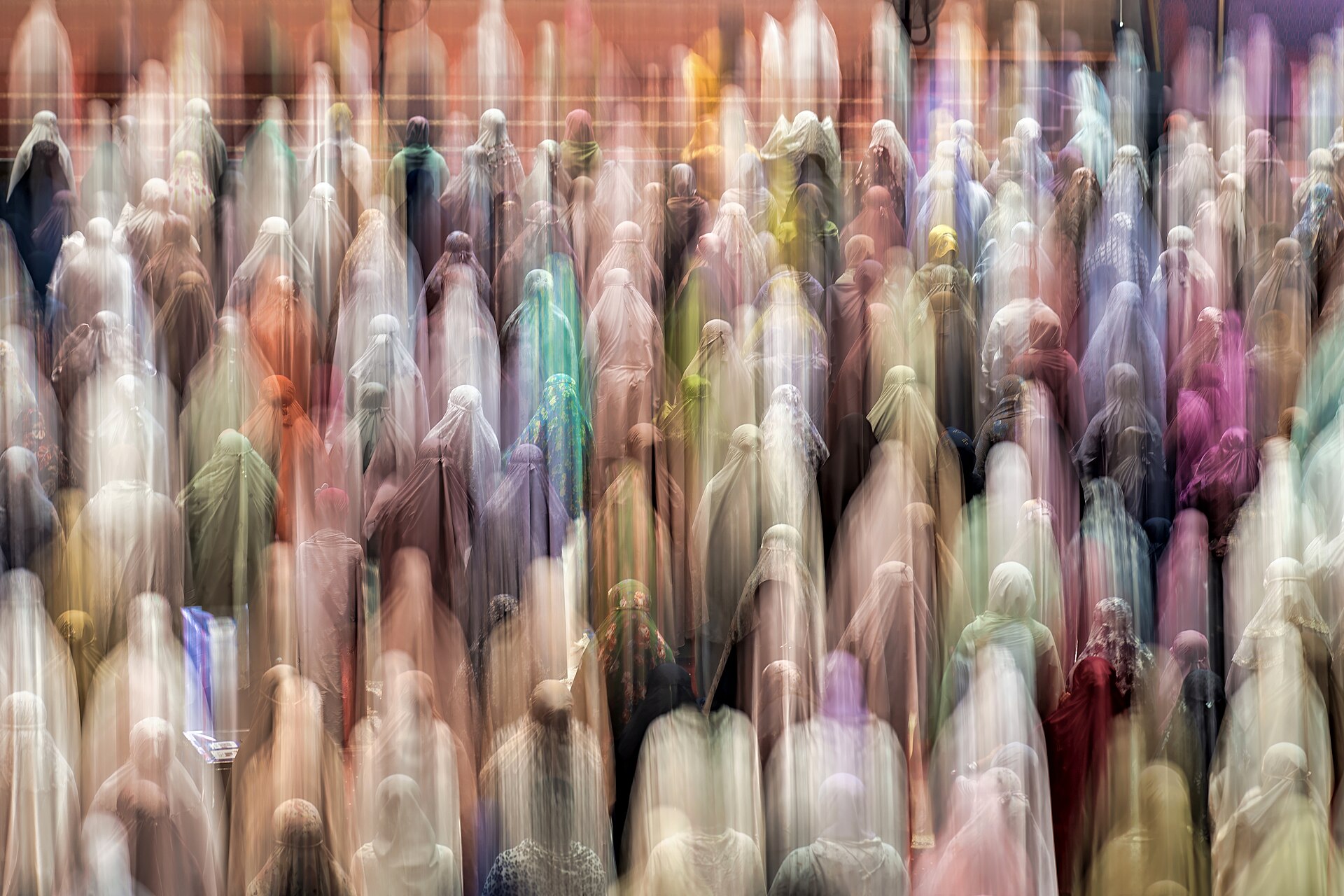
Muslims pray five times a day: subuh before dawn, dzuhur around midday, ashar mid-afternoon, maghrib at sunset, isya in the evening. The call to prayer, the adzan, is broadcast from mosque loudspeakers and there are a great many mosques. The pre-dawn one will wake you on your first night in a budget hotel and you will sleep through it by the third.
Practically, this means:
- Every mall, office tower, airport terminal, park and major station has a mushola — prayer room — usually signposted and separated by gender, with ablution taps outside. They are clean, they are free, and they are not tourist facilities, so do not wander through one taking photographs.
- Service in a restaurant or shop may pause briefly while a staff member prays. Wait. Visible impatience here is genuinely offensive.
- Friday midday is the big one. Jumu’ah congregational prayers pull men out of offices from roughly 11:30 to 13:30. Traffic around large mosques becomes impassable, some small businesses close entirely, and any meeting scheduled at noon on a Friday will be moved. Plan your Friday around it — this is exactly the kind of scheduling that our guide to avoiding Jakarta traffic exists to help with.
Visiting a mosque as a non-Muslim
You are welcome at Istiqlal and at most large mosques in Jakarta, and at Istiqlal you will be assigned a volunteer guide, usually a student, who genuinely wants to show you round. What is expected of you:
- Shoes off at the racks. Socks are fine.
- Long trousers or a long skirt; shoulders covered; women cover their hair. Loaner robes are provided at the entrance if you turn up unprepared, but arriving already dressed correctly is a courtesy in itself.
- Do not enter the main prayer hall during a prayer, and do not walk in front of someone who is praying.
- Photography of the building is fine. Photography of people mid-prayer is not, unless you have asked.
- Menstruating women are traditionally asked not to enter the prayer hall. Nobody will interrogate you about it.
Our full Istiqlal Mosque guide covers opening hours, the guided-tour arrangement and the donation convention in detail, and the temples and mosques overview does the same for the city’s other major religious sites.
Ramadan: what changes and what does not
During Ramadan, observant Muslims fast from dawn to sunset — no food, no water, no cigarettes. In Jakarta this is less totalising than in the Gulf: malls stay open, restaurants inside them serve normally, and nobody expects a foreign visitor to fast. But the texture of the city changes, and it is worth understanding before you book.
- Do not eat, drink or smoke on the street in daylight. Not illegal, but conspicuous and unkind. Eat inside, in a mall food court, or in your hotel.
- Small street warungs often hang a curtain across the front rather than close. Take the hint about discretion and go in.
- The hour before sunset is the worst traffic of the year. The entire city is trying to get home for buka puasa, the breaking of the fast, simultaneously. Do not schedule anything that needs to move across Jakarta between about 16:30 and 18:30.
- Being invited to a buka puasa is a genuine kindness and the food is extraordinary. Accept.
- Bars and clubs reduce hours or close outright for the month, and live-music venues thin out considerably.
- Idul Fitri — Lebaran — closes the month, and the week around it sees the mudik, the mass exodus of Jakartans back to their home villages. Millions leave. Transport is booked out solid, many small businesses shut for a week, and Jakarta becomes eerily, gloriously empty and easy to drive across. It is either the worst week to visit or the best, depending entirely on what you came for.
Because Ramadan follows the lunar calendar it moves about eleven days earlier each year, so check the dates against your travel plans rather than assuming. The Jakarta events and festivals calendar tracks it alongside the rest of the year.
Churches, temples and everything else
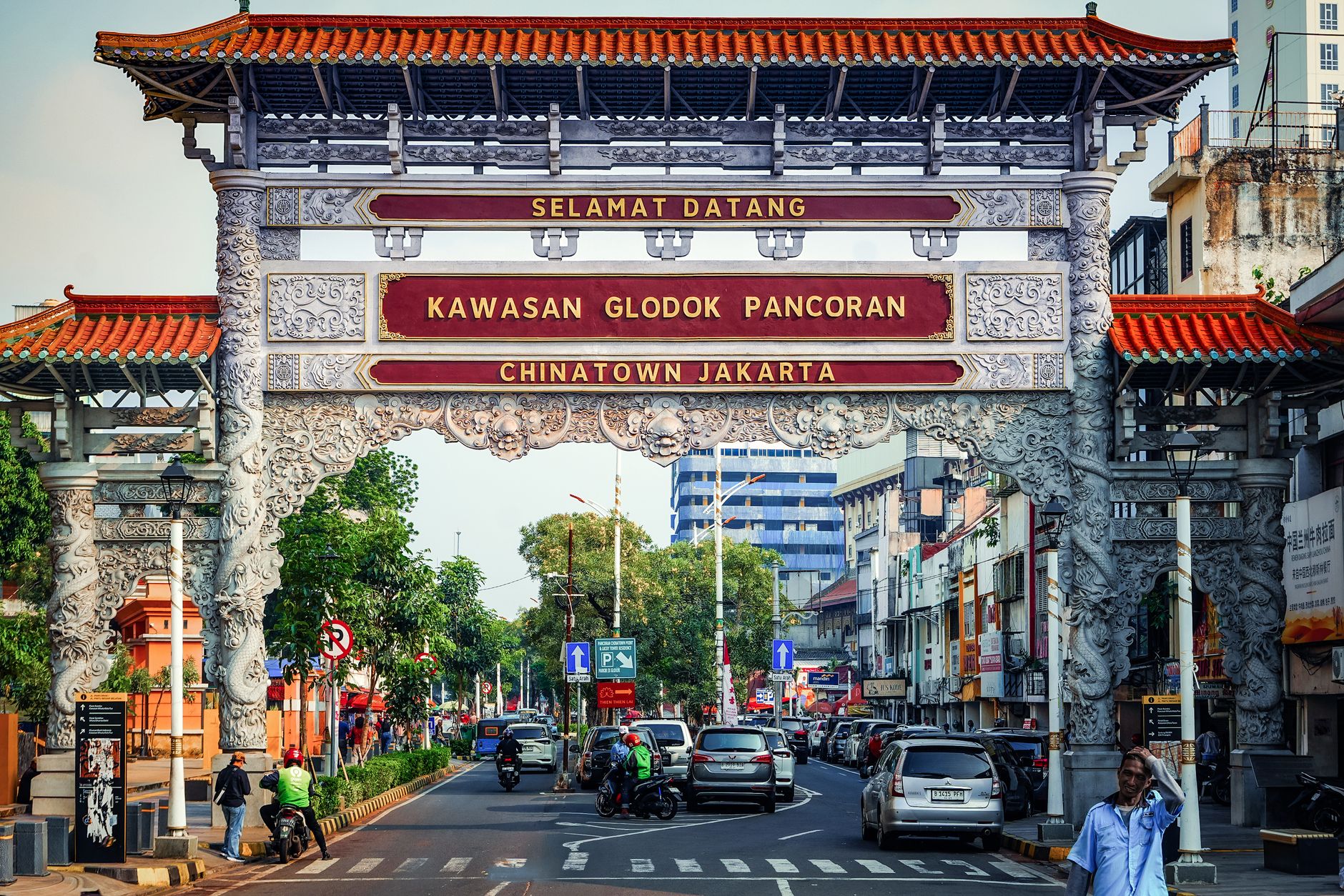
Jakarta Cathedral holds Mass in Indonesian and English and welcomes visitors outside service times. The Chinese temples of Glodok — Vihara Dharma Bhakti above all — are working places of worship rather than exhibits: burn incense if you are given a stick, do not point your camera into someone’s private prayer, and step over the raised threshold rather than on it. The same respect applies at the Hindu temples serving the Balinese and Indian communities. Nowhere in Jakarta will you be turned away for being the wrong religion; everywhere you will be judged, gently, on whether you behaved as though the space mattered.
How to dress in Jakarta
The climate says as little as possible — 25 to 32 °C year round with punishing humidity — and the culture says rather more than that. The resolution is lightweight fabric with reasonable coverage: linen, cotton, loose cuts, long sleeves that breathe. What not to do is dress for a beach holiday.
Everyday, out and about
For men, trousers or long shorts and a T-shirt or short-sleeved shirt is entirely normal. Going shirtless in public is not, anywhere, including near water. For women, the practical guidance is shoulders covered and hemlines at or below the knee for anywhere outside the malls and the southern nightlife strips. You will absolutely see young Jakartan women in Kemang or SCBD in outfits that contradict all of this, and they are on home ground with a network of context you do not have. A light scarf in your bag solves ninety per cent of the problem and doubles as protection against ferocious mall air conditioning — see what to pack for Jakarta for the rest of the list.
Places of worship
Shoulders, knees and cleavage covered for everyone. Hair covered for women in mosques. No shorts for men. Shoes off wherever there is a rack. Keep one outfit in the wardrobe that meets this standard and you never have to think about it again.
Restaurants, offices and rooftops
Jakarta’s upmarket restaurants and rooftop bars enforce smart-casual dress codes and mean it: no flip-flops, no vests, no sportswear, and increasingly no shorts for men after dark. Turning up in beachwear at a SCBD rooftop is the most common way visitors get refused entry in this city. Business dress is formal — a batik shirt is correct and often preferred for men at anything from a meeting to a wedding, which makes a good batik shirt the single most useful souvenir you can buy.
Eating: warung, restaurant, and somebody’s living room
At a warung or street stall
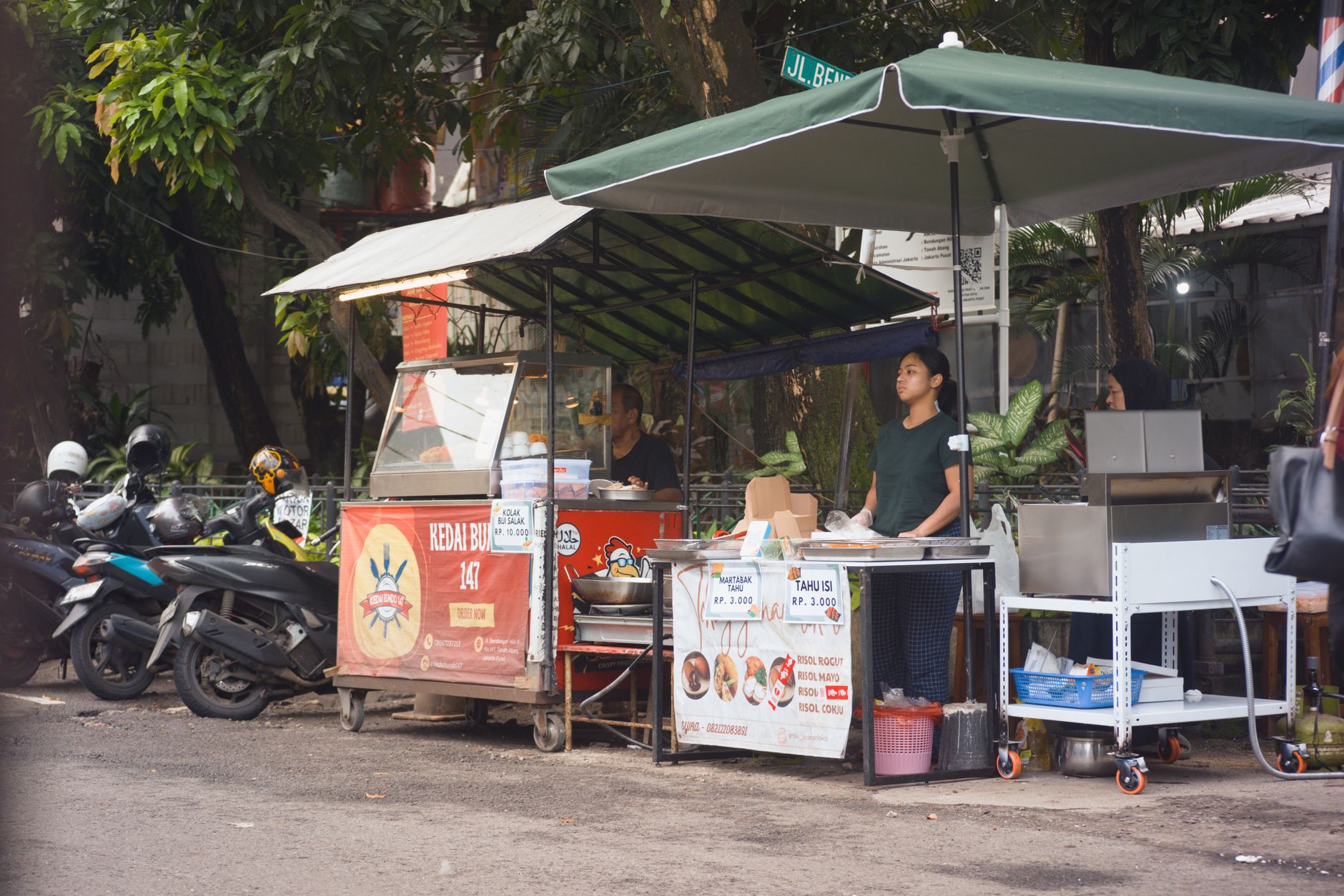
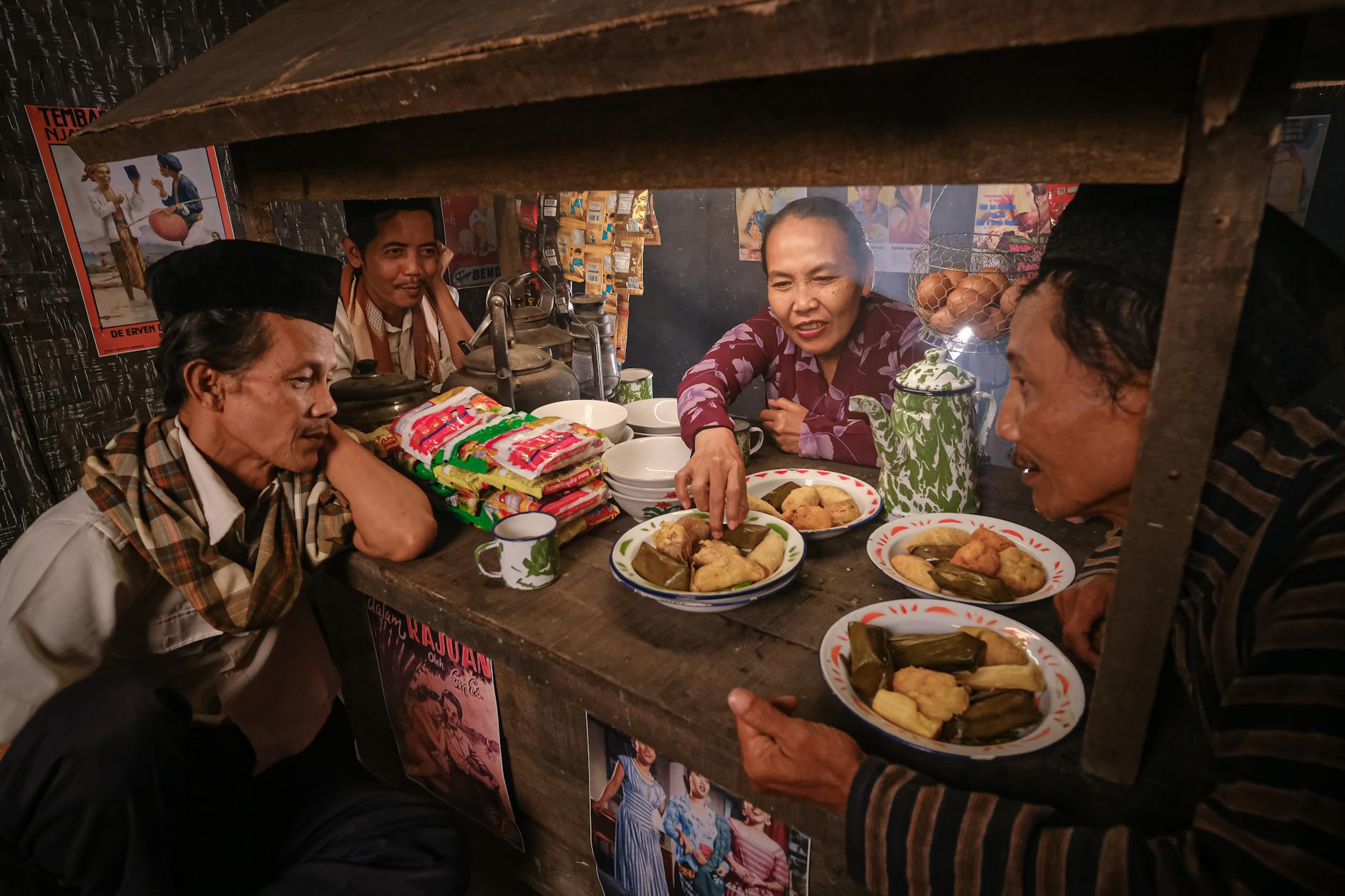
Sit down first, order after. At a nasi campur or Padang place you point at what you want from the display case — thumb, not finger — and it lands on rice. At a Padang restaurant specifically, a dozen small dishes may simply appear on your table uninvited; you are charged only for what you touch, so do not idly rearrange them. Cutlery is a spoon in the right hand and a fork in the left, used to push food onto the spoon, and the fork does not go into your mouth. Eating rice by hand is normal, right hand only, and nobody minds a foreigner using a spoon instead.
The price on the board is the price. No service charge, no tax, no tip expected. Say “terima kasih” when you leave. If you want to understand what you are actually looking at, our street food guide and the Betawi cuisine guide do the heavy lifting.
In a mid-range or upmarket restaurant
Menu prices are usually quoted “++”, which means a service charge of typically 5 to 10 per cent plus the local restaurant tax of 10 per cent gets added at the till. Together that is roughly 15 to 21 per cent on top of what you read on the menu, and it surprises people every time. Because service is already charged, an additional tip is optional — rounding up, or leaving 20,000 for genuinely good service, is generous rather than expected.
Eating in someone’s home
If you are invited to a Jakartan home, the rules tighten agreeably:
- Shoes off at the door unless told otherwise.
- Bring something. Fruit, good cakes, or something from your own country. Not alcohol unless you know the household drinks.
- Wait to be told where to sit, and wait for the host to say silakan — please, go ahead — before you start eating. Nobody eats first.
- Drinks arrive immediately. Do not touch yours until invited. Then at least sip it: leaving it entirely untouched suggests you suspect the household.
- Take a little of everything. Leaving a small amount on your plate is fine and in some readings signals you were well fed; clearing it completely may summon more food.
- You will be pressed to eat more. “Sudah kenyang” — I am already full — said with a smile is the correct exit, and you may need it three times.
Alcohol
Alcohol is legal in Jakarta and easy to find in bars, hotels, upmarket restaurants and larger supermarkets, but it is heavily taxed and it is not part of everyday life for most of the city. It is not sold in ordinary warungs or in the small Indomaret and Alfamart convenience stores. Expect bar prices several times what a supermarket charges. Getting visibly drunk in public is a much bigger social failure here than in Europe or Australia, and drinking in front of people who are fasting during Ramadan is worse. Jakarta’s bar and club scene is genuinely good and entirely legitimate — see the nightlife guide — it is simply not something that spills onto the street.
One serious warning that is not about manners: avoid unbranded or suspiciously cheap spirits anywhere in Indonesia. Methanol poisoning from adulterated arak and counterfeit spirits kills people every year. Drink branded product from a licensed venue or drink nothing.
Face, indirectness and the art of never saying no
This is the part that takes longest to learn and matters most. Indonesian social life, and Javanese social life in particular, is organised around not causing anyone embarrassment. Direct contradiction, public correction and blunt refusal all cause loss of face, and are avoided almost reflexively — which means the information you are receiving is frequently encoded.
Reading a “yes”
“Ya” often means “I have heard you”, not “I agree”. A genuine no is delivered as belum (not yet), mungkin (maybe), nanti (later), a sharp intake of breath, a laugh, or a change of subject. If you ask a driver whether he knows the way and he says yes while looking uncertain, he may mean he is confident he can find it, which is a different claim. The workaround is not to press harder — that only increases the pressure to agree — but to ask open questions instead of yes/no ones. “How long will it take?” beats “Can you do it by Tuesday?” every time.
Correspondingly, do not deliver bad news bluntly yourself. Soften, apologise, offer an alternative. And never, under any circumstances, dress someone down in front of other people. A raised voice in public does not signal that you are serious; it signals that you have lost control, and the room will side against you instantly and permanently. The calm, smiling, quietly persistent complainant gets results in Jakarta. The shouting one gets an immovable wall of politeness.
Jam karet
Jam karet — “rubber time” — is the standing joke about Indonesian punctuality, and like most standing jokes it is half true. Social arrangements genuinely do flex by half an hour without anyone considering it rude. Business meetings in Jakarta, however, start on time, and the traffic is the real reason plans slip rather than any cultural attitude towards clocks. Nobody in this city underestimates traffic on purpose; they underestimate it because it is genuinely unpredictable. Build in the buffer yourself, always cost a journey in minutes rather than kilometres, and forgive the person who is twenty minutes late from Kelapa Gading.
On the MRT, the bus and the street

Public transport in Jakarta runs on a stricter and better-observed code than the streets do, and the MRT is the best-behaved place in the city.
- No eating or drinking on the MRT. This is enforced, including water. Chewing gum too.
- Let passengers off before boarding. Floor markings show you where to stand, and people follow them.
- Priority seats are real. Elderly passengers, pregnant women, people with small children and disabled passengers get them, and a young Jakartan will stand up for a grandmother without being asked. Do the same.
- TransJakarta and the KRL have women-only carriages and bus sections, marked in pink. Men should not use them, and this is policed by fellow passengers. The KRL’s women-only carriages are at each end of the train.
- Queue. Jakarta queues far better than its traffic suggests.
- Keep your voice down and use headphones. Loud phone calls draw disapproving looks.
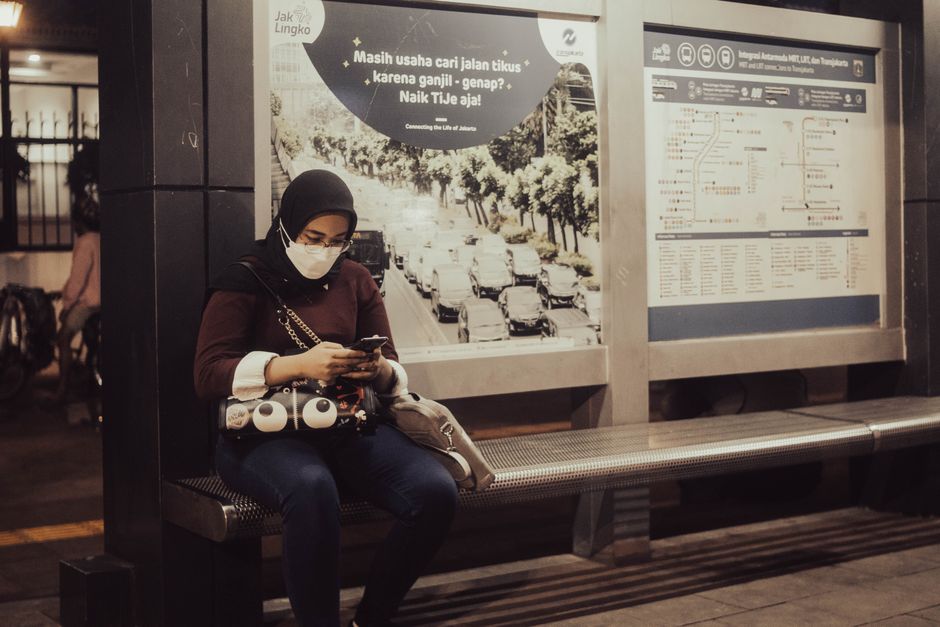
Practical detail on fares, cards and which line goes where is in the Jakarta MRT guide, the TransJakarta bus guide and the Jak Lingko card guide.
With ride-hailing, the etiquette is smaller but it matters: greet your driver, confirm the destination out loud, and if you are riding pillion on a Gojek, do not lean or shift your weight in corners. Rate honestly but generously — these are people’s livelihoods, and a low rating over traffic they did not cause is unfair. The Grab versus Gojek comparison covers the practicalities.
On the street, the rule is that crossing a road in Jakarta is a negotiation rather than a right. Make eye contact, raise a hand, walk at a constant predictable pace and do not stop halfway. Traffic flows around you. Hesitating and darting is what gets people hurt. Where a pedestrian bridge or a signalled crossing exists, use it.
Photography: what to ask and what not to shoot
Jakartans are, on the whole, delighted to be photographed and will often ask you for a selfie first — foreigners are still enough of a novelty in less-touristed districts that you may find yourself politely mobbed by a school group at Monas. Say yes if you are comfortable; it costs a minute and it is genuinely meant.
The courtesies going the other way:
- Ask before photographing an individual, especially a woman, an older person or a child. “Boleh foto?” — may I take a photo? — is enough.
- Do not photograph people praying without permission, and never inside a prayer hall mid-prayer.
- Do not photograph military or police installations, and be cautious around government buildings. There is no need to test this.
- Kampung housing and poverty are not a photo opportunity. If you would not shoot it in a poor neighbourhood at home, do not shoot it here.
- Drones require permission and are restricted over much of central Jakarta. Check the current rules before you fly one; do not assume.
Money, bargaining and tipping
Bargaining is expected in traditional markets — Tanah Abang, Pasar Baru, the antique stalls at Jalan Surabaya — and not expected anywhere with a price tag, which means malls, supermarkets, chains and restaurants. Where you do bargain, do it cheerfully. Open at around 50 to 60 per cent of the asking price, settle somewhere in the middle, and remember that the gap you are fighting over is often less than the price of a coffee at home. Walking away is a legitimate tactic; sneering at the goods is not, and grinding a vendor down to the last thousand rupiah over a 50,000 item makes you look small rather than shrewd. Our traditional markets guide has the district-by-district version.
Tipping conventions, since they come up constantly:
| Who | Convention |
|---|---|
| Warung, street food, food court | Nothing. The board price is the price |
| Restaurant with a service charge | Optional. Round up, or 20,000 for excellent service |
| Restaurant without one | 5–10% if you were looked after |
| Grab / Gojek | Round up in the app; small cash tip for a hard ride |
| Blue Bird taxi | Round up to the nearest 10,000 |
| Hotel porter | 10,000–20,000 per bag |
| Housekeeping | 20,000–50,000 per night, left in the room |
| Private driver for a full day | 100,000–150,000 on top of the roughly 1,000,000 day rate |
| Tour guide | 100,000–200,000 per day per group |
| Parking attendant who waves you out | 2,000–5,000. Genuinely useful, genuinely expected |
Carry small notes. The 2,000 and 5,000 notes are the working currency of daily courtesy in Jakarta and nobody will have change for your 100,000 at a food cart. Full cost planning lives in the Jakarta trip cost breakdown.
The lines worth knowing about
Most of this guide is about being a pleasant guest. This section is about staying out of actual trouble, and it is short because Jakarta is not a dangerous or heavily policed city for ordinary visitors.
Drugs. Indonesia has some of the harshest narcotics laws in the world, including capital sentences for trafficking and long custodial terms for possession. There is no quantity small enough to be safe and no nightlife venue where it is quietly tolerated. Do not carry anything for anyone, ever.
The revised criminal code. Indonesia’s new KUHP came into force on 2 January 2026. It criminalises sex outside marriage and unmarried cohabitation. Critically, these are delik aduan — complaint offences — and only a legal spouse, parent or child may lodge the complaint. Hotel staff, neighbours and passers-by have no standing, hotels are not required to check marital status, and unmarried couples are not being refused rooms. The practical risk to a visitor is very low. It is not zero, and the sensible reading is that relationships formed locally carry more exposure than a couple arriving together. Check your own government’s current travel advice before you go, because both the law and its enforcement are being actively debated.
LGBTQ+ travellers. Same-sex activity is not criminalised at national level, and Jakarta has a quiet, real queer scene. It is also a socially conservative city where public affection between same-sex couples attracts unwelcome attention, and where police raids on venues have happened. Most LGBTQ+ visitors travel here without incident by being discreet in public. Same-sex couples booking a twin room raise no eyebrows at all.
Blasphemy. Indonesia enforces blasphemy provisions and has jailed people over social media posts. Do not make jokes about religion — any religion — online or in public.
Politics. Discussing Indonesian politics with people you have just met is fine in general terms and unwise in strong ones. Papua and the 1965 killings are live, painful subjects. Listen more than you talk.
None of this should feel ominous. Jakarta’s practical safety situation — petty theft, traffic, the everyday stuff — is covered properly in is Jakarta safe, and the answer there is a fairly confident yes.
The Indonesian worth learning
Bahasa Indonesia is one of the easiest major languages to make a start in: no tones, no verb conjugation, no grammatical gender, and a Latin alphabet with consistent phonetic spelling. Twenty words will transform how you are treated, because so few visitors bother.
| Indonesian | English | When |
|---|---|---|
| Selamat pagi | Good morning | Until about 11:00 |
| Selamat siang | Good day | About 11:00 to 15:00 |
| Selamat sore | Good afternoon | About 15:00 to sunset |
| Selamat malam | Good evening | After dark |
| Terima kasih | Thank you | Constantly. Reply is sama-sama |
| Permisi | Excuse me | Squeezing past, getting attention |
| Maaf | Sorry | Apology, or before a question |
| Tolong | Please (asking for something) | “Tolong, Pak…” |
| Silakan | Please (go ahead) | Offering a seat, food, passage |
| Berapa? | How much? | Markets, taxis, everything |
| Terlalu mahal | Too expensive | Bargaining, said with a smile |
| Enak! | Delicious! | The single highest-value word in Indonesia |
| Tidak pedas | Not spicy | Say it early. Indonesian spicy is spicy |
| Tidak pakai babi | Without pork | Halal requests |
| Sudah kenyang | I’m already full | The polite refusal of a fourth helping |
| Belum | Not yet | Answer to married? children? and much else |
| Di mana…? | Where is…? | Add toilet, stasiun, musala |
| Bisa bahasa Inggris? | Do you speak English? | Better than assuming |
Pronunciation is close to Italian: c is “ch”, j is “j” as in jam, vowels are pure, and stress usually falls on the second-to-last syllable. Say “terima kasih” as tuh-REE-mah KAH-see and you will be understood everywhere.
What honestly does not matter
A short list, because a lot of etiquette advice about Indonesia is anxious out of proportion to reality.
- You will not offend anyone by being a foreigner. Curiosity, not hostility, is the default response to your presence.
- Being stared at is not aggression. Outside the malls and the expat districts, foreigners are interesting. A smile ends it every time.
- Small mistakes evaporate. Hand something over with the wrong hand and nobody will say a word or think about it again. It is the pattern of effort that registers, not the individual slip.
- You do not need to fast during Ramadan, cover your hair outside a mosque, or eat with your hands. Nobody expects any of it.
- “Bule” is not an insult. It is simply the word for a white foreigner, and it is used descriptively far more often than pointedly.
The honest verdict on etiquette here is that the anxiety is worse than the reality. This is a warm, forgiving, socially generous city, and the two things that will actually get you into trouble are losing your temper in public and dressing for a beach in a working capital. Fix those two and everything else is decoration. If you want the wider practical picture, the Jakarta travel tips guide is the hub for all of it.
Frequently asked questions
Do I need to cover my hair in Jakarta?
Only inside a mosque. Jakarta is not a city where non-Muslim women are expected to cover their hair in daily life, and you will see plenty of local women who do not. Carry a light scarf so you are never caught out at a mosque door, and use it against the air conditioning the rest of the time.
Can I wear shorts in Jakarta?
Men, yes, in most everyday contexts — longer shorts rather than very short ones. Women can too, though knee-length or longer draws less attention outside the malls. Shorts are not acceptable in mosques, and many upmarket restaurants and rooftop bars refuse them after dark for men. Never go shirtless in public.
Is it rude to refuse food or drink in Indonesia?
Refusing outright is read as rejecting the host rather than the dish. Accept, take a little, and say “sudah kenyang” — already full — when you have had enough. Leaving a small amount on the plate is fine. If you have a genuine dietary restriction, explain it clearly at the start rather than declining plate by plate; Indonesians are very used to halal, vegetarian and allergy requirements.
Do people speak English in Jakarta?
In hotels, malls, upmarket restaurants, the airport and among younger professionals, generally yes. With drivers, market vendors, warung staff and older people, often not. Google Translate’s offline Indonesian pack works well, and twenty words of your own works better.
How much should I tip in Jakarta?
Nothing at warungs and street stalls. Rounding up for drivers and taxis. Around 10,000 to 20,000 per bag for hotel porters and 20,000 to 50,000 a night for housekeeping. Restaurants above the warung level usually add a service charge of 5 to 10 per cent plus a 10 per cent restaurant tax, so anything further is genuinely optional.
Is it safe to visit Jakarta during Ramadan?
Yes, and it is a rewarding time to be here. Restaurants in malls stay open, hotels operate normally and nobody expects you to fast. Avoid eating, drinking or smoking on the street in daylight, expect brutal traffic in the hour before sunset, and be aware that bars and clubs cut back or close for the month.
What should I not do in Jakarta?
Do not hand things over with your left hand, do not point your index finger at people, do not touch adult heads, do not lose your temper in public, do not go shirtless or wear beachwear away from a pool, do not eat on the street during Ramadan daylight hours, and do not go anywhere near drugs. That list covers virtually every way a visitor gets into difficulty here.
Should I bargain in Jakarta?
In traditional markets and with street vendors, yes — open around half the asking price and settle in the middle, cheerfully. Anywhere with a price tag, no. Malls, supermarkets, chain restaurants and metered taxis are all fixed price and haggling there is simply awkward.
Is Jakarta conservative?
More conservative than Bali, less than you may be imagining. Central and eastern districts are noticeably more traditional than the southern belt around Kemang, Senopati and SCBD, where dress and behaviour are close to any other Asian capital. The sensible approach is to dress and behave for the more conservative end and enjoy the fact that the other end exists.
Related Jakarta Guides
- Jakarta Travel Tips: Everything to Know Before You Go
- Is Jakarta Safe? Honest Safety Advice for Visitors
- What to Pack for Jakarta
- Istiqlal Mosque: Visitor’s Guide
- Setu Babakan Betawi Cultural Village
- Cultural Experiences in Jakarta
- Traditional Markets in Jakarta
- The Jakarta MRT Guide
- Betawi Cuisine: What to Eat in Jakarta
- Getting Around Jakarta
Photo Credits
Tarawih prayers at Istiqlal Mosque: Portrait of Muslim Community Performing Tarawih Prayers at Istiqlal Mosque, Jakarta by Arifmuttaqin, CC BY-SA 4.0, via Wikimedia Commons.
Betawi dancers in traditional dress: Three Betawi Dancers 20240622 115231 by Naval Scene, CC BY-SA 4.0, via Wikimedia Commons.