Most visitors give this district ninety minutes: a coffee at Tak Kie, a look at a temple, a few photographs in the market lane, then back on the bus. That is a mistake, and not a small one. Glodok Chinatown Jakarta is not a food stop attached to the old town. It is the oldest continuously inhabited Chinese quarter in Indonesia, the product of a colonial segregation order issued after a massacre, and a place where the twentieth century did specific, documented violence to the people who live in it. Understanding that changes what you see in the lanes.
Glodok sits in Taman Sari, West Jakarta, immediately south of the colonial core. Read it alongside the Jakarta neighbourhoods guide for how it fits the wider city, the Kota Tua neighbourhood guide for the Dutch town it was pushed out of, and the North Jakarta and Ancol guide for the port that brought everyone here in the first place. If you have already read our eating in Kota Tua piece, this article goes considerably further than its Glodok section.
Why the Largest Chinatown in Southeast Asia Ended Up Here
Glodok is frequently described as the largest Chinatown in Southeast Asia. Measured by population of Chinese descent within a contiguous historic quarter, that claim holds up reasonably well, though nobody has ever run a definitive count and Jakarta’s Chinese-Indonesian community has long since spread across the city to Pluit, Kelapa Gading, Pantai Indah Kapuk and beyond. What is not in dispute is that Glodok is the oldest. And it exists where it does because of a deliberate decision made in 1740.
The VOC and the walls
Chinese traders were in Java long before the Dutch, but the Dutch East India Company actively recruited them. Batavia’s early economy ran on Chinese labour and Chinese capital: sugar mills in the hinterland, arak distilling, carpentry, market gardening, shipping, tax farming. By the 1730s tens of thousands of Chinese lived in and around the city. The VOC found this useful and threatening in equal measure, and restricted where they could live, requiring permits and pushing new arrivals to settle outside the fortified town.
Then the sugar market collapsed. World prices fell, mills closed, and thousands of Chinese labourers around Batavia lost their work. The Company’s response was to talk about deporting the unemployed to Ceylon, and rumours spread that the deportees were being thrown overboard at sea. In late 1740, bands of dispossessed Chinese workers armed themselves and moved on the city.
1740, and the Angke
What followed on 9 October 1740 and over the days after is known in Indonesian as Geger Pecinan, the Chinatown tumult. Dutch soldiers, sailors, militia and opportunistic civilians went through the Chinese quarter inside the walls, burning houses and killing residents indiscriminately. Contemporary and later estimates range from around a thousand to roughly ten thousand dead. Hospital patients were killed in their beds. Bodies were dumped in the river west of the city, and local tradition holds that the Angke takes its name from Hokkien words meaning red river, though etymologists dispute this and the name may well predate the killing. Either way, the association stuck.
In November 1740, with the surviving Chinese population scattered or hiding, the VOC formalised segregation: Chinese residents were to live in a designated zone outside the city walls, to the south. That zone is Glodok. Every lane you will walk exists because of a colonial order issued in the aftermath of a pogrom, and the temples were rebuilt on ground the Company assigned. The colonial architecture and history guide covers what the Dutch built on the other side of that boundary.
The New Order silence, 1967 to 1998
The second rupture came under Suharto. After the violence of 1965 and 1966, in which Chinese Indonesians were widely and falsely associated with communism, the New Order pursued a policy of forced assimilation. Presidential Instruction 14 of 1967 restricted Chinese religious observance, beliefs and customs to the private and family sphere. Chinese-language schools were closed and Chinese-language teaching was banned. Chinese-language media was reduced to a single state-supervised outlet. Chinese characters largely disappeared from shopfronts. Millions of people were pressured into adopting Indonesian-sounding names, and Chinese Indonesians carried identity documents that marked them out.
For 32 years, Chinese New Year in Glodok was something you did behind a closed door. Lion dances were not permitted in the street. Temples continued to function, which is why several of them adopted Sanskrit-derived Indonesian names and the label vihara, but public expression of Chinese identity was suppressed. If you are wondering why so many older Chinese Indonesians speak no Mandarin or Hokkien, that is the reason.
May 1998
The third rupture is the one nobody in Glodok has forgotten. Over three days in mid-May 1998, as the Asian financial crisis destroyed the economy and Suharto’s rule collapsed, organised mobs attacked Chinese-owned businesses and homes across Jakarta. Glodok was among the worst-hit areas. Harco Glodok was looted. Glodok Plaza was set alight, and large numbers of people died inside it. Official and NGO tallies for the riots citywide run to around 1,200 to 2,200 dead, over a thousand buildings destroyed, and documented cases of mass rape targeting ethnic Chinese women. There has never been a prosecution of anyone for organising it.
Handle this appropriately if the subject comes up in conversation. It is within living memory for anyone over forty in this district, families lost businesses and relatives, and a significant number emigrated and did not return. It is not an anecdote to collect.
Gus Dur, and the lanterns coming back
In January 2000, President Abdurrahman Wahid, universally known as Gus Dur, issued Presidential Decree 6 of 2000, revoking the 1967 instruction and permitting Chinese Indonesians to celebrate their traditions and practise their faith openly. Confucianism was subsequently recognised again as an official religion. In 2002 President Megawati Sukarnoputri declared Imlek, Chinese New Year, a national public holiday, first observed as such in 2003.
The visible result is everything you see: the red lanterns strung across the lanes, the lion dance troupes, the Chinese characters back above the shopfronts, the Cap Go Meh processions. It is barely a generation old as public practice. Gus Dur’s portrait hangs in a lot of Glodok shops for a reason. Our Jakarta interfaith heritage guide sets this alongside the city’s other religious communities.
Jin De Yuan: Jakarta’s Oldest Chinese Temple
On Jalan Kemenangan III stands the temple known by three names: Jin De Yuan in Mandarin, Kim Tek Ie in Hokkien, and Vihara Dharma Bhakti in Indonesian. It was founded in 1650 by a Chinese lieutenant, Kwee Hoen, as Koan Im Teng, a hall dedicated to Guanyin, the bodhisattva of compassion. It was destroyed in 1740 with the rest of the quarter and rebuilt in 1755 by Kapitan Oei Tjhie, who gave it the name Kim Tek Ie, golden virtue.
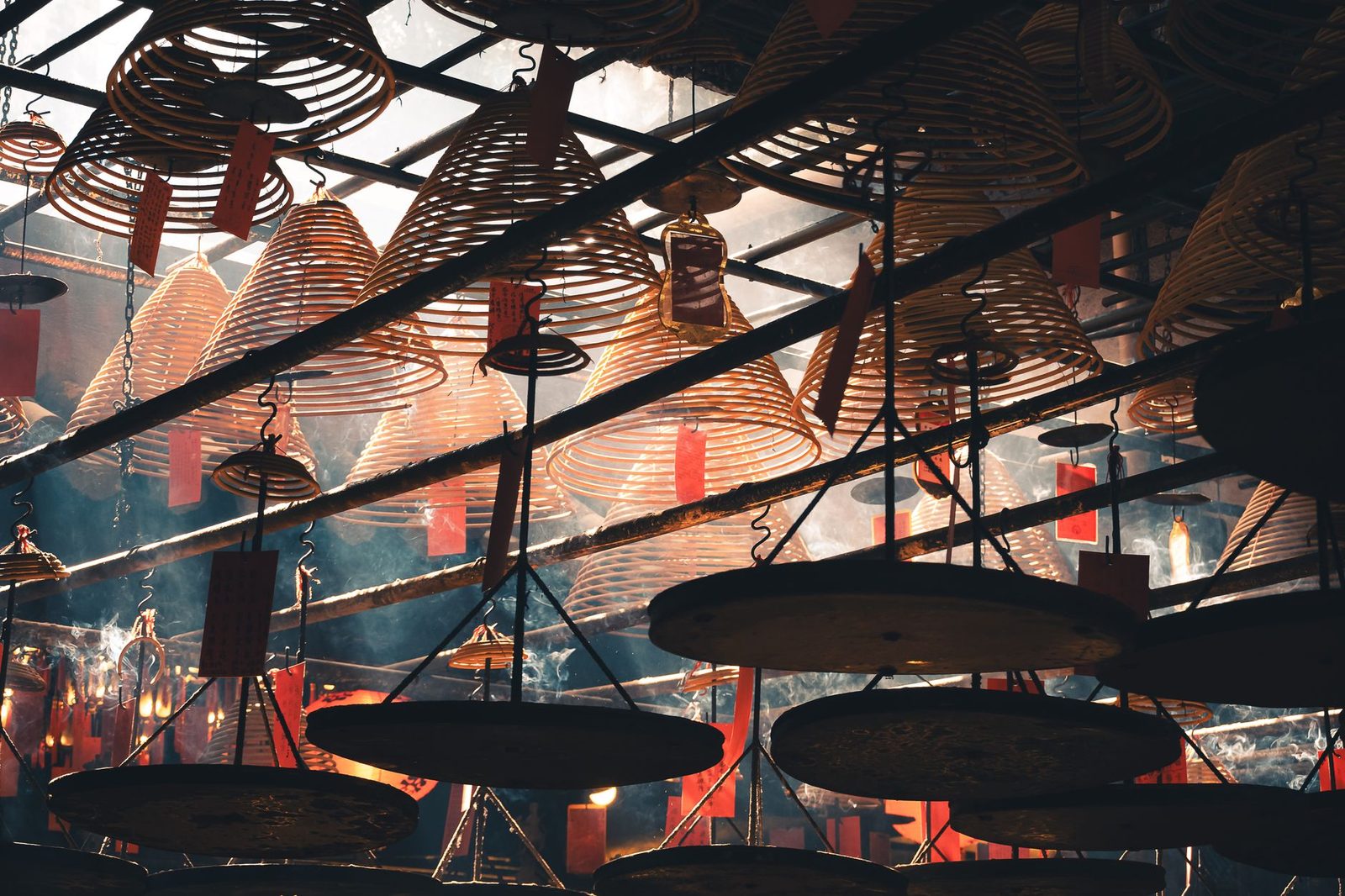
On the morning of 2 March 2015 it burned. A tarpaulin hung too close to a bank of candles caught, the fire spread through the timber structure, and the ornamented roof frame and around forty historic statues were destroyed. The rebuild has been slow and at times stalled, complicated by a long-running dispute between the foundations that claim responsibility for the temple. What that means for a visitor is that the complex you walk into is a working temple, not a museum piece, with restored sections, sections still under repair, and the daily rhythm of worship carrying on regardless. Go anyway. The smoke, the scale of the incense coils hanging from the ceiling, the stacked candle offerings and the ash-thick urns are the point, not the joinery.
Entry is free. There is no ticket office and no set opening hours in the way a museum has them; in practice the gates are open from early morning, around 06:00, until evening, and the temple is busiest at dawn, on the first and fifteenth days of the lunar month, and overwhelmingly so at Imlek. A donation box sits near the main hall and a few thousand rupiah is appropriate if you take photographs.
Toasebio and the Smaller Temples
Jin De Yuan gets the visitors, but it is not alone. Vihara Toasebio, a short walk away on the same street, is a smaller, quieter and in some ways more atmospheric temple, dedicated principally to a Chinese deity of local Hokkien devotion and still very much a neighbourhood place of worship rather than a stop on a tour. On a weekday morning you may be the only outsider inside.
Scattered through the surrounding lanes are further small shrines and klenteng, some tucked into the ground floors of shophouses, several with Buddhist, Taoist and Confucian elements layered together in the way Chinese Indonesian religious practice generally is. A few, notably in the wider Kota Tua and Ancol area, are older or more significant than their size suggests. Our guide to Buddhist temples in Jakarta maps the main ones, and the Tian Hou temple guide covers the sea-goddess temple that anyone interested in the maritime Chinese community should see. For the citywide picture across faiths, see temples and mosques in Jakarta.
Etiquette, and the photography question
These are functioning places of worship where people are praying, not photo sets. The rules are straightforward and largely unwritten. Cover shoulders and knees; a sarong is not required but a vest and shorts will draw looks. Remove hats. Walk around people making offerings, never in front of them. Do not point the soles of your feet at an altar, and do not touch statues, offerings or the divination blocks. If you want to light incense you are usually welcome to, but ask or watch first, and buy from the stall rather than taking from a bundle already offered.
On cameras: photography is generally tolerated and often actively fine, but there are three hard limits. No flash, ever, indoors. Do not photograph individuals at prayer at close range without asking, which in practice means using distance and a wide frame or simply not doing it. And do not climb on anything or block a doorway for a shot. If someone waves you off, put the camera away immediately without negotiating. A donation on the way out is good manners if you have taken pictures.
Petak Sembilan and Gang Gloria
Petak Sembilan is the market that runs through the lanes around Jalan Kemenangan and Jalan Pancoran, and it is where Glodok stops being picturesque and starts being real. It has been trading in some form for roughly two centuries. It is a wet market, which means exactly what it sounds like: fish on ice with the meltwater running across the floor, live frogs in tubs, eels, poultry, whole pigs’ heads, plus dried goods you will not see elsewhere in Jakarta. Dried seahorses, dried lizards, ginseng roots by the kilo, preserved plums, mushrooms in twenty grades, kue keranjang stacked in towers before New Year.
Is it for you? Honest answer: it depends entirely on your tolerance. The lanes are narrow, motorbikes push through them anyway, the floor is wet, the smell is strong in the meat section, and the animal-welfare standards will upset some visitors. It is not sanitised and nobody is performing for tourists. If that reads as an obstacle, skip the meat lanes and stick to Gang Gloria and the dry goods. If it reads as the reason to come, arrive by 07:00, when the market is at full intensity and the produce is fresh. By 11:00 it is winding down and by mid-afternoon it is largely over. Bring small notes and wear shoes you do not mind ruining. Our traditional markets guide and the Jakarta food markets guide put it in context with the rest of the city’s markets.
Gang Gloria is the narrow food alley within the same warren, and it is the single best-known lane in Glodok. It is barely two metres wide, hung with signage, and lined with stalls that have been in the same families for generations: noodle sellers, mie kangkung, kari, sekba, and the coffee shop everyone comes for.
Pantjoran Tea House and the Patekoan Tradition
At the corner where Jalan Pancoran meets the main road stands a two-storey colonial-era building that opened in 1928 as Apotheek Chung Hwa, one of the oldest pharmacies in the city. It was restored in 2015 and reopened as Pantjoran Tea House, and it is now the most comfortable place in Glodok to sit down.
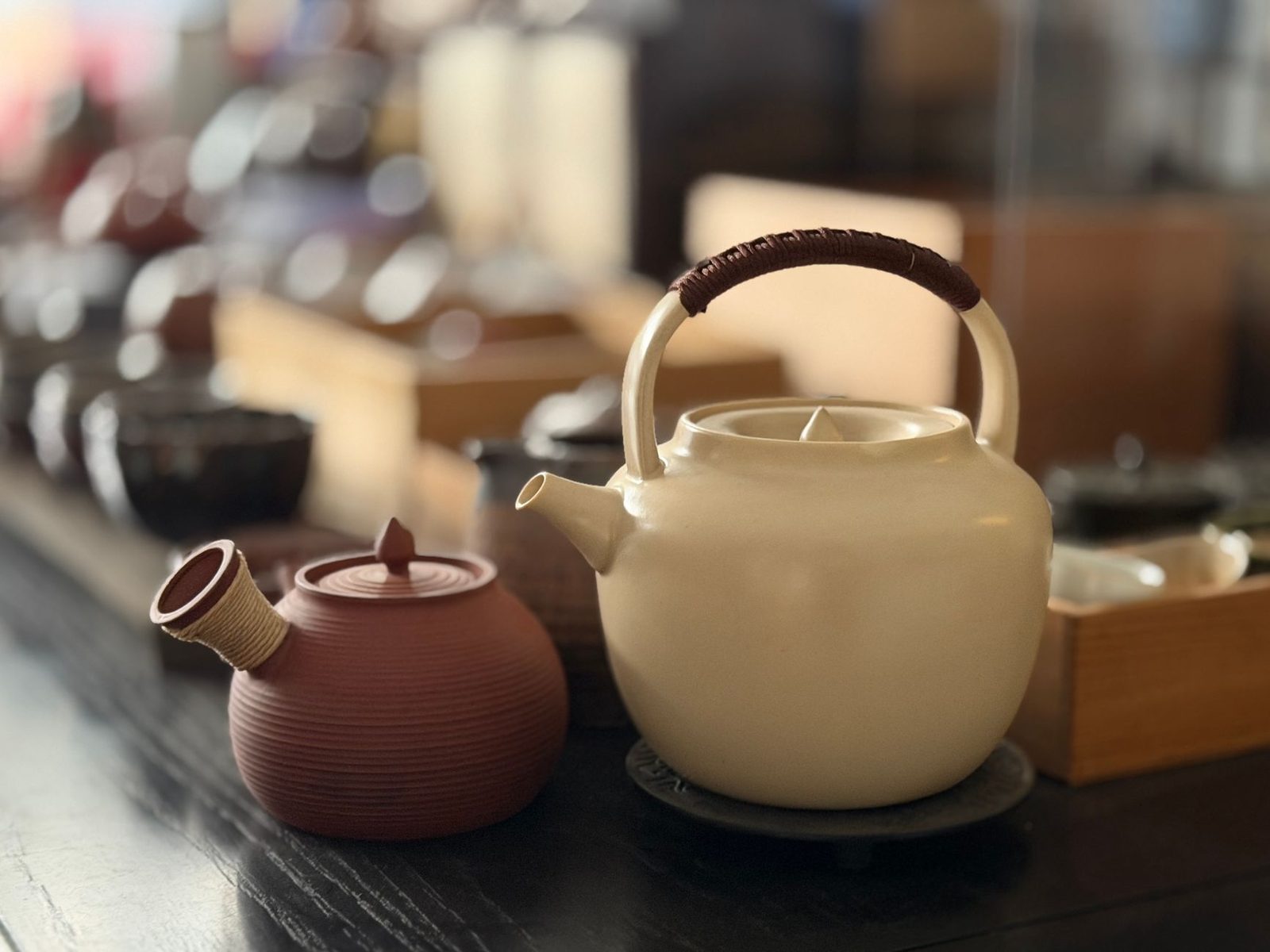
Outside the entrance is a table with eight teapots and a rack of clean glasses, marked free tea. This is patekoan, from the Hokkien for eight teapots. The tradition is attributed to Gan Djie, a seventeenth-century Chinese kapitan of Batavia, who at his wife’s suggestion set out eight pots of tea outside his office each day for labourers, porters and passers-by walking in the heat. The pots have been refilled here since the restoration, and the name of the street itself, Pancoran, derives from the water spouts that once ran along it. Pour yourself a glass. It costs nothing and it is genuinely refreshing after the market.
Inside, the tea house serves premium Chinese teas by the pot with local snacks: bakpao, kue keranjang, peranakan dishes. Reckon on Rp 40,000 to Rp 90,000 for a pot of tea and Rp 50,000 to Rp 120,000 for a plate of food, with service and tax added. The free tea table is generally out from around 08:00 to 18:00; the restaurant keeps longer hours and the upstairs room tends to open only at weekends. Hours here have shifted more than once, so treat those as indicative.
The Herbal Medicine Lanes
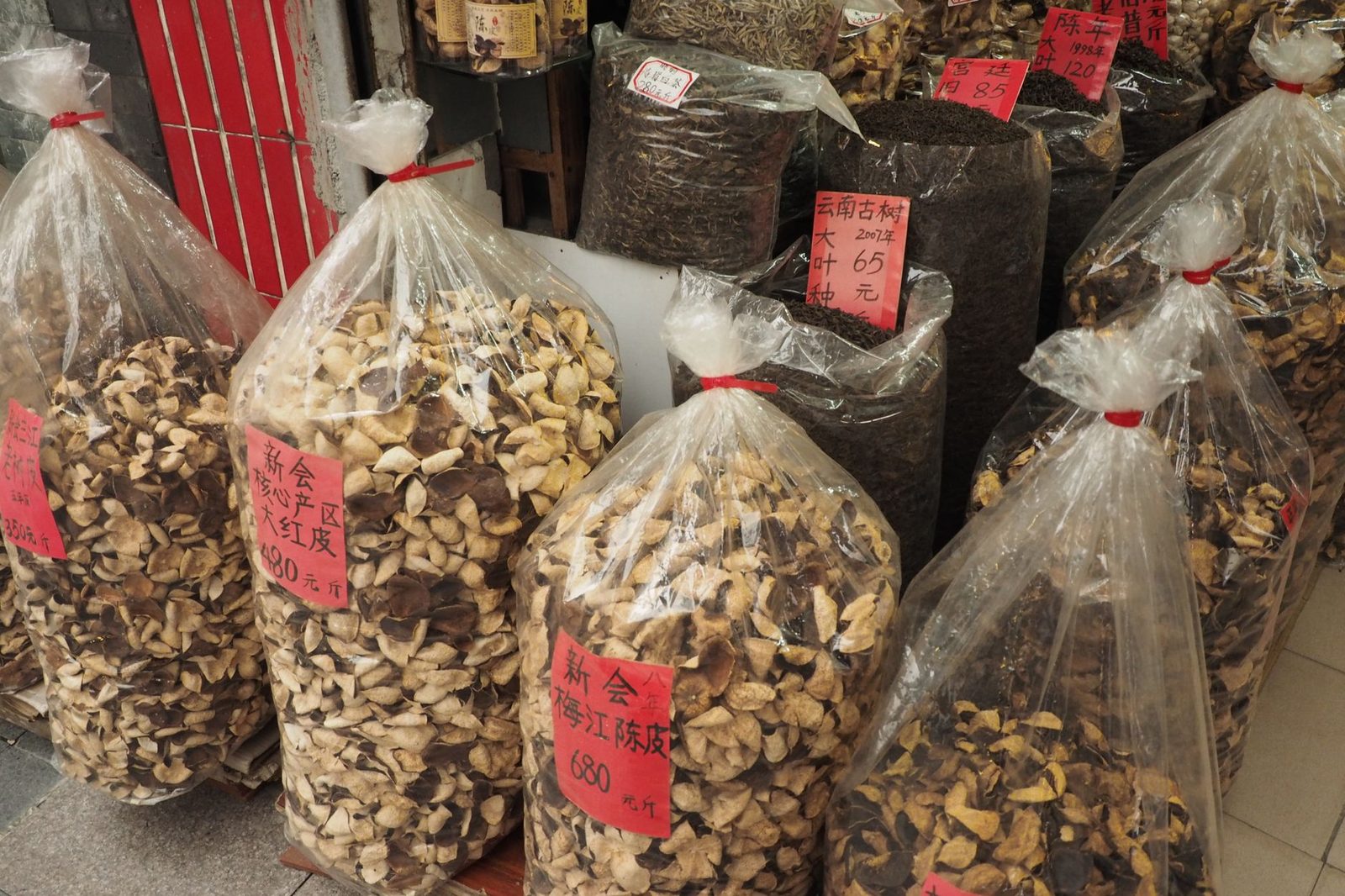
Jalan Pancoran Raya and the streets branching off it hold the largest concentration of traditional Chinese medicine shops in Indonesia. Many were founded in the Dutch period and are now run by third or fourth-generation owners. You will smell them before you see them: a dry, bitter, resinous air that hangs over the whole block.
Inside, the walls are floor-to-ceiling wooden drawers and glass jars. Dried roots, bark, fungus, seahorse, deer antler, ginseng graded by age and origin, birds’ nest at genuinely startling prices. Some shops keep a sinshe, a practitioner who diagnoses by taking the pulse at both wrists and asking questions, then blends a prescription weighed out on a hand balance and wrapped in paper. Others are straightforward retailers of packaged patent medicines.
As a visitor, the sensible approach is to look rather than buy. Do not take an unlabelled herbal prescription home; customs regimes vary and some traditional preparations contain species restricted under CITES, which is a serious matter at a border. What is safe and interesting to buy is loose tea, dried chrysanthemum, goji berries and packaged snacks, all of which travel fine. If you want gifts with a story, our Jakarta souvenirs guide has better options than a bag of unidentified bark.
The Electronics Markets: Still Worth It?
For thirty years Glodok meant electronics to most Jakartans. Harco Glodok, Glodok Plaza, Lindeteves Trade Centre and the surrounding blocks were where you went for a stereo, a laptop, a phone, a replacement circuit board, or a repair nobody else would attempt. The short answer for 2026 is that as a shopping destination it is largely finished, and as a working trade district it is not.
E-commerce did the damage. Reporting through 2025 and into mid-2026 describes Harco Glodok as visibly emptying, with traders saying walk-in customers keep falling and many now running their storefront primarily as a warehouse and pickup point for marketplace orders. Rice cookers and blenders do not sell over a counter any more. Several floors are dead space.
Glodok Plaza compounded it. On the night of 15 January 2025 a fire broke out on the seventh floor, in a karaoke and nightclub area, and spread upwards. Nine bodies were recovered, several from a karaoke room on the eighth floor, and identification was difficult. Investigators pointed to an electrical fault. The ground floor and the first two floors reopened in late February 2025; the upper floors stayed shut for clearance and repair. Do not plan a shopping trip around the building without checking what is currently trading.
Where Glodok still genuinely earns its reputation is repair, components and specialist trade. If you need a laptop screen replaced, an obsolete adapter, cabling, audio components, CCTV parts or anything a mainstream retailer no longer stocks, the technicians here will do it faster and cheaper than anywhere else in Jakarta. Bargain, expect to pay cash, and inspect before you leave. For general shopping, go elsewhere.
Eating in Glodok Chinatown Jakarta
This is the best Chinese-Indonesian eating in the country and it is cheap. It is also, in significant part, not halal, which needs stating plainly rather than skirted around.
Kopi Es Tak Kie
Down Gang Gloria, trading since 1927, this is the oldest coffee shop in Chinatown and it has resisted every temptation to modernise. White tiles, old marble-topped tables, mismatched glasses, a wall of photographs. The menu runs to about fourteen items. Order the es kopi susu, iced coffee with condensed milk, at around Rp 25,000, or the black version if you want to taste what the beans are doing. A bowl of bakmi runs around Rp 30,000 and comes with boiled chicken and minced pork over curly or flat noodles. Open roughly 06:30 to 14:00 daily. Go before 09:00 or you will queue.
The pork question, stated plainly
Glodok is the one district in Muslim-majority Jakarta where pork is openly and unapologetically central to the food. Sekba, a broth of stewed pork offal. Babi panggang, roast pork. Bakmi topped with minced pork. Bakut teh, the peppery pork rib soup. Pork buns, char siu, crackling. Many warungs in the lanes here are entirely non-halal, and most of them display no signage in English saying so, because their customers already know.
If you observe halal, this matters and you should plan around it. Do not assume a Glodok noodle shop is safe because the bowl looks like chicken; broths are frequently pork-based and the same utensils cross between dishes. What is straightforwardly available: the tea house, the fruit and dry-goods stalls, packaged snacks, and a growing number of certified-halal outlets inside Petak Enam and the surrounding malls, which do label themselves. Ask directly, using the word halal, and you will get a direct answer. Vegetarians have it easier than you might expect thanks to the Buddhist tradition of vegetarian eating around the temples, particularly on the first and fifteenth of the lunar month; see our vegetarian and vegan food guide.
Petak Enam, if the lanes are too much
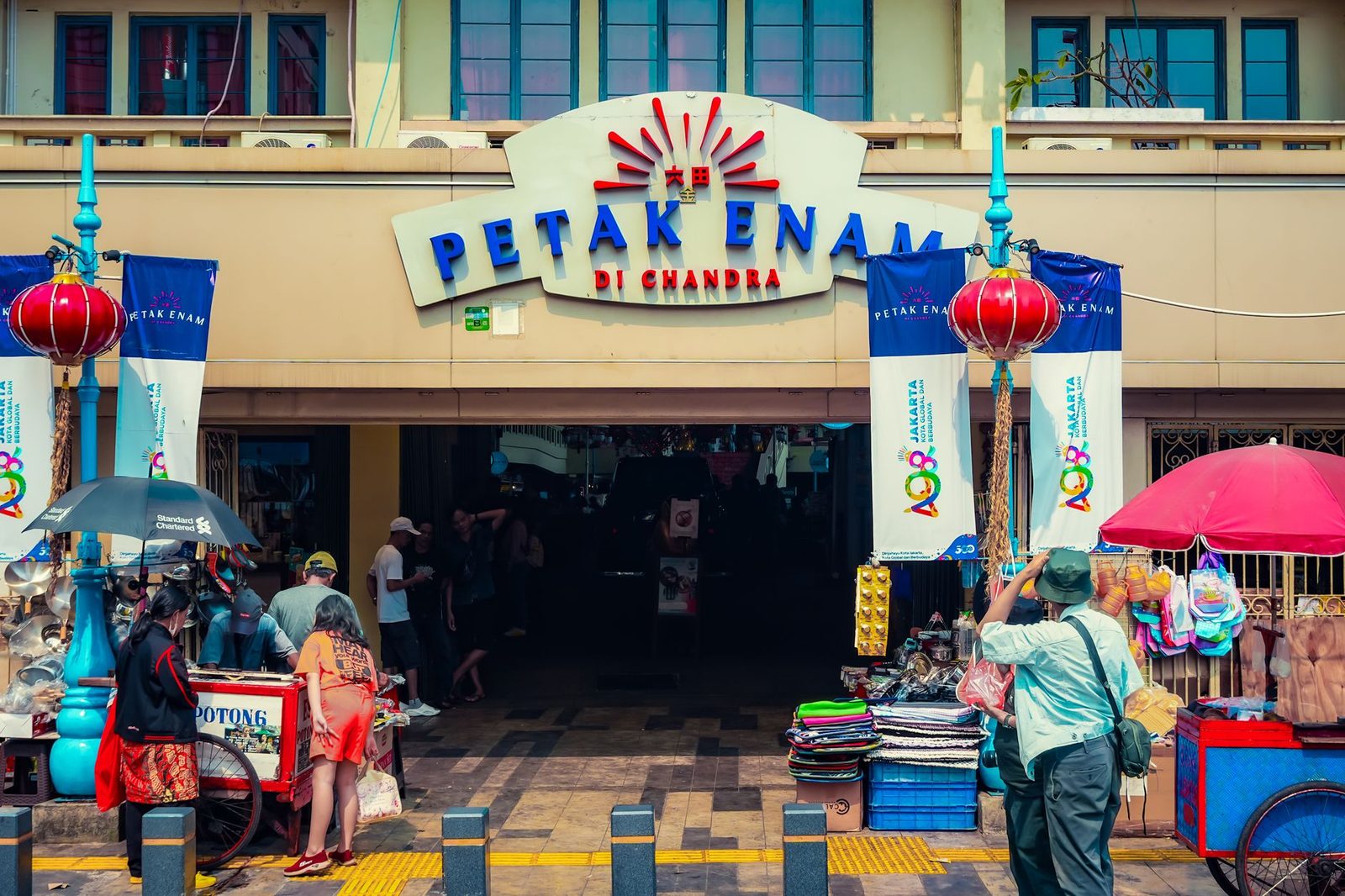
Petak Enam di Chandra, at Jalan Pancoran No 43, is a large food court built into the old Chandra shopping centre and opened at the start of the 2020s. It is air-conditioned, it is clean, it has proper seating and toilets, it collects several dozen Chinese-Indonesian vendors under one roof, and it is where Jakarta’s younger crowd goes to eat Glodok food without the wet market. Purists find it sanitised. They are right, and it is also the correct answer if you are travelling with children, elderly parents or anyone who will not enjoy a two-metre alley at 30 degrees. Prices sit slightly above the street: Rp 40,000 to Rp 90,000 a dish.
| Where | What to order | Typical price | Hours | Halal? |
|---|---|---|---|---|
| Kopi Es Tak Kie, Gang Gloria | Es kopi susu, bakmi | Rp 25,000-35,000 | approx 06:30-14:00 daily | No |
| Petak Sembilan street stalls | Sekba, kue, fresh fruit | Rp 15,000-40,000 | Roughly 06:00-13:00 | Mostly no |
| Pantjoran Tea House | Pot of tea, bakpao, free patekoan tea outside | Rp 40,000-120,000 | Free tea approx 08:00-18:00 | Check per dish |
| Petak Enam di Chandra | Wide Chinese-Indonesian range | Rp 40,000-90,000 | Late morning to evening | Some outlets certified |
For a broader survey of what to eat in this city and what the dishes actually are, see the Jakarta food guide, the list of must-try Jakarta dishes and, if you would rather someone else navigated the lanes, our Jakarta food tour guide. Budget eaters should also read cheap eats in Jakarta.
Imlek and Cap Go Meh: What Actually Happens
Chinese New Year falls on Saturday 6 February 2027, opening the year of the Goat. Cap Go Meh, the fifteenth night that closes the celebration, falls fifteen days later, around 20 February 2027. Imlek itself is a national public holiday in Indonesia; Cap Go Meh is not.
The build-up starts about two weeks out and is arguably better than the day itself. The lanes fill with vendors selling kue keranjang, red decorations, lanterns, hampers, plum blossom branches and clothing, and Petak Sembilan runs at a pitch it does not otherwise reach. Temples install enormous candles, some over a metre tall, sponsored by families and burning for days.
On the eve and the day, Jin De Yuan is close to impassable. Worshippers arrive through the night, the incense smoke is thick enough to sting, and queues to make offerings run out into the street. If you want to observe rather than participate, come early morning rather than evening, keep well back, and accept that you will be uncomfortable and jostled. Lion dance and barongsai troupes work the streets and the shopfronts across both weeks, and businesses pay them for a performance at the door for luck. Cap Go Meh brings the larger processions, though Jakarta’s are more modest than the famous ones in Singkawang in West Kalimantan or Bogor’s street parade.
Practical notes for the period: many Glodok shops and some warungs close for two or three days over the holiday itself, which catches visitors out. Hotels in the area fill. Traffic around Kota Tua is severe. And rain is likely, since February sits in the middle of the wet season. Our Jakarta events and festivals guide tracks the rest of the calendar, and Jakarta cultural experiences covers what to do with the rest of the trip.
Mangga Besar, Next Door
A kilometre east of the temples, Jalan Mangga Besar is Glodok’s alter ego and it operates on entirely different hours. By day it is unremarkable: shophouses, hotels, a KRL station. From about 22:00 it becomes one of Jakarta’s principal late-night districts, heavy on karaoke lounges, massage parlours, spas and clubs, with a reputation that is exactly what you would expect and a fair amount of activity that sits in a grey zone.
It is also, more benignly, a serious late-night eating street. Seafood, sate, kwetiau goreng and Chinese-Indonesian dishes are served until 03:00 or later at open-fronted places along the main road, and this is where kitchen staff and shift workers eat. If you are here for that, our late-night eats guide has the specifics. If you are curious about the other side of it, the karaoke guide explains the difference between a family KTV and the other kind, which is a distinction worth knowing before you walk into one. Broader context in the Jakarta nightlife guide.
Getting to Glodok
Start with the correction, because a lot of recent writing gets this wrong. There is no Glodok MRT station in service. The Jakarta MRT North-South line still terminates at Bundaran HI. Phase 2A is under construction beneath this exact area, the tunnels between Harmoni and Kota have been holed through, and the Glodok and Kota station boxes were reported at around 87 per cent complete in July 2026. But the operational targets are the Bundaran HI to Harmoni section around 2027 and the Harmoni to Kota section, which includes Glodok, by the end of 2029. Anyone telling you that you can take the MRT to Chinatown today is describing a station that is not open. The construction hoardings on Jalan Gajah Mada are real; the trains are not running under them yet.
What works instead:
| Mode | Route | Cost | Notes |
|---|---|---|---|
| KRL Commuter Line | To Jakarta Kota terminus, then 10-15 minutes on foot south | Rp 3,000-6,000 | The best answer. Frequent, cheap, avoids all traffic |
| KRL to Mangga Besar | Mangga Besar station, then a short ride or 15-minute walk west | Rp 3,000-5,000 | Handy if you are combining with Mangga Besar |
| TransJakarta | Corridor 1 to Glodok stop on Jalan Gajah Mada | Rp 3,500 | Drops you closest of all, but subject to street traffic |
| Grab or Gojek car | Door to door | Rp 40,000-90,000 from central hotels | Slow at peak; the lanes themselves are impassable to cars |
| Gojek motorbike | Door to door | Rp 20,000-40,000 | Fastest, and can get much closer to the market |
Once you arrive, everything is on foot. The core, from Pantjoran Tea House through Petak Sembilan to Jin De Yuan and back, is a loop of well under two kilometres, and no vehicle bigger than a motorbike gets down most of it. Details on rail in the KRL commuter line guide, on buses in the TransJakarta guide, on the current network in the Jakarta MRT guide, and on ride-hailing in Grab versus Gojek.
A Half-Day Route That Works
Take the first KRL that gets you to Jakarta Kota by 06:30. Walk south down Jalan Pintu Besar Selatan into Glodok as the market is peaking. Do Petak Sembilan and the wet lanes first, while it is cool and everything is running, allowing an hour. Come out at Gang Gloria and have breakfast at Tak Kie by 08:00, before the queue.
From there walk to Jin De Yuan, ten minutes through the lanes, and give it half an hour. Add Toasebio if you want the quieter version. Then the herbal medicine block on Pancoran for the smell and the drawers, then Pantjoran Tea House for the free tea and a sit down, which by now you will want. If you still have appetite, finish at Petak Enam in the air conditioning around 11:30.
That is four and a half hours and it is the whole district properly seen. From Glodok you are twenty minutes’ walk from Fatahillah Square, so the natural continuation is the Kota Tua walking tour in the afternoon, or the museums covered in Jakarta’s culture and history museums. Do not attempt Glodok in the afternoon heat as a first stop; the market will be over and you will have the worst of the temperature with the least of the atmosphere.
Being Honest About the Difficult Parts
The heat is the main obstacle. Glodok has almost no shade, the lanes trap air, and the combination of 32 degrees, high humidity, cooking fires and crowds is genuinely draining. Two hours here feels like four somewhere else. Drink more water than you think you need, and treat the tea house and Petak Enam as scheduled cooling stops rather than optional extras.
The crowding is real and it is not the tourist kind. These are working lanes with motorbikes, handcarts and porters moving through them. You will be squeezed against a wall. Wear a bag across your body at the front, keep your phone in a pocket rather than your hand, and be aware that pickpocketing does happen in the densest sections, though violent crime effectively does not.
The animal handling in the wet market will distress some visitors. Live frogs, eels and poultry are sold and killed on site. That is normal practice across Southeast Asia and nobody is doing it for effect, but if it will ruin your morning, avoid the meat lanes entirely.
Flooding is a genuine seasonal risk. Glodok sits low, close to the old canals, and parts of Taman Sari take water during heavy rain between November and March. Check the forecast, and if a serious downpour is coming, reschedule rather than getting stuck.
And finally: this is a residential neighbourhood, not an attraction with an entrance. People live above the shops, worship in the temples and work in the lanes at six in the morning. Treat it accordingly and you will find Glodok one of the friendliest districts in the city. Treat it as a backdrop and you will get the cold response you have earned.
FAQ: Glodok Chinatown Jakarta
Is there an MRT station at Glodok? Not yet. The line currently ends at Bundaran HI. Phase 2A construction is well advanced beneath Glodok, with the station structure reported around 87 per cent complete in mid-2026, but the Harmoni to Kota segment containing Glodok station is targeted for the end of 2029. Take the KRL commuter line to Jakarta Kota and walk ten to fifteen minutes south instead.
What is the best time of day to visit Glodok? Between 06:00 and 10:00, without qualification. The wet market is at full tilt, the temples are active with morning worship, the coffee shops are open, and the temperature is bearable. By early afternoon the market has packed up and the heat is unpleasant. The exception is Mangga Besar, which is a night district.
Is Glodok safe for tourists? Yes. Violent crime against visitors is very rare and the neighbourhood is busy and self-policing. The realistic risks are opportunistic pickpocketing in crowded lanes, motorbikes moving fast in narrow spaces, and wet, uneven flooring. Ordinary care handles all three. Solo travellers, including women, generally report no problems during daylight hours.
Can I eat in Glodok if I only eat halal? With care, yes, but much of the street food here is pork-based and unlabelled. Stick to the tea house, fruit and dry-goods stalls, packaged items, and the certified-halal outlets inside Petak Enam and nearby malls. Ask directly using the word halal; vendors answer honestly. Assume nothing from appearance, since broths and utensils commonly cross over.
How long should I spend there? Four to five hours does the district properly, including the market, two temples, the medicine lanes, the tea house and a meal. Ninety minutes gets you a coffee and a temple and not much understanding. If you are combining with Kota Tua, do Glodok first thing in the morning and the old town after lunch.
Can I take photographs in the temples? Generally yes, with restraint. No flash indoors, no close-up shots of individuals praying without permission, no climbing or blocking. If anyone signals you to stop, stop at once. Leaving a donation of Rp 10,000 to Rp 20,000 in the box afterwards is normal courtesy if you have been shooting.
Is Glodok worth visiting for the electronics? Only for repairs, components and hard-to-find parts, where it remains the best place in Jakarta. As a general electronics shopping destination it has been hollowed out by e-commerce, and Glodok Plaza has operated only on its lower floors since the fatal fire of January 2025. For a new phone or laptop, buy elsewhere.
When is Chinese New Year in Glodok? Imlek 2027 falls on Saturday 6 February, with Cap Go Meh closing the fortnight around 20 February. The two weeks beforehand are the most interesting period to visit, when the markets are at their peak and decorations go up. On the day itself, Jin De Yuan is extremely crowded and many shops close for two or three days.
Where to Go Next
Glodok pairs naturally with the colonial city it was excluded from. Walk north into Kota Tua, or read our guide to Indonesian heritage sites in Jakarta for the wider list of what survives.
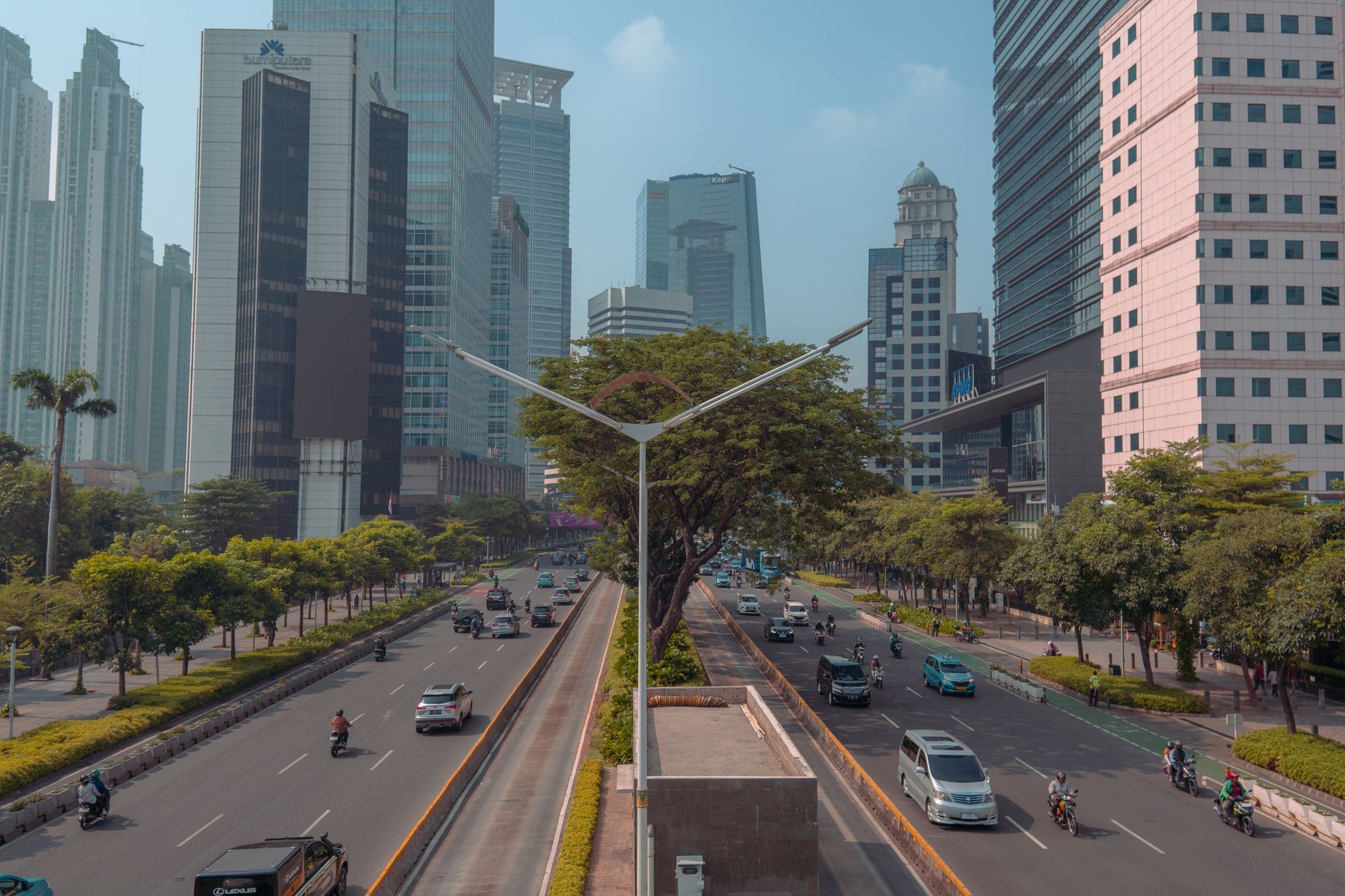
Further afield, the contrast with the modern city is worth making deliberately: the SCBD and Sudirman guide covers the glass-and-steel corridor built on cleared land two centuries later, the Menteng guide the planned garden suburb of the late colonial era, and the Central Jakarta guide everything in between. For more religious sites on foot, the religious sites walking tour links the temples here to the cathedral, Istiqlal and the rest. And if you want more places in this city that reward a slow morning, try our Jakarta hidden corners list.
Glodok is also one of the best places in Jakarta to sleep cheaply. The Packer Lodge, one of the city’s most-reviewed hostels, sits in a side street near the Gajah Mada Citywalk mall, and waking up here means breakfast in Chinatown before the day-trippers arrive. Our guide to budget hostels in Jakarta compares it with the alternatives.